Episode 9 · May 17, 2026 · 57min

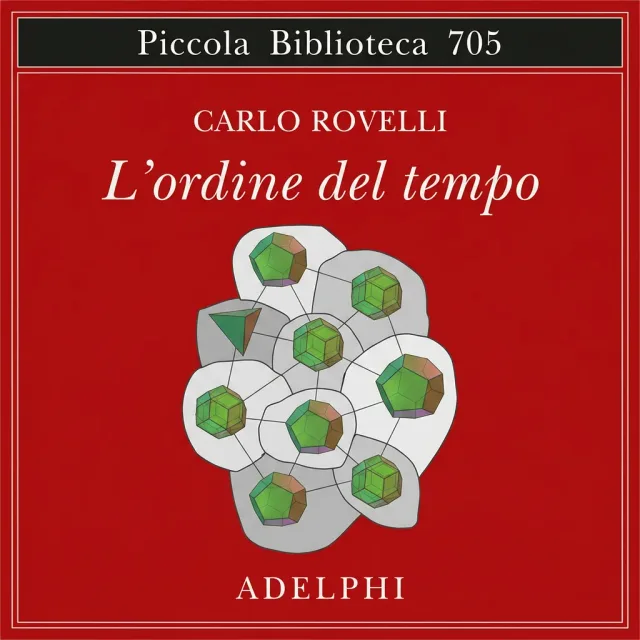
Carlo Rovelli: Everything You Know About Time Is Wrong

In Buona Compagnia is an Italian podcast. This is the English version of the episode: the video has English subtitles, and the transcript, reflections and sources are translated. The book quotes in this episode are our own translation from the Italian original, L'ordine del tempo, not the wording of the official English edition, The Order of Time (translated by Erica Segre and Simon Carnell, 2018). Versione italiana →

What if time isn’t the same for everyone? What if it flows differently depending on where you are? What if past, present and future don’t exist the way we think? These are the questions answered by Carlo Rovelli, an Italian theoretical physicist who has spent his life working on loop quantum gravity. The Order of Time is his book exploring these ideas.

The journey starts with Einstein, 1915. Masses deform spacetime, and time flows more slowly near a mass. If you go to the mountains and I stay on the plain, after thirty years your clock shows more time than mine. An astronaut who spends six months on the Space Station comes back to Earth about 5,000 seconds younger than those who stayed behind. There is no single time: everyone has their own proper time.

Then Rovelli takes us deeper. In the elementary laws of physics, past and future can’t be told apart. Only entropy, heat dissipating, gives us the arrow of time. But entropy exists only for us: because we can’t see every single molecule.

At the end comes the most disarming truth. “We are time”, Rovelli writes. Time is the way finite, mortal creatures, able to perceive only certain scales, relate to the universe. You are a note in a symphony. An event that begins, unfolds and ends. And finiteness isn’t a curse, it’s the gift.

Transcript 21 chapters · 57min Sources 39 sources cited · deep dives

Ten key reflections from the episode

1

But death doesn't frighten me; it didn't frighten me as a boy, but back then I thought it was only because it seemed far away.

Now, at 60, the fear hasn't come. I love life, but life is also toil, suffering and pain, and I think of death as a well-earned rest, the sister of sleep, a gentle sister who will soon come to close my eyes and stroke my head.

Carlo wants to die like Job, who died when he was full of days. And he writes: "Can I savor some more? Yes, I would like to savor a little more of those days, of the kisses of the woman I love, of her presence that gives meaning to everything, more of the afternoons in the sun, of the winter Sundays lying on the sofa at home filling page after page with formulas, trying to wrest one more small secret from the thousand that still surround us.

But today I have drunk deeply from this sweet and bitter chalice of life, and if the angel came right now to tell me 'Carlo, it's time', I would not ask him to let me finish my sentence: I would smile at him and follow him."
2

Finiteness isn't a curse, it's the gift. Without an ending, nothing would have value.

Think of a kiss. It lasts a second. It's precious precisely because it ends. If kisses lasted forever, they wouldn't be kisses anymore: they'd be something else, nothing.

A song, for example "Hey Jude" by the Beatles, lasts seven minutes. It's beautiful precisely because it unfolds and then ends.

If it never ended, it wouldn't be a song anymore. And the same goes for you. Your life is precious precisely because it ends.

The people you love, afternoons in the sun, laughing with your brother: everything has value because it doesn't last forever. Finiteness is what gives life meaning.

3

Reality is often different from how it appears. The Earth looks flat, but it's a sphere. The Sun seems to move across the sky, when in fact we're the ones turning. And the structure of time isn't what it seems either.

4

Time flows faster in the mountains than on the plain.

In everyday life the difference is fractions of a nanosecond a year. You don't notice it. But it's real, it's measured and it's cumulative.

Einstein showed that gravity doesn't only curve space: it curves time too. Space and time aren't two separate things. They're a single fabric.

5

Imagine a big elastic mat stretched out in space. That's "spacetime". When you place a heavy object on it, the Earth, a star, a black hole, the mat curves.

It sinks, like a bowling ball on a mattress. And near the heavy object, where the mat is most curved, time flows more slowly. Far away, where it's almost flat, it flows faster.

GPS satellites orbit at an altitude of about 20,200 kilometers. Their atomic clocks gain about 38 microseconds a day compared to clocks on the ground. It seems like nothing. But if engineers didn't correct this difference, after just two minutes your GPS would start getting things wrong. The errors would build up at a rate of 11 kilometers a day.

6

The ability to understand before seeing is the heart of scientific thinking.

Anaximander, in antiquity (2,600 years ago), had understood that the sky continues beneath our feet, before ships had sailed around the Earth.

Copernicus understood that the Earth goes around the Sun before astronauts saw it turning from the Moon.

Einstein understood that time doesn't flow uniformly before clocks were precise enough to measure the difference.

7

"The difference between past and future, between cause and effect, between memory and hope, between regret and intention, does not exist in the elementary laws that describe the mechanisms of the world."

8

We see the water in a glass the way astronauts see the Earth from the Moon. Calm, with a blue sheen. Of everything that happens on Earth, despair, happiness, chaos, wars, nothing can be seen from the Moon. Just a blue marble. Within the reflections of a glass of water there is a similar, tumultuous activity of billions of molecules, and there we see absolutely nothing.

9

A person is an "event" that lasts 80 years. A stone is an "event" that lasts a million years. A mountain is an "event" that lasts 100 million years. They're all events. Things themselves are just happenings that stay unchanged for a while, before returning to dust. Because sooner or later, of course, everything returns to dust.

10

We are, for ourselves, to a large extent what we see and have seen of ourselves mirrored in our friends, our loves and our enemies.