Episode 11 · June 20, 2026 · 48min

Luca Parmitano: he nearly drowned in space, now he's going to the Moon

In Buona Compagnia is an Italian podcast. This is the English version of the episode: the video has English subtitles, and the transcript, reflections and sources are translated. Camminare tra le stelle has not been published in English, so the quotes from the book are our own translation from the Italian. Versione italiana →

Luca Parmitano is the first European ever assigned to an Artemis program crew: on June 9, 2026, NASA named him pilot of Artemis III. The mission, planned for 2027, will test the lunar landing vehicle and the maneuvers that will bring human beings back to the surface of the Moon, and Luca will fly as pilot, the first European ever on a crew of the program.

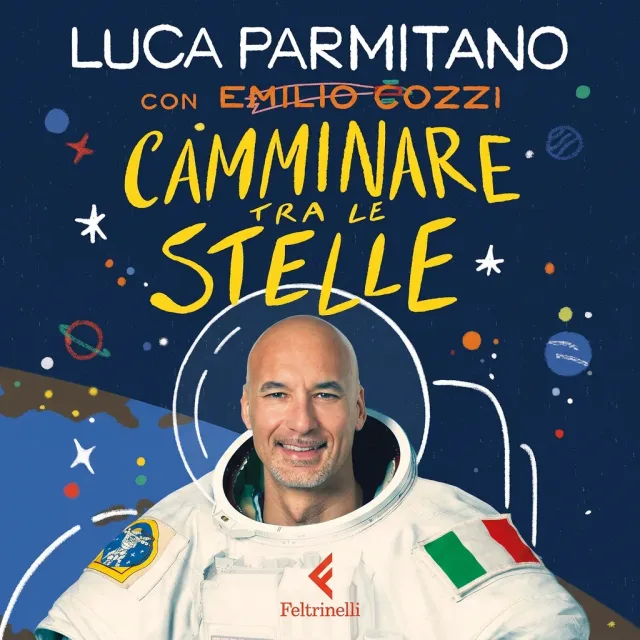
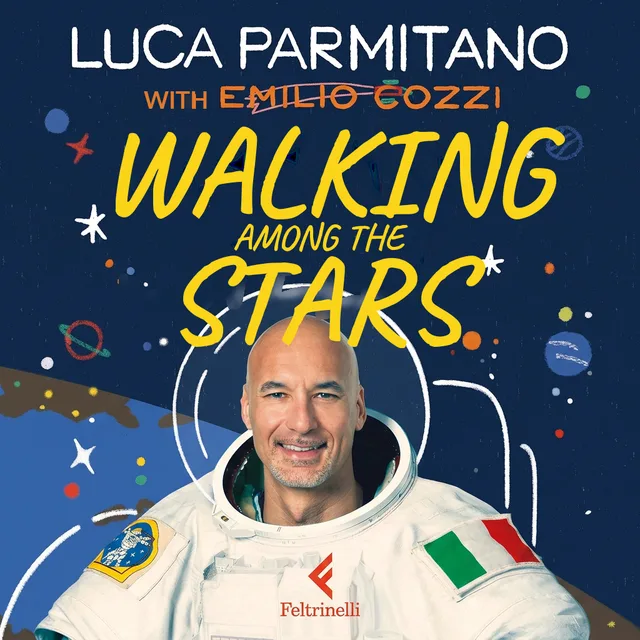
In this episode we dive into Camminare tra le stelle (Walking Among the Stars), the book in which he retraces his story.

July 16, 2013, four hundred kilometers above the Earth. During his second spacewalk, Luca’s helmet starts filling with water: about a liter and a half. Within a few minutes he can’t see, he can’t hear, and he realizes he could become the first astronaut in history to drown in orbit. He saves himself in the dark, making his way back to the airlock by pulling himself along a cable.

From there we go back in time to understand how he got there: the Sicilian boy who was afraid of the dark, the flight exams he failed and then passed by a whisker, the encounter that made him understand that becoming an astronaut was possible, maybe not probable. Then the four spacewalks of 2019 in which he repaired the AMS, the largest particle detector ever put into orbit: a two-billion-dollar experiment that captures cosmic rays in search of dark matter. The chances of success were estimated at 25%.

The most beautiful idea, for us, is this one: “I had understood: it’s always worth committing yourself to training; it’s always worth seeking the limits of our abilities, even at the risk of failing; it’s always worth giving it everything, both physically and mentally, to do something we believe is important.”
Transcript 48min Sources 7 sources cited · deep dives

Ten key reflections from the episode

1

Fear can actually be a very useful tool for acting with the greatest readiness. Up to a certain level, fear and stress have positive physiological effects. The heart pumps harder to prepare the muscles, and thanks to the rise in adrenaline (a hormone) the brain becomes more reactive. The speed of reasoning increases. It's essential to learn to use these responses as a tool, and not let them control us. The difference lies in knowing how to manage it, in making it your ally.

2

I had understood: it's always worth committing yourself to training; it's always worth seeking the limits of our abilities, even at the risk of failing; it's always worth giving it everything, both physically and mentally, to do something we believe is important.

3

Professional explorers are all those people who aren't satisfied with the things they already know. They're adults who haven't stopped looking at the world with the curious eyes of children: they've kept the desire to investigate, to discover, to understand. Thank goodness, because if it weren't so, we'd all be in trouble.

4

Try to think about what would have happened, think how things would have gone, if our ancestors had stopped in front of an obstacle. If instead of risking their lives crossing the sea or climbing a mountain for the first time, they had looked each other in the face and said: "Let's calm down, we don't know what's on the other side. Let's stop here, it's safer." In that case, human beings would have gone extinct a long time ago. Sooner or later they would have used up the available resources, and then, forget spaceships: we wouldn't even have gotten as far as building a raft out of tree trunks.

5

Sacrifices? Not at all. I never talk about sacrifice, because when you choose a path in tune with what you want, there are no sacrifices. I don't want a life of sacrifice, but an intense, full life, with all the steps needed to make it happen.

6

Some time ago, in Vienna, I happened to eat the best scrambled eggs of my life. I was in a small restaurant, and the eggs were so good that I wanted to compliment the owner. Behind him was the cook, a young Italian rising star. He heard me and was moved. For me, he is the astronaut of scrambled eggs, and I'm sure that somewhere there's also an astronaut of pizza, or of dance. You don't need to become an astronaut to fly among the stars. You touch the sky by giving everything to what you know how to do. If you're Roberto Bolle, you fly among the stars when you dance. If you're an athlete, you take off when you compete in the race you've trained for months, or maybe years. If you make pizza, when you put the mozzarella into the recipe you're preparing, you're at the peak of your inspiration and concentration. You're on your own extravehicular activity. And you have to give your best.

7

Utopia is like the horizon. I take two steps closer, it moves two steps away. I walk ten steps, and the horizon runs ten steps ahead. No matter how far I walk, I'll never reach the horizon. What is utopia for? It's for this: so that I never stop walking.

8

When I know more, I'm able to do more things and to do them better. I broaden my skills in a positive cycle that improves the life of humanity on Earth.

9

Every future is as big as the whole world. The future, like the world, doesn't belong to you, but it's in your hands. It's unique, but it's never the same. It seems infinite, but it's only infinitely fragile.

10

I've learned this: you'll have enough time to choose your path. Sometimes you'll discover that the path didn't exist until you took the first step. It doesn't matter. The only thing that counts is loving to walk. Choose what you love, love what you've chosen! And if the fork is rough going, when the obstacles seem insurmountable, when the light can't reach to light your step, know that sometimes you have to get lost in the dark in order to find yourself. Embrace difficulties: they'll make the path more precious. Seek out challenges: they'll make your step surer. Finally, you'll have travel companions, who will sometimes follow the same trail, and other times will drift away from it only to come back, or to disappear forever. You'll love their company, and you'll miss them when they leave. And if they take part of your baggage away with them, look closely: you'll realize that not only will you be missing nothing, but you'll have been enriched.