
Living with little is not only healthy, it frees us from anxiety about life's needs. When, by rare fortune, we become rich, it lets us face that condition consciously. The poverty of his childhood allowed Brunello to truly appreciate everything he built.
Episode 2 · September 21, 2025 · 46min
The Entrepreneur Who REFUSES Excessive Profits (Yet Reaches 1.3 Billion)
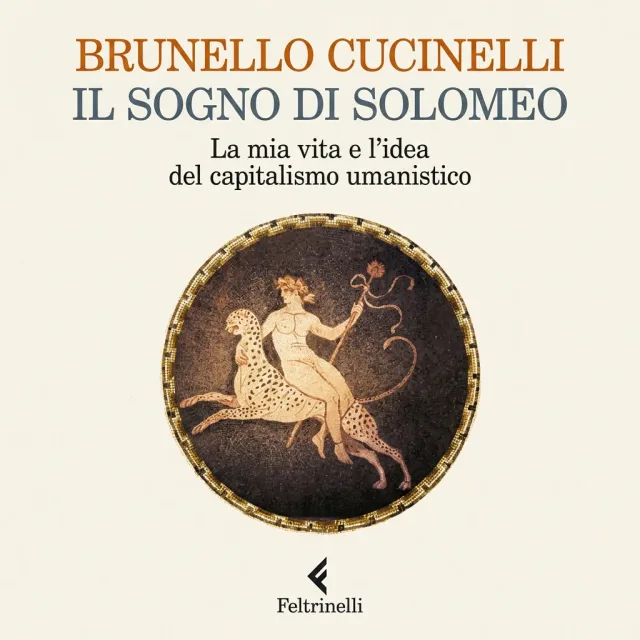
In Buona Compagnia is an Italian podcast. This is the English version of the episode: the video has English subtitles, and the transcript, reflections and sources are translated. The book was written in Italian (an English edition exists as The Dream of Solomeo: My Life and the Idea of Humanistic Capitalism), and the quotes on this page are our own translation from the Italian. Versione italiana →
Brunello Cucinelli is an Italian entrepreneur who built a listed cashmere company with €1.4 billion in annual revenue by applying a rare principle: profit must not cause harm or offense to anyone. The Dream of Solomeo is his autobiography.
He grows up in a farming family in Umbria, with no electricity and no running water in the house. When his father leaves the countryside for the factory, Brunello sees him come home humiliated, with tears in his eyes. From that pain his mission is born: to dedicate his life to respecting people’s moral and economic dignity.
During his university years he meets Federica, from a crumbling medieval village called Solomeo. He falls in love with her and with the place. At 25 he starts making colored cashmere sweaters for women, aimed at absolute luxury: expensive but not overpriced, handmade by Umbrian artisans. When the company grows, he moves its headquarters from Perugia to Solomeo and buys the tower, the castle, the whole village, which becomes the homeland of his soul.
Forty years later, it is one of the most respected luxury houses in the world. He calls it humanistic capitalism: he wants fair growth, fair profit, and for everything to be gentle.
The Entrepreneur Who REFUSES Excessive Profits (Yet Reaches 1.3 Billion)
Brunello Cucinelli
The Entrepreneur Who REFUSES Excessive Profits (Yet Reaches 1.3 Billion)
Now playing
The Entrepreneur Who REFUSES Excessive Profits (Yet Reaches 1.3 Billion)
Ten key reflections from the episode
The goal should not be exponential growth or excessive profits, but fair growth, fair profit, and for everything to be gentle. Brunello Cucinelli is a listed company, but it produces with dignity, respecting producers, artisans and workers with pay above the average.
Every generation must keep its own seed, made of lessons and wisdom, to pass on to those who come after. Live as if every day were your last, plan as if you were going to live forever. Brunello plants oaks knowing he will never see their shade, because they will make life more beautiful for those who come after.
Seeing his father come home from work humiliated, with tears in his eyes, made Brunello understand that he would dedicate his life to respecting people's moral and economic dignity. His mission as an entrepreneur was born from that pain.
In a globalized world, the only sustainable differentiation is the kind that cannot be repeated. Instead of competing on cost, Cucinelli specialized in absolute luxury: products that are expensive but not overpriced, that are never thrown away. He wasn't selling sweaters, he was selling family heirlooms.
While everyone was emigrating to the cities, Brunello built an empire in an abandoned medieval village. Solomeo is not just a headquarters: it is inspiration, it is the homeland of his soul. A competitor can copy the cashmere, but cannot replicate the creative energy of that place.
I dreamed of a form of capitalism where profit would cause no harm to people or to things. In his model, workers receive 35.8% of revenue, shareholders only 10.1%. There can be no quality without humanity.
No emails after 5:30 p.m. No phones in meetings. At most 7 to 8 hours of work. What interests me is the quality of working hours, not the quantity. Brunello spends hours in front of the fire thinking, practicing the Roman otium. Work must not devour people's lives.
During the 2008 crisis, he personally wrote to every customer: Know that you can count on us. Offensive words come out easily but cause wounds that heal with difficulty. Kind words may be short, but their echo is endless.
We've been told there are only 2 or 3 geniuses in every 1,000 people. I think that if you have 1,000 people, you have 1,000 geniuses: simply different kinds of genius. Everything is based on esteem, and esteem generates creativity. Even the person with the most humble tasks knows exactly what is happening in the company.