

Episode 5 · February 2, 2026 · 42min

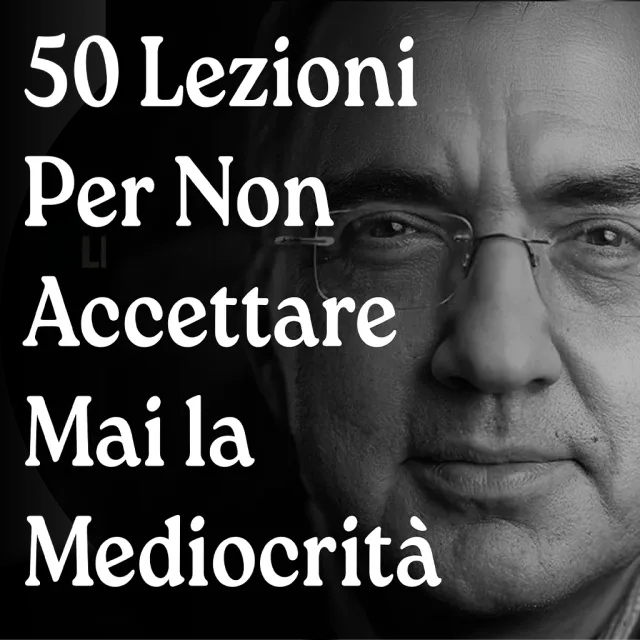
Sergio Marchionne: 50 lessons for never accepting mediocrity

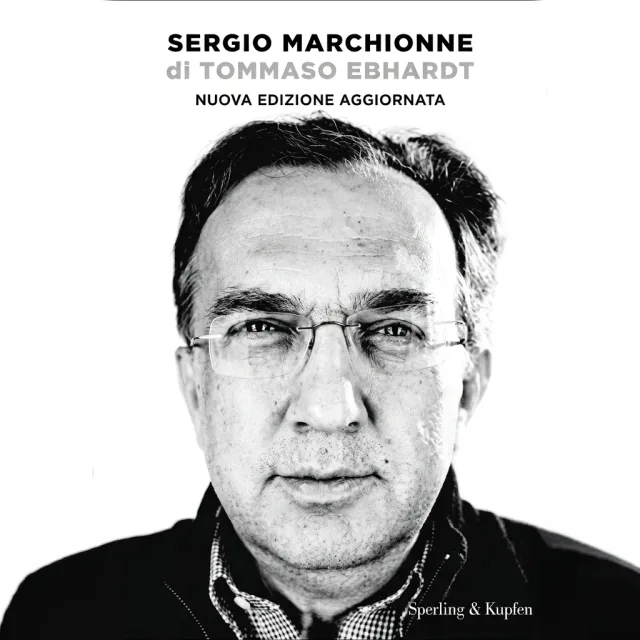
In Buona Compagnia is an Italian podcast. This is the English version of the episode: the video has English subtitles, and the transcript, reflections and sources are translated. The lessons and quotes come mostly from Italian sources (Marchionne's speeches and Tommaso Ebhardt's biography, which has no English edition), so unless a line was originally in English, the quotes on this page are our own translation from the Italian. Versione italiana →

“Settling for a mediocre life is never worth it”: that is the line Sergio Marchionne used to close his last public speech, at the University of Trento, in 2017. Less than a year later he died at 66, working until his last day. We have distilled fifty lessons from his life.

Marchionne believed that change was the only great certainty, and that nobody was too big to fail. When he arrived at Fiat in 2004 he said “I smell industrial death,” then he cut 200 executives, redrew the hierarchy, and went looking for hidden talent. He was a fixer: “until I’ve finished, I can’t stop.”

His convictions were simple and brutal. “Those who don’t adapt are destined to die.” “The best time to consolidate is when you’re strong, not when you’re desperate.” “Quality is not a negotiable good, the rest is garbage.” “Compromises never lead to solving problems.”

In the end, working until he was admitted to the hospital in Zurich, Marchionne summed it all up in one sentence: “I do it all the way, without thinking about the consequences.” And he leaves anyone listening with a single idea: the impossible is only what hasn’t been done yet.

Transcript 42min

Our 10 favorite lessons

1

"Settling for a mediocre life is never worth it. The journey of self-discovery can be full of a thousand pitfalls, but you will have to make it on your own, without avoiding the obstacles. Find your own way, change it as many times as you like, and follow your dreams. Think about what mark you want to leave and what difference you want to make."

From Sergio Marchionne's speech at the University of Trento, 2017.
2

"Change itself is the only great certainty. Nobody is too big to fail. The only protection is the ability to accept change."

Fiat dominated in the 1950s, when it was competing with Volkswagen for first place in Europe. In 2004 it was losing 5 million euros a day and was practically bankrupt. GM, the world's number one car maker for decades, lost over 70 billion dollars between 2004 and 2008.

3

"I am a fixer, I fix things. Until I've finished, I can't stop."

That was how Marchionne described himself. He kept to this principle until he was admitted to the hospital in Zurich: "I do it all the way, without the slightest thought for the consequences for me personally, without thinking about the consequences for my body."

4

Freedom is choosing the right responsibilities.

When you're free you can do anything, and choose which responsibilities are the right ones for you. Marchionne could have stayed at SGS after turning it around, or gone back to studying in Toronto. He chose to take on a collapsing Fiat, and put his face and his reputation on the line.

5

The impossible is only what hasn't been done yet.

It's very simple, idealistic, fluffy. But Marchionne did exactly that: something that was impossible, he made possible. Saving Fiat. Buying Chrysler. Listing Ferrari.

6

"The best time to consolidate is when you're strong, not when you're desperate."

Marchionne had learned it as CEO of Alusuisse, where between 1997 and 2000 he orchestrated the merger with Canada's Alcan and then with Péchiney. He did it when he was the most profitable player in the aluminum industry, because he knew that staying alone meant becoming marginal.

7

Seeing opportunity where everyone else sees ruins.

When Marchionne bought Chrysler during the 2008 crisis, everyone saw Chrysler as something to avoid; he saw in it the biggest opportunity to expand Fiat. "A crisis creates opportunities that don't exist in normal times, but you need the clarity to see them and the courage to act."

8

"Quality is not a negotiable good, the rest is garbage."

At Fiat he introduced a rule that terrified the supervisors: if a worker was silenced for reporting a defect, his boss would be fired on the spot. "We live in a flat world. If I'm not able to produce with the same levels of quality as in the United States, then I have no right to stay in the market."

9

"The compromises Fiat made in the past only had the effect of avoiding dealing with the problems that needed solving. Compromise never leads to solving problems. Compromise is just a convenient way out."

Connected to another of his convictions: "I don't tell lies to my people, I don't feed them bullshit, I don't do it with the leaders, with the white collars, and I don't do it with the people on the assembly line. I take care of them, I can't lie to them."

10

"When I die I want my gravestone to say just one thing: this man made a difference."

It's the line Ron Bloom said to Marchionne on the stairs of the US Treasury Department, while they were negotiating Fiat's takeover of Chrysler. It became the principle Marchionne carried with him: "you have to make a damn difference. If you keep that goal in mind, whatever your job is, the rewards, financial ones included, will come over the course of your career."