













Episode 6 · March 31, 2026 · 1h 13min

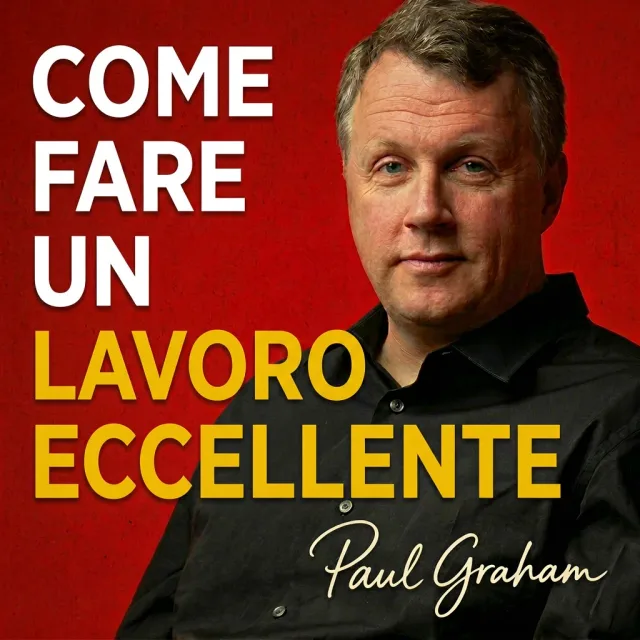
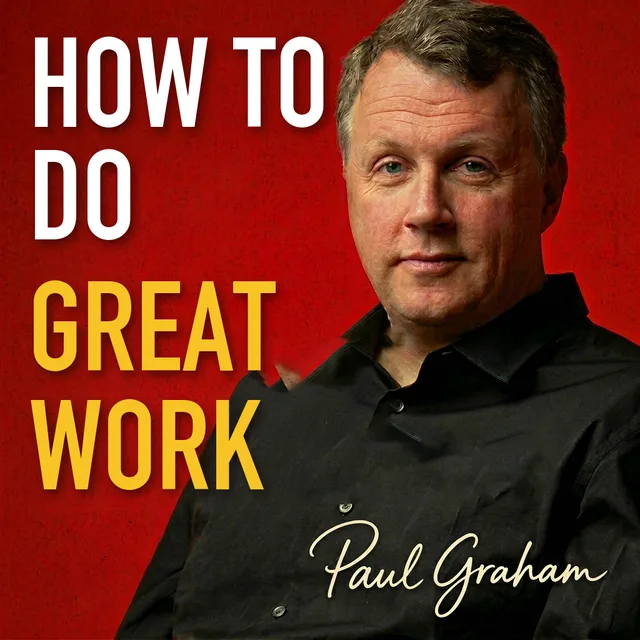
How to Do Something Great: We Read Paul Graham (in Italian)

In Buona Compagnia is an Italian podcast. This is the English version of the episode: the video has English subtitles, and the transcript, reflections and sources are translated. Wherever we read from the essay, the English uses Paul Graham's original words. Versione italiana →

“If you asked an oracle the secret to doing great work and the oracle replied with a single word, my bet would be on ‘curiosity’”: that is the central message of Paul Graham, founder of Y Combinator, the startup accelerator that Airbnb, Dropbox, Stripe, Reddit and Twitch all went through. How to Do Great Work is his 2023 essay, 12,000 words in which he tries to answer one question: how do you find the work you were born to do?

Graham spells out three qualities of the right work: a natural aptitude for it, a deep interest in it, and real scope to do something great. Few people know it by 14, like Mozart, who was playing the harpsichord at three. Most are like Newton, who moved from one field to another and spent more time on alchemy and theology than on mathematics.

The ideas that keep coming back are simple. “Curiosity is the best guide. Your curiosity never lies.” “Boldly chase outlier ideas.” “Unfashionable problems are undervalued.” “Great work often takes something that already exists and shows its latent potential.” “Originality isn’t a process, but a habit of mind.”

It all comes back to the word we started with. The whole process, Paul writes, is a kind of dance with curiosity.

Transcript 23 chapters · 1h 13min

Ten key reflections from the episode

1

The difficulty of figuring out what to work on varies enormously from person to person. As a kid you get the impression that everyone has a calling, and all you have to do is figure out what it is. Sometimes that's how it works in real life: some people figure out what to do as children, like Mozart. But others, like Newton, move restlessly from one kind of work to another.

2

The way to figure out what to work on is by working. If you're not sure what to work on, guess. But pick something and get going.

3

Develop a habit of working on your own projects. Don't let "work" mean something other people tell you to do. If you do manage to do great work one day, it will probably be on a project of your own. It may be within some bigger project, but you'll be driving your part of it.

What should your projects be? Whatever seems to you excitingly ambitious. As you grow older and your taste in projects evolves, exciting and important will converge.

4

There's a kind of excited curiosity that's both the engine and the rudder of great work. It will not only drive you, but if you let it have its way, will also show you what to work on. What are you excessively curious about, curious to a degree that would bore most other people? That's what you're looking for.

5

Let's talk a little more about the complicated business of figuring out what to work on. The main reason it's hard is that you can't tell what most kinds of work are like except by doing them. You may have to work at something for years before you know how much you like it or how good you are at it. And in the meantime you're not doing, and thus not learning about, most other kinds of work. So in the worst case you choose late based on very incomplete information.

6

The educational systems in most countries pretend it's easy. They expect you to commit to a field long before you could know what it's really like. It would be better if they at least admitted it, if they admitted that the system not only can't do much to help you figure out what to work on, but is designed on the assumption that you'll somehow magically guess as a teenager. They don't tell you, but I will: when it comes to figuring out what to work on, you're on your own. Some people get lucky and do guess correctly, but the rest will find themselves scrambling diagonally across tracks laid down on the assumption that everyone does.

7

What you should not do is drift along passively, assuming the problem will solve itself. You need to take action. But there is no systematic procedure you can follow. When you read biographies of people who've done great work, it's remarkable how much luck is involved. They discover what to work on as a result of a chance meeting, or by reading a book they happen to pick up. So you need to make yourself a big target for luck, and the way to do that is to be curious. Try lots of things, meet lots of people, read lots of books, ask lots of questions.

8

If you're making something for people, make sure it's something they actually want. The best way to do this is to make something you yourself want. Write the story you want to read; build the tool you want to use. Since your friends probably have similar interests, this will also get you your initial audience.

9

There are a lot of forces that will lead you astray when you're trying to figure out what to work on. Pretentiousness, fashion, fear, money, politics, other people's wishes, eminent frauds. But if you stick to what you find genuinely interesting, you'll be proof against all of them. If you're interested, you're not astray.

10

But while you need boldness, you don't usually need much planning. In most cases the recipe for doing great work is simply: work hard on excitingly ambitious projects, and something good will come of it.