





01 Intro
Airbnb, Dropbox, Stripe, Reddit, Twitch.
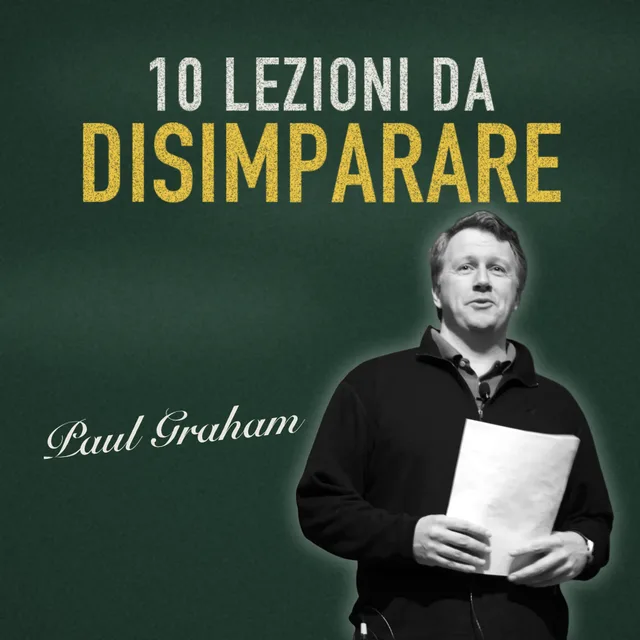
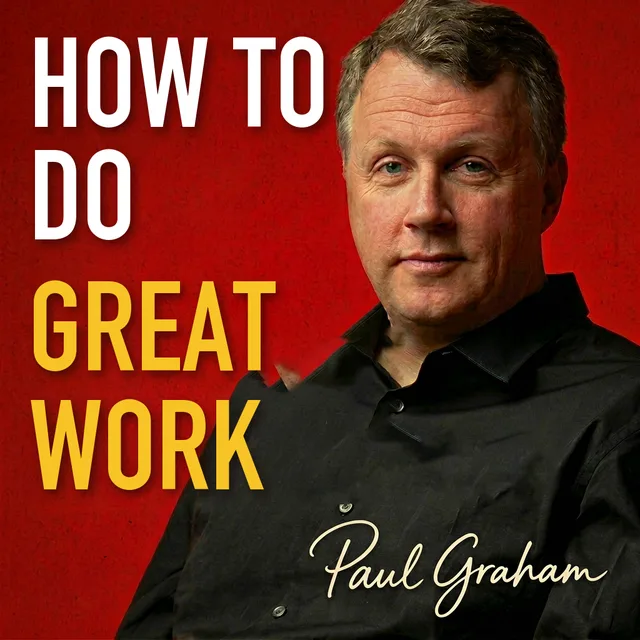
What do all these companies have in common? They all went through one single place: Y Combinator. Y Combinator is the most important startup accelerator in the world, the one that takes young people with an idea and gives them the tools to turn that idea into a successful startup. Since 2005 it has funded more than 4,000 startups with a combined value of over $600 billion. The man who created all of it is called Paul Graham. But Graham wasn't just any investor. Before Y Combinator he was a programmer. He wrote one of the first pieces of software for building online stores and sold it to Yahoo in the '90s for $49 million.
And before that, strangely, and this is really interesting, he had studied painting in Florence, at the Accademia di Belle Arti.
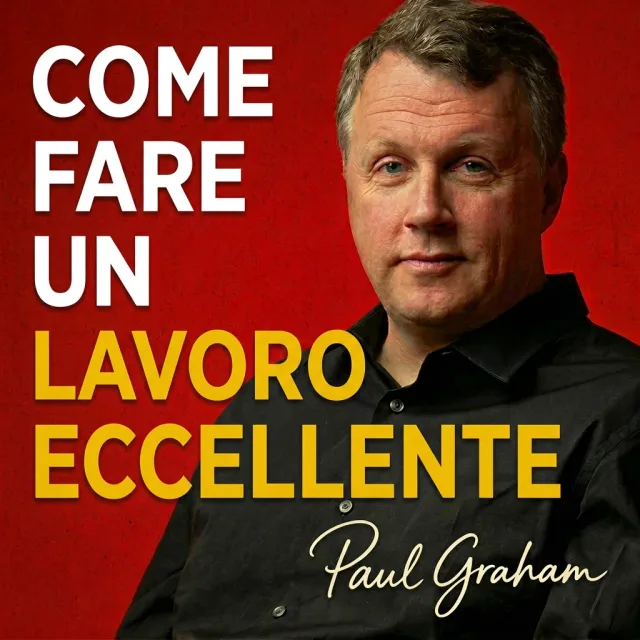
Paul is also known for his essays. He's been writing online since 2001, and they've become very important reading all over the world for anyone interested in building startups. In 2023 he published one of his longest essays and, in our opinion, one of the most beautiful: How to Do Great Work.
A really long essay, 12,000 words, in which he tries to answer the question all of us ask ourselves.
How do I find the thing I'm made for, the thing I was born to do? How do I do it at the highest possible level? And how can I build a life around what I love? It's not just about startups or technology; it's about scientists, artists, writers, musicians. It's about curiosity, obsession, dreams, and why the most creative people in the world all have something in common.
Right, in this new episode of In Buona Compagnia we decided to take this essay apart piece by piece.
Hi everyone, we're Marco and Francesco, and welcome to a new episode of In Buona Compagnia. Every month we pick a book that made us think, a biography, an essay, an idea, anything that inspires us and that we can draw reflections from to apply to our work and our lives. The goal of this project isn't to entertain you, or to teach you anything. What we do is collect the pieces left along the road by people who did great work in their lives, the way you pick up pebbles on a long walk. This isn't a manual. What will you do with it? Decide freely. What we promise you, though, is that by spending a few hours a week with us you'll have been in good company, and you'll have found something worth taking with you.
02 The three qualities of the work
Okay, let's start. So... I'm not supposed to start. Let's start from the beginning. So, one thing Paul is trying to answer in this essay is: what's the recipe for doing great work? The first thing he makes clear is that this recipe assumes a person is ambitious. So the first step, which seems very obvious, is to decide what to work on. And the work you choose, according to Paul, needs to have three qualities. The first quality is that it has to be something you have a natural aptitude for. Here the first thing that came to mind for me was Samantha Cristoforetti, who we did the previous episode on. Remember when she was training on the AMX fighter-bomber, and her commander, when he later goes to watch the launch of her first space mission, writes to her: you really seem to have been born to do that. The second quality is that you need to have a deep interest in that thing. Of course, in Samantha's case, well, she certainly had a deep interest in becoming an astronaut, because if she hadn't, she obviously wouldn't spend hours and hours in the pool training for weightlessness, doing something so hard on her own body. And the third quality is that this work offers the chance to do magnificent work. It sounds easy, but it isn't. It's often very difficult. It's very difficult, especially when you're young, because when you're young you don't know exactly what you're good at, and above all what different kinds of work are like. Also because some kinds of work you end up doing might not even exist yet. One example is being a podcaster: for someone who has a podcast now, ten years ago that job didn't exist.
03 Mozart or Newton: those who find their calling right away and those who search for it all their lives
In fact he writes, "while some people know what they want to do at 14, most have to figure it out." So if I don't fall into the category of fourteen-year-olds, or sixteen- or twenty-year-olds, whatever, who already know what they want to do, how do I find out if I don't know? And Paul's answer is simply: get to know things. Getting to know things means having as many experiences as possible in as many different fields as possible. In fact he writes, "If you're not sure what to work on, guess."
"But pick something and get going." When you said that many people already know at 14 what to do, while others still have to figure it out, Paul always gives an example of the difference between Mozart and Newton. I don't know if you read those, okay. At three, Mozart starts experimenting on his own at the harpsichord. At five he composes his first piece of music, and at six Mozart was already performing in front of two imperial courts. So Mozart never went looking for his calling; he never woke up at five going: damn it, what am I supposed to do with my life? No, it was his calling. Many people aren't like Mozart.
Most people.
Most people. Many people are like Newton. Newton became famous because he published Principia Mathematica, which contains the laws of motion and the law of gravity. But that wasn't the only thing he was doing in those years. He was obsessed with alchemy and theology. In Newton's private library, which held 1,752 books, the great majority of those books were about theology, then alchemy. And then after that, only 9.6% mathematics, and physics with only 3%. So he wrote much more about theology and alchemy than about mathematics and physics. The only thing is that all these writings, millions and millions of words on alchemy and theology, were never published. And so what Paul is referring to is this. Paul writes: the difficulty of figuring out what to work on varies enormously from person to person. As a kid you get the impression that everyone has a calling, and all you have to do is figure out what it is. Sometimes that's how it works in real life. Some people figure out what to do as children, like Mozart. But others are like Newton, moving restlessly from one kind of work to another. Maybe, in hindsight, we can identify a calling for them. So in this case, looking back, only from the end, because we already know how Newton's life ended, we look from the end back to the beginning and say in hindsight, okay, Newton's calling was mathematics, physics, but why not say his calling was alchemy and theology? He wrote much more about them, he devoted the end of his life to them; at 84, I wrote it down here, he was still working on an alternative history of the Old Testament. So after the Principia Mathematica was published, what did he keep doing all that time? Theology and alchemy. So in hindsight we have this illusion that his calling was mathematics and physics, but maybe his calling, the one he felt, was theology and alchemy. Then he identifies it as an illusion created by hindsight bias. At the time there probably wasn't a voice calling him that he could have listened to. So while some people's lives converge quickly, there will be some whose lives never converge. And for these people, figuring out what to work on is not so much a prelude to hard work as an ongoing part of it, like a set of simultaneous equations, for these people. So Paul is saying that for many people, finding your calling isn't something you do at the start. You find it by working and by continuing to ask yourself the question. Is this what I want to do? Figuring out what to work on never ends; it's always there while you work. And it's not a question you settle once and for all. It's a question that stays with you your whole life. And then he describes it as a set of simultaneous equations. In mathematics, simultaneous equations are equations you can't solve one at a time; they have to be solved together, in parallel. So for some people the same thing happens. You're working on something, but at the same time you're trying to figure out whether that's really the right work. And these two things always go together, in parallel, without one finishing before the other.
04 Curiosity is the engine of everything
And Paul goes on: "Develop a habit of working on your own projects." "Don't let 'work' mean something other people tell you to do." Ah, this is a beautiful part, one of the really beautiful lines. "If you do manage to do great work one day, it will probably be on a project of your own." "It may be within some bigger project, but you'll be driving your part of it." And so now that he's talking about projects: what should our projects be? And he answers, "Whatever seems to you excitingly ambitious." So at seven it may seem exciting and stimulating to build Lego, at 14 to learn to ski, and at 21, anything else you're passionate about is always stimulating. Paul writes that the most important thing is to "always preserve excitingness." And what's the engine of everything, the rudder that steers our drive, our thirst for knowledge? It's curiosity.
Yes, this is maybe the one line to take away from this essay, if you take just one. The rudder and the main engine of everything is always curiosity.
Right, and this is one of the points I marked as one of the most important, because it's a question I had never asked myself, and after I read it I was like, holy cow, damn. And he writes: "What are you excessively curious about, curious to a degree that would bore most other people?" "That's what you're looking for."
Then he writes: "Once you've found something you're excessively interested in, the next step is to learn enough about it to get you to one of the frontiers of knowledge." "Knowledge expands fractally, and from a distance its edges look smooth, but once you learn enough to get close to one, they turn out to be full of gaps." Did you get what that means?
05 Knowledge looks smooth from a distance; up close it's full of gaps
You're the one who knows this; I kept quiet because I don't know much about it, I'm waiting for you. Anyway, we approach something new, a project, anything at all, and the way to excel at what we do is through knowledge. So learning, learning as much as we can about that subject. But maybe we reach a point where our knowledge feels like enough. So from a distance it's a smooth wall, perfect, uniform, where we know everything. But then if we go inside that wall, it's actually full of holes, full of gaps.
What I pictured to visualize this concept is that if you look at the coast of Italy from a plane at very high altitude, it looks like a very smooth line, but as you get lower and lower, what do you see? You see bays, headlands; go lower still and you see rocks, cliffs, irregularities. So the closer you get, the more the details appear. Human knowledge works exactly like that. So from a distance, when you know little about a subject, it seems like you understand everything, like everything is in order. But when you really go deep into that subject, the walls that looked smooth before, where you thought you knew everything, fill up with holes, with unanswered questions. "The next step is to notice them."
"This takes some skill, because your brain wants to ignore such gaps in order to make a simpler model of the world." "Many discoveries have come from asking questions about things that everyone else took for granted." "If the answers seem strange, so much the better." "Great work often has a tincture of strangeness." "You see this from painting to math." "It would be affected to try to manufacture it, but if it appears, embrace it." So he's talking about strangeness, and strangeness also ties into outlier ideas. In fact he writes: "Boldly chase outlier ideas, even if other people aren't interested in them, in fact, especially if they aren't." "If you're excited about some possibility that everyone else ignores, and you have enough expertise to say precisely what they're all overlooking, that's as good a bet as you'll find."
What do you think it means that the brain wants to ignore these gaps to make a simpler model of the world?
Well, like we said before, in the first case the wall is smooth, so our knowledge seems uniform; our brain wants to make us believe we know everything, so that we make less effort to learn even more, to go deep and fill in those gaps that seem not to be there but actually are.
06 System 1 and System 2: why the brain makes models that are too simple
Okay, I'll ask you a question to get to a point... a baseball bat, okay? And a ball cost 1.10 together. One euro and ten cents. The bat costs one euro more than the ball. How much does the ball cost? Ten cents. Okay, perfect, okay. That's exactly the point I wanted to make. So, if the answer is 10 cents, the answer is wrong. This is the question from Daniel Kahneman, I don't know if you've ever heard of him; he was an Israeli-American psychologist and he won the Nobel Prize in Economics in 2002 for his research on how human beings make decisions. Daniel published a book called Thinking, Fast and Slow. And the most important finding is that the brain works through two systems. System 1, which is fast and direct, and System 2, which is slow and reflective. When I asked you that question, what you used was System 1. So System 1 is an advantage but also a disadvantage, because in this case you gave an impulsive answer that seemed right but is actually wrong. System 2, on the other hand, is the more reflective one. Now, going back to the question I asked you, well, the question is 5 cents, the answer is 5 cents. The idea that the brain makes the simplest model of the world is because when you look at something and you can't find the questions about it, the brain tries to cover that hole with an answer that seems plausible, instead of spending a huge amount of time thinking and going in search of the answer that might be right, that might even go against years and years of research. A more practical and more familiar example is Einstein and Newton. The question is: what did Newton know, and everyone after him for 200 years, not 5 years, not 10, for 200 years? Newton's theory explained everything about the force of gravity. One of Newton's assumptions was that space was fixed. The problem is that even back then there were gaps in Newton's thinking. One of these gaps was that, with his equations, nobody quite understood why Mercury's orbit wasn't like the orbit of all the other planets. Now, we know the Sun is at the center and all the planets orbit the Sun in an ellipse, but Mercury was the only planet, strangely, that had a different orbit. So what did everyone think? They thought there was another small planet, which they called Vulcan, that somehow made Mercury go around in a different orbit. The problem is that this planet Vulcan didn't exist. And yet if you think about it, how is it possible that only Einstein then came along with his theory to answer these gaps? So, as it says here, in this case we can point to the brain's System 1, where this hole in knowledge gets plugged with a plausible explanation, without going looking for something that might contradict years of physics and go against the reputation of people like Newton. This is important: plugged with a plausible explanation. Then Einstein comes along. Einstein was known for his great imagination. The interesting thing is that he wasn't a physicist; he was, remember, a clerk at the patent office in Bern. In short, he discovered that, one, gravity isn't an invisible form that attracts objects like Newton, okay? It isn't an invisible force that attracts objects, as Newton thought; gravity is the curvature of space. So try to picture it: he imagined that space isn't fixed, but that with an object as heavy as the Sun space curves, which is so cool, space curves, and gravity is these planets going around the Sun. Through Einstein's equations people understood why Mercury went around in a different orbit. We can put it up here anyway; the main idea is that the orbit never closes. The orbit itself rotates around the Sun. Now, it's hard to explain, but if you look at it visually, you can understand exactly what I'm saying. The other thing I wanted to tell you, which I wrote down earlier, is that you said before that the way to figure out what to work on is by working, so by doing something. And here Paul writes, "You'll probably guess wrong some of the time, but that's fine. It's good to know about multiple things." "Some of the biggest discoveries come from noticing connections between different fields." And what comes to mind here? There's one person who comes to mind, and that's Darwin. Well, he's an example, one, of following your own interests, and two, of how the biggest discoveries are made by people who notice connections between different fields. Before Darwin, what did people think if the question was: why are animals made the way they are? Because God created them that way?
07 Darwin and Malthus: great discoveries come from connections between different fields
So animals are the way they are because God created them that way.
Then along comes Darwin, who at that point had been traveling around the world for five years. He reaches the so-called, and correct me if I'm wrong, Galápagos Islands, and he finds some small birds called finches. And what does he notice on this island? That there are 13 different species of finches, each with a different beak. And the question is: how is it possible that there's the same bird but different species, so with different traits? So then he comes back from this long voyage; we're in 1838, two years after Darwin got back from this voyage, and that month he picks up a book. He says so himself: he picks up a book by chance, not for work, and here we see the connection between different fields, what Paul was saying earlier. He picks up a book by an English economist who, 40 years before Darwin picked it up, published this essay on the principle of population; his idea is that population grows geometrically and food arithmetically. What does that mean? It means, try to imagine a family. This family has four children, these four children have children, those children have children, so the population grows exponentially, while food can't grow exponentially. So his conclusion, and this is interesting, is that the human population will always grow faster than the Earth can feed it, so there will always be hunger, disease and war, and not everyone will be able to survive.
But he didn't foresee innovation.
Exactly. But what does Darwin see in this? Why are you laughing?
Because you study it in microeconomics. And there was the example of how he hadn't foreseen the innovation of machines.
Wait, here's how he tells it in his autobiography: "In October 1838 I happened to read for amusement Malthus on Population." "And being well prepared to appreciate the struggle for existence which everywhere goes on, it at once struck me that under these circumstances favourable variations would tend to be preserved, and unfavourable ones to be destroyed." "The result of this would be the formation of new species." "Here, then, I had at last got a theory by which to work." So, in short, Darwin took an abstract idea from Thomas, that resources are never enough for everyone and so there's always a struggle for survival. And Darwin thought this applies not only to humans but to animals too. Whoever has a trait that's better for surviving, finding food, avoiding predators, withstanding the cold, will live longer and have more children.
08 The three motives that make us work hard
So after Paul gives this example of connecting different kinds of knowledge, the next step, which maybe seems obvious but I think is important because, as usual, Paul analyzes it in depth, is working hard. But what is it that drives us to work hard? Like we said before, it's curiosity, and so interest. So he writes, "Interest will drive you to work harder than mere diligence ever could." So if I do something because I have to, studying for example, okay? And I study because I want to do well at school and get good grades, fine, I'm diligent. But on the other hand, my interest in doing anything else is much more powerful than mere diligence, than simply wanting to do something well. And so the motives that drive us to work hard are three: "curiosity, delight, and the desire to do something impressive." And then he writes, "Sometimes they converge, and that combination is the most powerful of all."
And of course we always have curiosity as the main engine.
So curiosity, the desire to know; delight, so not just diligence but delight, feeling good doing something; and then the desire to do something impressive.
And like you said, it's important, we're repeating this because for me it's important: it's important to be interested in what you do, because it will drive you to work harder than mere diligence ever could. Let's go deeper into this later, into what to work on. And in fact I carry on.
09 When ambition comes before interest (and why it becomes paralyzing)
"Let's talk a little more about the complicated business of figuring out what to work on." And here he writes that the main reason it's hard to figure out what to work on is that we don't actually know what working on something is like, because the only way to find out what a kind of work is like is by doing it. So a young person doesn't have enough reference points to be able to say: I love this, I don't love this, I don't like this, I'd rather do this other thing. "The nature of ambition exacerbates this problem," the problem of not knowing what other kinds of work are like because you have no reference points. "Ambition comes in two forms, one that precedes interest in the subject and one that grows out of it." "Most people who do great work have a mix," so not just the first or just the second, a mix. "The more you have of the former, the harder it will be to decide what to do."
If ambition, and this is my interpretation, if ambition comes before interest, it's hard to choose what to do, because you're always asking yourself: if you're an ambitious person, you keep asking, but if I choose A will I do something great, if I choose B will I do something great, and so you're paralyzed, because the ambition comes before the interest. You're not really interested in anything, but you're ambitious. The other example is when ambition grows out of interest. The example I wrote down is Armani. There the ambition grew out of his interest in fashion. So in the second case you've already found a path. What you have to do is keep going down that path. But in the first case, if you have no path but you're ambitious, it's hard to choose which path. And here I wrote that most people have a mix of both anyway. The problem is when you have too much of the first and too little of the second. Because ambition without any kind of path is paralyzing, but ambition without any interest in what you do is also not enough, you see? So the people who do great things, according to Paul, have a mix of all these things.
10 Paul Graham's critique of the education system
At this point Paul almost unleashes his hatred for the education system, and he writes: "The educational systems in most countries pretend it's easy." So, what we were saying before about ambition. "They expect you to commit to a field long before you could know what it's really like." "And as a result an ambitious person on an optimal trajectory will often read to the system as an instance of breakage." "It would be better," much better, "if they at least admitted it, if they admitted that the system not only can't do much to help you figure out what to work on, but is designed on the assumption that you'll somehow magically guess as a teenager." "They don't tell you, but I will:" "when it comes to figuring out what to work on, you're on your own." "Some people get lucky and do guess correctly, but the rest will find themselves scrambling diagonally across tracks laid down on the assumption that everyone does." When I finished reading this paragraph, a question came to mind, and it's exactly the question Paul asks next: "What should you do if you're young and ambitious but don't know what to work on?" "What you should not do is drift along passively, assuming the problem will solve itself." Why? Guess what? It doesn't solve itself. "You need to take action." "When you read..." there, that's exactly what we're doing. "When you read biographies of people who've done great work, it's remarkable how much luck is involved." And that's exactly what Samantha was talking about: giving luck its proper weight. Exactly. "They discover what to work on as a result of a chance meeting, or by reading a book they happen to pick up," so like Darwin's case earlier. "So you need to make yourself a big target for luck," "and the way to do that is to be curious." And I'd add: also always be ready. "Try lots of things, meet lots of people, read lots of books, ask lots of questions."
"When in doubt, optimize for interestingness." Again, always these two words, curiosity and interest.
Also because fields change; in fact here he writes, "What mathematicians do, for example, is very different from what you do in high school math classes."
And one thing that came to mind right away is that in high school, or at university anyway, you study math to pass an exam, but what math and physics can actually lead you to do in real life is maybe have an adventurous life, the way Samantha had and is having, because she followed a fascinating path, and she knows math, she knows physics, but she applies them to live an interesting life, not to pass an exam. I don't know if I'm making sense. If someone told me: study math and physics because they're two tools that can lead you to a super adventurous life.
You'd do it. Instead of taking an exam for a grade.
"But a field should become increasingly interesting as you learn more about it." "If it doesn't, it's probably not for you."
"Don't worry if you find you're interested in different things than other people." "The stranger your tastes in interestingness," so your interests, "the better." "One sign that you're suited for some kind of work is when you like even the parts that other people find tedious or frightening."
What came to mind, and I think Paul probably talks about it in other essays, is that a programmer who loves what he does also loves the trickiest part, which is debugging. So going in and looking at where the code is.
So going back over the whole code. Exactly. Finding the bug.
11 "Scratch your own itch": build something you yourself want
Right, then here he writes, he continues and writes, and this one's important: "But fields aren't people; you don't owe them any loyalty." "If in the course of working on one thing you discover another that's more exciting, don't be afraid to switch." This is important, I wrote it down today: fields aren't people, you don't owe them any loyalty.
"Instead of making what they want, they try to make what some imaginary, more sophisticated audience wants." "And once you go down that route, you're lost."
Okay, but this one is about making a product. Here he writes: "If you're making something for people, make sure it's something they actually want." "The best way to do this is to make something you yourself want." "Write the story you want to read;" "build the tool you want to use." "Since your friends probably have similar interests, this will also get you your initial audience." "This should follow from the excitingness rule." "Obviously the most exciting story to write will be the one you want to read." "The reason I mention this case explicitly is that so many people get it wrong." "Instead of making what they want, they try to make what some imaginary, more sophisticated audience wants. And once you go down that route, you're lost." This is really important, because how can you know the wants and needs of an imaginary audience? What he means is that you have to start from what in English is called "scratch your own itch," which in Italian you could translate as grattati il tuo prurito. And here the first thing that came to mind is a part of a book called Rework by Jason Fried and David Heinemeier Hansson, I'm not pronouncing it right, anyway they're the two founders of the software called Basecamp and Hey. Hey is an email service and Basecamp is project management software. Anyway, they wrote this book, I really like how they think and how they write, and there's this part of the book called "Scratch Your Own Itch," exactly what Paul is referring to, which is making something you yourself want. And here the book says, and this is nice: "The easiest, most straightforward way to create a great product or service is to make something you want to use." "That lets you design what you know, and you'll figure out immediately whether or not what you're making is any good." "At our company we build products we need to run our own business." "When you build a product or service, you make hundreds of tiny decisions each day." "If you're solving someone else's problem, you're stabbing in the dark." "When you solve your own problem, the light comes on." "And you know exactly what the right answer is." An example? James Dyson. "He scratched his own itch." "While vacuuming his home, he realized his bag vacuum cleaner was constantly losing suction power." So it wasn't an imaginary problem for someone else; it was a problem he had, and so he tried to solve it for himself. So, wait, I wrote down more: "These people scratched their own itch and discovered a huge market of people who needed exactly what they did." "That's how you should do it too." "When you build what you need, you can assess the quality of what you make quickly and directly." "Above all, solving your own problem lets you fall in love with what you're making." "You know the problem and the value of its solution intimately." "There's no substitute for that." "After all, you'll be working on this, hopefully for years, maybe the rest of your life." "It had better be something you really care about."
12 The forces that lead you astray
So up to now we've talked about trying to figure out what to work on. But it's not that easy. Because he writes that, on top of the difficulty of figuring out what to work on, "there are a lot of forces that will lead you astray": "Pretentiousness, fashion, fear, money, politics, other people's wishes, eminent frauds." "But if you stick to what you find genuinely interesting, you'll be proof against all of them." "If you're interested, you're not astray." That one's beautiful.
"Following your interests may sound like a rather passive strategy, but in practice it usually means following them past all sorts of obstacles." "You usually have to risk rejection and failure. So it does take a good deal of boldness." "But while you need boldness, you don't usually need much planning." This one's interesting too. "In most cases the recipe for doing great work is simply: work hard on excitingly ambitious projects, and something good will come of it." "The trouble with planning is that it only works for achievements you can describe in advance." "You can win a gold medal or get rich by deciding to as a child," but that doesn't work with natural selection, for example.
About planning, I wrote in my notes: when you're in middle school, you have to have already chosen your high school. When you're in high school, you have to already know which university. When you're at university, you have to already know what to do next. When you've chosen what to do next, say a master's, you have to already know what to do after the master's, so where to work and what to do with your life. And here I wrote: let me take one step at a time; it's precisely by taking one step at a time that you make big leaps forward, improvements, progress, and so great things.
13 Why you can't plan a great discovery: the story of Alexander Fleming
Then he writes: "the right strategy is not to plan too much." "At each stage do whatever seems most interesting and gives you the best options for the future." It gives, I love this, it gives you the best options for the future. "I call this approach 'staying upwind.'"
But I think that once you've found something exciting to work on, planning is still important. Yes. I mean, what we're doing now, if we didn't have planning, so when to record, what to read. Exactly, good, good, good.
But that works for things you already know in advance. If you want to plan a video you're going to make, you can plan that, because you know the steps. But if you want to plan a great discovery or great work, you can't plan it. An example I wrote down here, which is beautiful, is the story of Alexander Fleming, because with penicillin he saved millions and millions and millions of people. That's an episode we should do too. Do you know how he discovered penicillin? Alexander Fleming was a bacteriologist trying to understand how the human body fights infections from the inside, and at 46, before going on vacation in Scotland, he leaves a Petri dish, that's what it's called, which is simply a dish where you put a jelly-like liquid, and in this liquid you put some bacteria, and if you leave them somewhere warm the bacteria multiply and form small spots visible to the naked eye called colonies. What happens? I don't know how it's possible, but usually all these Petri dishes have to go inside an incubator, because the temperature there is constant, so it's warm, and the bacteria reproduce much faster. But he leaves one dish out on the balcony, there. I don't know why he leaves it there, but the problem there is that the temperature can vary because it's not inside the incubator, it can be warm, it can be cold or warm, and so the growth of these bacteria can become unpredictable. Then what happens? This part is so interesting. He's on vacation in Scotland, and on the second floor of the lab they're studying mold. And what happens? The mold spores, which are tiny, super invisible seeds that travel through the air, were probably carried from the second floor to the floor where this Petri dish was. And then what happens? After his vacation Fleming gets to this dish he'd left on the balcony and sees something very strange: the dish was dotted with colonies of bacteria. Except, so picture a dish like this, a dish like this, dotted with bacteria, and then a small area, a circle where the mold was, and around this circle there were no bacteria at all. The mold that had landed on the dish belonged to the genus Penicillium, hence the name penicillin. To defend itself from bacteria in its natural environment, this kind of mold produces a chemical. This substance attacks the bacteria's cell walls and destroys them. At the Nobel Prize he said these words: "When I woke up just after dawn on September 28, 1928, I certainly didn't plan to revolutionize all medicine by discovering the world's first antibiotic, or bacteria killer. But I suppose that was exactly what I did." So let's go back to the really important line. The trouble with planning: he couldn't plan the discovery of penicillin. So "the trouble with planning is that it only works for achievements you can describe in advance."
14 The two forms of procrastination (and which one is more dangerous)
And he goes on: "Even when you've found something exciting to work on, working on it is not always straightforward." "There will be times when some new idea makes you leap out of bed in the morning and get straight to work. But there will also be plenty of times when things aren't like that." "You don't just put out your sail and get blown forward by inspiration." "There are headwinds and currents and hidden shoals." "So there's a technique to working, just as there is to sailing." "For example..." "While you must work hard, it's possible to work too hard, and if you do that you'll find you get diminishing returns:" "fatigue will make you stupid, and eventually even damage your health." "It will probably be harder to start working than to keep working." In fact he writes: "Work has a sort of activation energy." And that's true. Before you start doing something, you're switched off, you don't feel like it. Then as soon as you start and get into the flow, it almost feels like you could keep going forever without stopping. "Try to finish what you start, though," no matter what, "even if it turns out to be more work than you expected." "Finishing things is not just an exercise in tidiness or self-discipline." "In many projects a lot of the best work happens in what was meant to be the final stage," and that's the truest thing in the world.
"When I'm reluctant to start work in the morning, I often trick myself by saying 'I'll just read over what I've got so far,'" for five minutes. After five minutes you get into the flow and keep going.
And that's an activation process. You said starting work. And he writes, this is beautiful: "there are two senses of starting work, per day and per project," "there are also two forms of procrastination." "Per-project procrastination is far the more dangerous." "You put off starting that ambitious project from year to year because the time isn't quite right," I don't have time, I'm tired, other things. Thousands of things to do, and "when you're procrastinating in units of years, you can get a lot not done," so you never start that particular project. "One reason per-project procrastination is so dangerous is that it usually camouflages itself as work."
But per-project procrastination too. And you've got a project too, but instead of doing that you do something else. In many cases, for example, reading more information, because I don't know enough, so I have to learn more, study more, watch more tutorials, read more. That, to me, is per-project procrastination, because instead of doing what you have to do you don't do it, but it looks like you're working.
But actually you're not. "The way to beat it," procrastination, "is to stop occasionally and ask yourself: Am I working on what I most want to work on?" It sounds like a silly question, but it isn't. And then he makes a point that I think is super interesting. "When you're young it's ok if the answer is sometimes no," more or less, I'd add. "but this gets increasingly dangerous as you get older." For the simple reason that we're running out of time.
15 Consistent work and the exponential growth we don't see
We're running out of time, yes.
Right, and this is exactly where he makes his point about time, which is beautiful. "Great work usually entails spending what would seem to most people an unreasonable amount of time on a problem." That's so beautiful: I spend hours and hours and hours, weeks, months on a project, and that amount of time I put into the project is unthinkable to anyone else. Are you crazy, spending so much time on that project? "You can't think of this time as a cost, or it will seem too high." "You have to find the work sufficiently engaging as it's happening." And then he talks about time. And time seems infinite. It isn't. And once we were talking about time, and you were explaining to me that technically I'm richer than you, for the simple reason that I have more time. "There may be some jobs where you have to," and this is nice, "where you have to work diligently for years at things you hate" before you get to something you truly love.
"But this is not how great work happens," because "great work happens by focusing consistently on something you're genuinely interested in." And this is nice: "When you pause to take stock, you're surprised how far you've come."
"The reason we're surprised is that we underestimate the cumulative effect of work." "Writing a page a day doesn't sound like much," but if you do it every day for years, you'll write books. "That's the key: consistency." So being consistent. "People who do great things don't get a lot done every day. They get something done, rather than nothing," every day. So work compounds too. So if you look at the graph of work, at first it looks linear, but then it actually grows exponentially. And in fact he then writes, exactly: "If you do work that compounds, you'll get exponential growth."
And learning is one of those, for example. "The more you learn about something, the easier it is to learn more."
I jumped ahead to what he writes. The trouble with exponential growth is, like I was saying, if you look at the curve, the trouble is that at the start the curve is flat, so it feels like you're not making any progress, like you're working for nothing. But it's not like that, because it's an exponential curve. But we can't grasp it right away, because at first we only see the start of the curve, so the straight line, which seems not to move, no progress at all.
16 Why aiming high is easier than just being good
But something that grows exponentially can become so important that it's worth making an effort, even if you don't know whether it grows, whether it will grow exponentially.
And in fact he writes, "If people consciously realized they could invest in exponential growth, many more would do it." Right, and then he makes a point that I think ties back to ambition, the drive to be the best. I aim to be the best, but it's not that important whether one day I actually become number one. In fact he writes, "And that is what you're aiming for," "because if you don't try to be the best, you won't even be good." So again, what matters isn't being number one, what matters is aiming to be number one.
But here he writes: "ambition is a phenomenon where almost all the error is in one direction, where almost all the shells that miss the target miss by falling short," meaning they miss the target because they land too short, not because they go too far. So to me this metaphor means that people don't fail because they aim too high, but because they aim too low.
And in fact, "though it might seem like you'd be taking on a heavy burden by trying to be the best," so it's extremely hard to try to be the best, "in practice you often end up net ahead." "In some ways it's easier to try to be the best than to try merely to be good." How do you read this? What I told you before: the fact that I aim to be the best because I want to be number one. Even if I don't get to be number one, it doesn't matter, but just aiming to be the best takes me much further than simply aiming to be good would have, just keeping my head above water, let's say. Right, here I went way ahead and got to...
Wait, this one's nice. "One way to aim high is to try to make something that people will care about in" 300 years. "Not because their opinions matter more than your contemporaries', but because something that still seems good in a hundred years is more likely to be genuinely good." I don't know how far this applies to everyone, I mean making something that can last 100 years, but the idea of making something that doesn't change. Again the examples from Jason Fried, let's call him Jason, I don't know how to pronounce the surname. Anyway, in Jason's case an example that comes to mind is that he met Jeff Bezos, and a piece of advice Jeff gave him was to focus on what doesn't change. Meaning, in ten years, in twenty years, nobody will say: I no longer want my packages to arrive the next day. So focus on something that won't change in the future.
17 Optimism as an advantage for anyone who wants to do great work
Paul also talks about the role of being optimistic, the advantage of being optimistic. Because he writes: "There may be some jobs where it's an advantage to be cynical and pessimistic, but if you want to do great work it's an advantage to be optimistic, even though that means you'll risk looking like a fool sometimes." "You may have to throw things away and redo them." That's so true. "You won't necessarily have to, but you have to be willing to." So even if I spend hours and hours on a project or on doing something, and in the end the result isn't optimal, I convince myself it's optimal precisely because I worked on it for so long, and my brain doesn't want me to waste another 18 billion hours redoing it all from scratch. "And that can take some effort," being willing to start over, that is. "When there's something you need to redo, status quo bias and laziness will combine to keep you in denial about it." So, what I was saying before. "To beat this ask: If I'd already made the change, would I want to revert to what I have now?" "Have the confidence to cut." "Don't keep something that doesn't fit just because you're proud of it, or because it cost you a lot of effort." Right, so we've talked about curiosity, interest, ambition, optimism.
But before we go on, let's go back, because you didn't talk about, we didn't talk about the temptation to be someone else when you're young.
Never.
"They often feel like nobodies. But you never need to worry about that problem," "because it's self-solving if you work on sufficiently ambitious projects." If you work on an ambitious project and succeed, you become the person who did it. In this case your reputation takes care of itself. "So just do the work and your identity will take care of itself."
18 "Originality isn't a process, but a habit of mind"
I mean, it's the part where he talks about the creative process. "I've never liked the term 'creative process.'" "Originality isn't a process, but a habit of mind." "Original thinkers throw off new ideas about whatever they focus on, like an angle grinder throwing off sparks. They can't help it." And then, here I marked this one, really beautiful. "I don't know if it's possible to cultivate originality, but there are definitely ways to make the most of however much you have." "For example, you're much more likely to have original ideas when you're working on something." So again, "Original ideas don't come from trying to have original ideas" for their own sake. "They come from trying to build or understand something slightly too difficult." Slightly too difficult. So original ideas don't just show up by chance because you're waiting for them; it's because you're working on something, and you're so focused and so immersed that sooner or later, while trying to build something great by solving this project, the original ideas arrive. A bit like how opportunities and luck don't come to the person sitting and waiting for them; they come to the person who's ready when the opportunity shows up. So, for example, going back to Samantha's case: she trains for months, years, to do an EVA, an extravehicular activity. On her first mission she doesn't do one, but on the second mission, when the opportunity to do the EVA came, if she hadn't been ready, the luck that once again gave her the chance to do the EVA, she wouldn't have been able to do it, precisely because she wouldn't have trained and so wouldn't have been ready. So all the time she put in beforehand, maybe the moment didn't come when she expected it, but it came. Right, another passage that struck me is "the other thing you need," which is "a willingness to break rules," so again, against the system. "Paradoxical as it sounds, if you want to fix your model of the world, it helps to be the sort of person who's comfortable breaking rules."
And that's so true.
"Few understand the degree of rule-breaking required," "because new ideas seem much more conservative once they succeed." So a new idea that at first seems revolutionary, once it succeeds, actually seems normal, as if it had always been there. Now, I don't know if this is where he writes it, but I made a note of it. Anyway, it's Copernicus. Before, people thought the planets and the Sun went around the Earth, but actually the Sun is at the center and the planets and the Earth go around it. So when the theory that the Sun is actually at the center is presented, nobody believed it: that's impossible, you're foolish, you're stupid. Today that idea is the conservative one, when before, the conservative idea was that the Earth was at the center. Exactly. And in fact he writes, "Indeed, if you think about it, a good new idea has to seem bad to most people, or someone would have already explored it."
"How do you recognize these?" "You can't with certainty." So, "Often ideas that seem bad are bad. But ideas that are the right kind of crazy tend to be exciting; they're rich in implications; whereas ideas that are merely bad tend to be depressing."
19 Why outsiders make discoveries: Marchionne and independence from the rules
And here there's another beautiful piece that connects with Marchionne, because he writes: "The other way to break rules is not to care about them, or perhaps even to know they exist." "This is why novices and outsiders often make new discoveries;" "their ignorance of a field's assumptions acts as a source of temporary passive independent-mindedness." So outsiders again; why is he referring to Marchionne here? Because Marchionne was an outsider, so he didn't know all the ties between Fiat and politics, and the importance and weight politics had on Fiat's business decisions. He couldn't care less. "One reason people are more conservative when choosing problems than solutions is that problems are bigger bets." "A problem could occupy you for years, while exploring a solution might only take days." And that's so true.
20 Unfashionable problems, and questions as partial discoveries
This is interesting too. "But even so I think most people are too conservative." "They're not merely responding to risk, but to fashion as well." "Unfashionable problems are undervalued." Unfashionable problems are undervalued. Nice. "One of the most interesting kinds of unfashionable problem is the problem that people think has been fully explored, but hasn't." "Great work often takes something that already exists and shows its latent potential." "So if you're interested in a field that others think is tapped out, don't let their skepticism deter you." "People are often wrong about this." "Working on an unfashionable problem can be very pleasing." "There's no hype or hurry." Then he writes: "How do you find these?" "By letting your curiosity have its way," always curiosity, "and tuning out, at least temporarily, the little voice in your head that says you should only be working on 'important' problems." To me this is also one of the most beautiful lines: tune out the little voice that tells you that you should only be working on important problems.
And so this is another question Paul asks that made me think: "if you were going to take a break from 'serious' work to work on something just because it would be really interesting, what would you do?" And above all, what would you work on?
In the end, deciding what to work on, so which problems to solve, is much more important. It's "in a sense the key to the whole game." "Few grasp this." "One of the biggest misconceptions about new ideas is about the ratio of question to answer in their composition." "People think big ideas are answers, but often the real insight was in the question." Ah, here's another dig at schools. "Part of the reason we underrate questions is the way they're used in schools." "In schools they tend to exist only briefly before being answered." "But a really good question can be much more than that." "A really good question is a partial discovery." "How do new species arise?" "Is the force that makes objects fall to earth the same as the one that keeps planets in their orbits?" "By even asking such questions you were already in excitingly novel territory." "Unanswered questions can be uncomfortable things to carry around with you. But the more you're carrying, the greater the chance of noticing a solution," "or perhaps even more excitingly, noticing that two unanswered questions are the same." "Sometimes you carry a question for a long time." "Great work often comes from returning to a question you first noticed years before, in your childhood, even, and couldn't stop thinking about." "People talk a lot about the importance of keeping your youthful dreams alive, but it's just as important to keep your youthful questions alive."
21 The advantages of youth and the advantages of age
In fact Paul writes, "It's a great thing to be rich," it's a great thing "to be rich in unanswered questions." "Even a project that fails can be" ambitious. "In the process of working on it, you'll have crossed territory few others have seen," or encountered. "And there's probably no better source of questions than the ones you encounter in trying to do something slightly too hard." "Use the advantages of youth when you have them, and the advantages of age once you have those." "The advantages of youth," like we were saying before, "are energy, time, optimism, and freedom." "The advantages of age are knowledge, efficiency, money, and power." "With effort you can acquire some of the latter when young and keep some of the former when old." "The old also have the advantage of knowing which advantages they have." "The young often have them without realizing it." "The biggest," like we said before, "is probably time." "The young have no idea how rich they are in time." "The best way to turn this time to advantage is to use it in slightly frivolous ways: to learn about something you don't need to know about, just out of curiosity," just because I want to, "or to try building something just because it would be cool, or to become freakishly good at something." "Spend time lavishly when you're young, but don't simply waste it." "The most subtle advantage of youth, or more precisely of inexperience, is that you're seeing everything with fresh eyes," and so with different eyes, and so you see opportunities where others don't. "You arrive at adulthood with your head full of nonsense, bad habits you've acquired and false things you've been taught, and you won't be able to do great work till you clear away at least the nonsense in the way of whatever type of work you want to do." There it is, again. "Much of the nonsense left in your head is left there by schools." "We're so used to schools that we unconsciously treat going to school as identical with learning." A lot of the time, going to school does equal learning. But I don't learn just by going to school. "Since you were a small child, there was an authority at the front of the class telling all of you what you had to learn and then measuring whether you did." "But neither classes nor tests are intrinsic to learning; they're just artifacts of the way schools are usually designed." Here it is, a slightly paradoxical view: "If you're still in school, try thinking of your education as your project, and your teachers as working for you rather than vice versa." "That may seem a stretch, but it's not merely some weird thought experiment," it's the truth. "It's the truth economically, and in the best case it's the truth intellectually as well": teachers work for you. And then, of course, "The best teachers don't want to be your bosses. They'd prefer it if you pushed ahead, using them as a source of advice, rather than being pulled by them through the material." That's true. They tell you what the problems are and how to solve them. So the comparison is with a simple math formula: analyze this graph, apply this procedure. But then in real life it's not like that. In real life the first step is figuring out what the problems are, and then it's even harder to find a solution and solve them. "But perhaps the worst thing schools do to you is train you to win by hacking the test. You can't do great work by doing that." Why does he talk about this test? Because actually great work often comes from things that already exist, so he talks about copying. Because he writes, "People new to a field will often copy existing work," which is normal; it's not just copy and paste, it's copying, taking, analyzing, reworking, restructuring and presenting it again. And in fact this is beautiful. So earlier we talked about talent and originality. "Originality is the presence of new ideas, not the absence of old ones." Originality is the presence of new ideas, but not the absence of old ones.
Does that mean the old ones still count? They're still part of it?
Actually, maybe they're even more important, because they're the foundation of future work. And then the ideas you've created will one day become the old ones. And in fact... "There's a good way to copy and a bad way." "If you're going to copy something, do it openly instead of furtively, or worse still, unconsciously." "The really dangerous kind of copying... is the kind that's done without realizing it, because you're nothing more than a train running on tracks laid down by someone else." And in fact, again, "New discoveries often have to be conceived initially as variations of existing things." So take Einstein, for example, okay? With Maxwell's equations, or Newton's. It's not that he discovered something new, is it? He took the problem, something that already existed, and refined it by answering a question, a problem that was already there. "And when you do copy something, don't copy every feature of it." "Some will make you ridiculous if you do." "The features that are easiest to imitate," and this one's really, really beautiful, "the features that are easiest to imitate are the most likely to be the flaws." Precisely because they're easier to copy. So I mean, we studied Marchionne's story, okay? And for example he travels constantly, day and night. For a manager, for example, it's easy to travel day and night, the way Marchionne did. But actually the fact that Marchionne traveled so much and gave so much time to work is really a flaw, because it took time away from family, friends, children. So that trait, which is easy to imitate, is actually a flaw. Whereas take a trait of Marchionne's like his ability to see change as an opportunity, to see opportunities where everyone else saw rubble. For example, buying Chrysler during the 2008 crisis: nobody wanted to spend a cent, and he spends everything he has to buy another company that was going bankrupt. That trait is much harder to imitate; it's not so easy to throw yourself in the way Marchionne did. So that's not a flaw.
22 Morale as a living organism: how to protect it from setbacks
Right, now he talks a bit about motivation, the drive to do things, and he writes: "Husband your morale." "It's the basis of everything when you're working on ambitious projects." "You have to nurture and protect it like a living organism." "Morale starts with your view of life." "You're more likely to do great work if you're an optimist," "and more likely to if you think of yourself as lucky than if you think of yourself as a victim." So again, seeing luck in the positive parts rather than the negative ones, rather than considering yourself a victim or unlucky when you're actually not. "One of the biggest mistakes ambitious people make is to allow setbacks to destroy their morale all at once, like a balloon bursting." Here I wrote "beautiful": "You can inoculate yourself against this by explicitly considering setbacks a part of your process."
Okay, I didn't get this one.
Setbacks, so failures, are actually part of the process. But the problem with ambitious people is that they're so ambitious they want results right away. And maybe it's really hard to accept a setback, so to look at a failure not as a huge tank that crushes your morale and knocks you to the ground, but as part of the process, exactly, an opportunity to grow. I'd read somewhere that failure is the opportunity to remove what doesn't work. Right, this one's nice too: "It's not necessarily a bad sign if work is a struggle, any more than it's a bad sign to be out of breath while running." So I mean, being out of breath in the sense that I'm studying to the max, giving it everything, so if I end up out of breath it means I'm tired, that I've done a lot. Whereas if I finish still relaxed, my legs don't hurt, it means I didn't give it my all.
Also because now a line comes to mind, again from David's podcast, how did it go? The reward for great work is more great work. How do you say "reward" in Italian? The reward for great work is more of this great work. I don't know exactly how it translates, but you get the idea.
So again, it's not a bad sign to be out of breath while running. "So learn to distinguish good pain from bad." "Good pain is a sign of effort; bad pain is a sign of damage." So it's a bit like that interview with Jeff Bezos where he says anxiety is simply the awareness that you're not doing what you should be doing. So it's the same thing. That's bad pain, because I know I'm not doing what I should be doing, but if I get to the evening wrecked, with a headache, my eyes hurting because they burn, but because I gave it everything, that's good pain. Right, this one too. "The people you spend time with will also have a big effect on your morale." "You'll find there are some who increase your energy and others who decrease it," "and the effect someone has is not always what you'd expect." "Seek out the people who increase your energy and avoid those who decrease it."
"Don't marry someone who doesn't understand that you need to work, or sees your work as competition for your attention." "If you're ambitious, you need to work; it's almost like a medical condition."
"Morale is physical. You think with your body, so it's important to take care of it." So I mean, morale is super important because it's like the body, because it holds us up. The body holds us up physically; morale holds us up when it comes to continuing to work and persevering. So just as it's important to take care of your body, so training and nutrition, it's also important to take care of your morale, so not letting yourself be destroyed by the first setbacks that will come. "People who do great work are not necessarily happier than everyone else, but they're happier than they'd be if they didn't." And this one's nice. "In fact, if you're smart and ambitious, it's dangerous not to be productive."
"People who are smart and ambitious but don't achieve much tend to become bitter."
And then he writes that fame "just adds noise." "The opinion of people you respect is signal," but the opinion of a much larger group, so people you don't respect, just adds noise. And giving weight to the opinion of people you don't respect is really the desire for fame, so to... be famous.
"The prestige of a type of work is at best a trailing indicator and sometimes completely mistaken." "If you do anything well enough, you'll make it prestigious." "So the question to ask about a type of work is not how much prestige it has, but how well it could be done."
You've quoted this line before.
About Soldini? Yes. Because with Soldini, you'd think of him as anything but a prestigious person. But now what he does has become prestigious.
Because he's the one who made it prestigious.
Exactly, because he did it so well.
And for so long.
But back when he was selling jewelry to support himself...
It wasn't prestigious.
It wasn't prestigious, but now that he's working with Ferrari to build the new Hypersail, it's prestigious.
23 "If you remember just one thing, it's curiosity"
So we're almost at the end, and he writes: "Believe it or not, I tried to make this essay as short as I could." "If you made it this far, you must be interested in doing great work." "And if so you're already further along than you might realize," "because the set of people willing to want to is small."
If you have to remember just one thing, it's that "Curiosity is the best guide." "Your curiosity never lies, and it knows more than you do about what's worth paying attention to." "Notice how often that word has come up." "If you asked an oracle the secret to doing great work and the oracle replied with a single word, my bet would be on 'curiosity.'" "That doesn't translate directly to advice." "It's not enough just to be curious, and you can't command curiosity anyway. But you can nurture it and let it drive you." "Curiosity is the key to all four steps in doing great work:" "it will choose the field for you, get you to the frontier, cause you to notice the gaps in it, and drive you to explore them." "The whole process is a kind of dance with curiosity."
The factors in doing great work, as you say, are curiosity, ability, interest and luck. "Luck by definition you can't do anything about, so we can ignore that." "And we can assume effort, if you do in fact want to do great work." "So the problem boils down to ability and interest." "Can you find a kind of work where your ability and interest will combine to yield an explosion of new ideas?" So what he's saying is: you can't control luck; effort, if you want to do great work, effort is a given; so the problem boils down to ability and interest, so interest and curiosity. So "there are so many different ways to do great work, and even more that are still undiscovered." "Out of all those different types of work, the one you're most suited for is probably a pretty close match."
"It's just a question of finding it, and how far into it your ability and interest can take you." "And you can only answer that by trying." So "Don't worry about being presumptuous." "You don't have to tell anyone." "And if it's too hard and you fail, so what?" "Lots of people have worse problems than that." "In fact you'll be lucky if it's the worst problem you have." "Yes, you'll have to work hard. But again, lots of people have to work hard." So probably if you're very... if you're interested and curious about what you do, even if you have to work hard, you'll be working less hard than your peers. So "The discoveries are out there, waiting to be made." "Why not by you?" Right, that's how we want to wrap up this episode of In Buona Compagnia. I hope you enjoyed it, and if you did, share it with someone it could be useful to. Just a reminder that we have our own newsletter where we send out the main reflections from every episode. You can go to inbuonacompagnia.com and see everything we've put together for you. And if you'd like to write to us, of course we'll leave the email here in the description. Thanks so much, and see you in the next episode. Bye bye.