"When you are solving a problem or inventing something new, or even reinventing something old, you can find yourself stuck, with no solution appearing to be viable. It is a frustrating and terrifying process, especially if you are on a time line with an unmovable product debut date, set by celestial mechanics. That place is what I call the Dark Room."
Episode 16 · September 27, 2026 · 1h 10min
The Engineer Who Convinced NASA to Try a Crazy Idea on Mars
In Buona Compagnia is an Italian podcast. This is the English version of the episode: the video has English subtitles, and the transcript, reflections and sources are translated. Wherever we read from the book, the English uses Adam Steltzner's original words. Versione italiana →
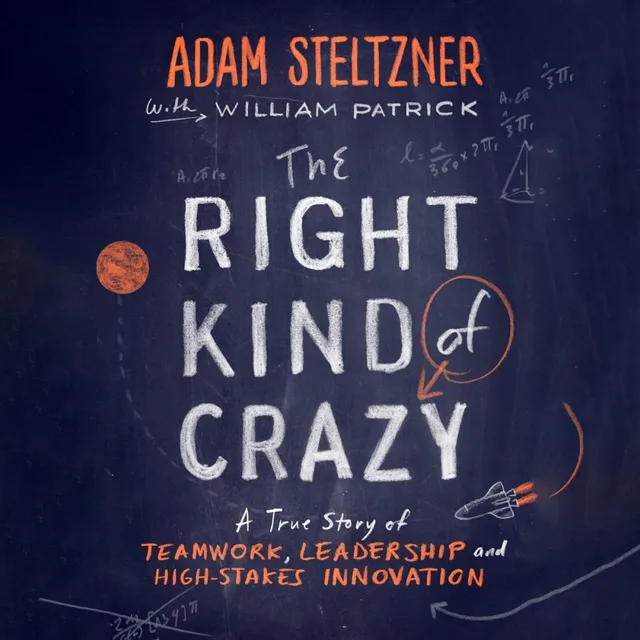
Adam Steltzner led the team that landed Curiosity on Mars in August 2012: a rover the size of a MINI Cooper, set down with a maneuver nobody had ever tried before. The Right Kind of Crazy is his memoir, never published in Italy.
In high school the only subject he did well in was drama. After graduating he works in a health food store and plays bass in a band. One night, driving to a gig, he sees the constellation Orion in the east. After midnight, driving home, he finds it in the west, and he wonders how that motion really works. Everything starts from that question: the College of Marin, physics, Caltech, and a first interview at NASA’s Jet Propulsion Laboratory that ends with “You can find your own way out.”
Soon after, another JPL manager calls him back, and this time Adam gets in. He starts as an analyst, checking whether designs drawn up by others hold together. It isn’t the job he dreamed of, but it is a thousand times better than the store: at last he is doing something real.
The turning point comes with a project to harpoon a comet. The team is in chaos, and Adam, without anyone asking him, steps back, breaks the problem into pieces and helps the others solve it. From then on, JPL stops seeing him as just an analyst.
A few years later he works on the landing of the Spirit and Opportunity rovers. A year before launch they test the parachute by dropping it from a helicopter: it opens and explodes, and nobody understands why. After months of tests they find the solution, and in 2004 the two rovers land on Mars.
With Curiosity the problem is even bigger: the rover is so heavy that none of the systems used until then can land it. The idea he and his team propose looks like something out of a cartoon, a rocket that descends over Mars and lowers the rover on cables, and that is where the book’s title comes from: the right kind of crazy.
After ten years of work, on the night of the landing Adam and his team can only watch the screens and wait for a signal to arrive from Mars.
The Engineer Who Convinced NASA to Try a Crazy Idea on Mars
Adam Steltzner
The Engineer Who Convinced NASA to Try a Crazy Idea on Mars
Now playing
The Engineer Who Convinced NASA to Try a Crazy Idea on Mars
Ten key reflections from the episode
"The toughest thing about the Dark Room is that you don’t know if it’s the darkness before dawn or the darkness before pitch-black. Your stress hormones are flowing, so there’s no shortage of motivation to stick with it. The challenge is to avoid a sense of hopelessness."
"Tom Rivellini reminded me of the old saying, “The coward dies a thousand deaths.” There’s plenty of time to confront “the worst” if it comes to that, so there’s no point rushing ahead to assume that you’ve reached it. Today I tell my teams, “Just keep working, and if death comes to visit us, let us be surprised.” Where there is will and ingenuity, there has always been a way."
"Holding on to the doubt meant listening to all that the problem had to say and not making assumptions, and committing to a plan of action based on them, until the deepest truth presented itself."
"Developing something new and novel is a nonlinear process. Being part of that process, as a team member or a leader, can be anxiety provoking, because we don’t know where it is going and we don’t know if we are really going to find a solution that works or meets our needs. The temptation to short-circuit the team process is strong. It is only by holding on to the doubt that we can allow ourselves to fully understand the problem we are solving and fully develop the solution."
"Over time I have found that most of what gets in the way of my seeing the universe as it really is comes from me. Excitement, pride, preconceptions of what the universe should look like all get in my way, but the most common block is fear. Fear that I won’t measure up, fear that I can’t get the answer to the open questions, fear that I will let others down, fear that I will shrink in the eyes of others and in my own esteem—all of these can sit in between me and understanding."
"I didn’t have a particular game plan. I was simply following my curiosity. I had let go of any expectation about where my efforts might take me. I certainly had no expectation of great success. I wasn’t waiting to become Elvis Costello anymore. I was simply doing my best to learn about my world and the universe around me. In some sense I was starting small, starting at the ground floor with the bedrock truth of the physical universe and hoping to build up from there."
"In fact, it is our curiosity that we need to engage and our fear that we need to hold at bay, or release, if we’re going to find what we’re looking for. It is as if there are two forms of decision making: fear based and curiosity based."
"One of my favorite Teddy Roosevelt quotes is “Far and away the best prize that life offers is the chance to work hard at work worth doing.” I feel very lucky to think that the work I do is worth doing. I also feel very lucky to work on a scale that requires people to work together in teams. I appreciate teamwork so much that I’ve developed a riff on Mr. Roosevelt’s quote: “That great work requires many people coming together is one of the great prizes life has to offer.”"
"The trick is to exhibit leadership—lead—without having to claim leadership or to subjugate others. This is leadership really as a service function, as a gift to the group."