01 Intro
Think about it. "We didn't even have electricity, television, a telephone or running water in the house." "The only concession to modernity was a small battery-powered radio."
Every day he talked about his dreams: one day he wanted to be an engineer, another an explorer, then a revolutionary, then a humanist, and around 25 he reached his final decision, that he wanted to make cashmere pullovers, though at first only for women.
And then he combines this with something even more unique.
What he dreamed of, and in the end managed to achieve, was a form of contemporary capitalism where profit would not involve, in any form, harm or offense to people or to things. In an interview he says: "But how can you work 12 hours a day?" "Where does your mind end up?" "The right kind of work does tire a person, but only with a healthy physical tiredness, while for the mind it should be something like a game." And something he focuses on a lot is that he writes that the main help that led him to become the successful entrepreneur he is today wasn't studying at the most important university in the United Kingdom, or an internship at the most prestigious company in Italy, but something much more ordinary and humble.
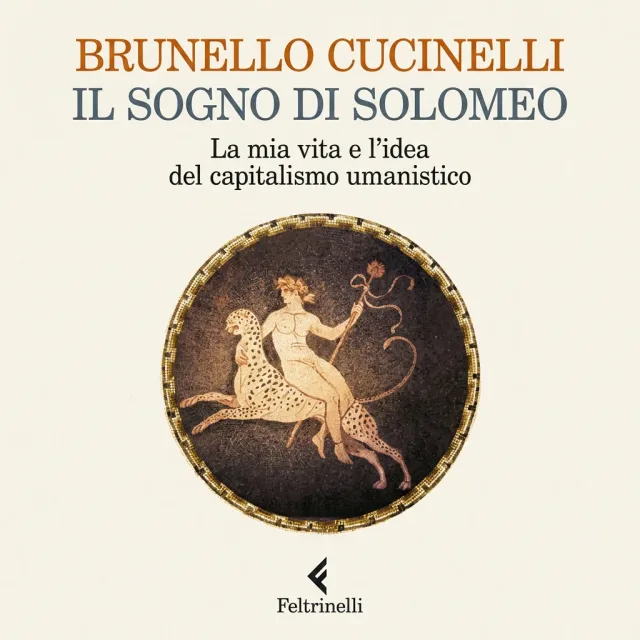
He says there are three things you can't buy, and the last one I'd never thought of: you have to take care of... "Marcus Aurelius left us what is perhaps the most complete of all maxims: live as if every day were your last, plan as if you were going to live forever." Welcome to In Buona Compagnia. We're Marco and Francesco, and every month we dive into the story of a person who fascinates and inspires us, and we tell you what we learn. This month we read the book The Dream of Solomeo by Brunello Cucinelli, and today we're going to tell you what we learned. Ok Fra, what do you think was the most important thing you learned?
02 "I feel like a custodian of creation": the entrepreneur of the world's beauty
When I finished reading the book, the first thing that came to mind is that today, a lot of the time, mostly watching the news, the papers, we're always used to murders, massacres, something chilling and cruel anyway. And a lot of the time also something like, maybe we've convinced ourselves that planet Earth, nature anyway, would be better off without us. But in my small way I consider myself an optimist, and so I've always thought that actually without us, without human beings, the whole picture of creation would collapse, and finally, reading this book, I found a person who thinks like me, and who is actually much more optimistic than me, and that's exactly why there's so much to learn from Cucinelli. And above all, one thing he repeats almost endlessly in the book is that he feels like a custodian of creation and he feels responsible for the beauty of the world. I mean, tell me how many times you've heard a multibillionaire entrepreneur say he feels like a protector of the beauty of the world, responsible for it. He doesn't say it just for the sake of saying it, or to please people or to make himself liked: he repeats it constantly, in every chapter, all through the book.
03 Enchanted years: a childhood in a farming family
Yes, another beautiful thing is the way Cucinelli describes his childhood years. They're the first two words this story starts with, he writes "enchanted years", and you'd never expect to read those words from a boy who was born into poverty. Think about it: "We didn't even have electricity, television, a telephone or running water in the house." "The only concession to modernity was a small battery-powered radio." And then, beautifully, he tells it here, at six years old. "On summer mornings I'd go down to fetch the bread, and my uncle Tonino, who worked as the stableman, helped me milk." "Then I'd go back to the kitchen and mix that warm, frothy milk with barley coffee, and dip in it the bread that my parents baked in the wood-fired oven only once a week." And this life in the countryside, growing up in a farming family, passes on to Cucinelli some very important lessons that shape not only his personality, but also his mindset as a future entrepreneur. The first lesson, which I think is one of the most important ones, is that in sufficiency there is abundance. Here he writes: "Simple flavors have no less taste than the most refined ones." "Water and a piece of bread give the fullest pleasure to those who know how to appreciate these values." "Living with little is not only healthy, it frees us from anxiety about life's needs and protects us from the twists of fate."
04 In sufficiency there is abundance
Right, like you said, this is also a phrase I think is really beautiful, "in sufficiency there is abundance", and it's precisely farm life that starts to shape him. Because Brunello writes that, in his view, a human being starts to form and build their way of thinking in the first part of their life. And in the first part of his life, in childhood, he got used to sufficiency, to having what is necessary. And it's from this period that he's strongly influenced, above all by watching his grandfather, he says, who prayed to receive the right wind, the right cold, the right sun and the right rain. And it's right here, in fact, that his first reflections begin on the beauty of creation, on his wish to feel responsible, but above all to understand what the right balance was between profit and gift.
05 Honest profits: inside the Cucinelli financial statements
"In fact, at Christmas, when the accounts were settled with the landowner" (who owned the farm), "when my uncle and grandfather came back home they never talked about numbers." "All we learned from them was that it had gone fairly well that year, or 'a good year, let's hope the new one is better', which meant there was little money." "But I didn't mind this moderation." "We didn't think too much about money." "That idea", like you said, "that idea of the right amount of everything has always attracted me." And this is a lesson that pushes Cucinelli to grow the company in a completely different way. The key concept here is the right amount of everything. Cucinelli's goal was never to grow the company quickly, to have exponential growth or to make excessive profits. In fact, when he chooses the location for his growing factory, where is it? It's Solomeo. He could have chosen any other town, but instead he chooses Solomeo, and he writes: "We didn't make excessive profits." "That was our goal." "We wanted fair growth, fair profit, and for everything to be gentle." Brunello Cucinelli is a listed company, and the goal was to make a product with dignity. He wanted profit with dignity. And that meant respecting the producers of the raw materials, the artisans, the people who worked for the company, also with pay that was much higher than average. Everything had to be balanced. And here he writes: "More than 50% of our shareholders are American investors." "Before we went public, I told them: are you looking for a company that grows very fast, that makes profits that are too high?" "Well, don't invest in this company." "Do you want instead a company that grows gracefully?" This word struck me, hearing it from a person who thinks of profit as something graceful. "So I told them: do you want a company that grows gracefully, that lets its suppliers grow along with it, so that your artisans can grow, and the company's staff too?" "Well, then invest in this company." In fact, if we go and look at the 2024 Financial Statement, it's interesting, because Brunello Cucinelli is listed on the stock exchange, so anyone can go and look at the Financial Statement. It's interesting to look at the revenue, what it spends on workers, on artisans, and if you look here you see that, well, total revenue is 1.3 billion. I think I did the math right, but I could be wrong. But from the math I did, 18.3% goes to employees, and 17.5% of all revenue goes to external artisans, which is around 223 million. Then we have the suppliers. 8.1% goes to suppliers, the ones who supply the cashmere, the leather, the fabrics. Another percentage goes to running the company, so rent for the stores, marketing, transport. And only 10.1% of all revenue goes to shareholders and owners.
06 Why stay in the village instead of moving to the city
So just by looking at these numbers, this analysis you did, you can see how special Brunello is as a person, how different from everyone else. It really highlights that he truly is different from everyone else, and that, especially in those years, while everyone was emigrating from the countryside to the city looking for better luck, more money and a better job, he does the opposite, and he still holds the opposite view today, and decides to build a literally multibillion empire in a medieval village. Where does this wish to stay in an enchanted place come from, when he was surrounded by people who wanted to leave the place they were born in? Because every Christmas the whole family got together, and in particular there was an uncle who had gone to live in France. And what his uncle told them about his experience, the fact that he always missed home, he always missed Italy, his habits, deeply influences Cucinelli's thinking. And in fact he writes: "Moved by his hard experience, I thought that a human being, if he wishes, must be able to live where he was born, among the shapes, the smells, the spirit of the places that forged him and looked after him."
07 What is lost in the move from countryside to city
Another thing that certainly influenced Cucinelli to choose Solomeo as the company's headquarters is when, at the age of 12, his family moves to Perugia, and like so many families, ours too, moving from the south to the north to work in factories, and so to have more, to look for a better life, a more prosperous life. And here he writes: "Overnight, our way of life changed completely." "Now we had a bathroom, a shower, heating and electricity." "Television made a big difference, because when we ate all together we were less sociable, because naturally we watched television." "So what was this city we were now experiencing?" "It gave us many things, cars, material benefits, but none of them really necessary, and some of them even led us to isolate ourselves." And this is an important point, because you can see it, especially today: loneliness, spiritual and economic poverty go hand in hand with the progress of the modern city, and they contribute to that ache of the soul we then have to live with.
08 Books and solitude as a true education
Moving from the countryside to the city, he also suffers real discrimination. He writes that yes, he came from the countryside, and he didn't even speak Italian, he spoke dialect, even though the move wasn't from Perugia to Turin or from Perugia to Milan, but just from the countryside to the city of Perugia. Even in this case you could see the difference between those who lived in the countryside and those who lived in the city. And so the only outlet Cucinelli had was books. And something he focuses on a lot is that he writes that the main help that led him to become the successful entrepreneur he is today wasn't studying at the most important university in the United Kingdom, or an internship at the most prestigious company in Italy, but something much more ordinary and humble: books. And he gives this definition of books, which is fascinating, he writes: "Books teach us to listen to the human voice of others and our own, and that is why they are practically irreplaceable for our soul." And another help he calls essential is solitude, meaning the ability to know yourself. And in an interview we watched, he also says he can light a fire in winter, sit in front of it, and stay there for hours and hours and hours, simply thinking, but alone. And those hours spent thinking aren't wasted, they're hours used to get to know himself, to know his own soul.
09 The book that changes everything: The Marketing Imagination
The emperor Hadrian, he says, considered books "a guide to life, and life a confirmation of the immense value of books." And in fact, from the way he writes the book, the way he speaks, you can really tell he's a poet, a philosopher, he's passionate about philosophy. And then, since we're talking about books, let's talk about that book, that idea that really shaped Cucinelli as an entrepreneur. At the age of 25 he reads a book that would become the cornerstone of his entrepreneurial mindset. The book was called The Marketing Imagination, by Theodore Levitt, and it was about economics and markets, a fundamental book that shapes Brunello Cucinelli as an entrepreneur. But before talking about this book, it's interesting to see why he chose to go into fashion. And also to see that he really wasn't a good student at university.
10 Federica, university and the encounter with fashion
Exactly, because after he moves to Perugia, he finishes high school and decides to start university, but let's say he isn't all that interested, because in three years he only takes one exam.
He studies engineering.
And this also shows us that success actually doesn't come from being a top student, from getting straight A's. Back then, while he's going to school or to university, on the same bus he meets his future wife, Federica. And Federica is a key figure, because she's connected both to his passion for fashion and to his decision to stay in Solomeo. He decides to stay in Solomeo because Federica is from Solomeo. Cucinelli actually isn't from Solomeo, Federica is. And so as he starts seeing her and visiting this village, he falls in love with it, and seeing it so abandoned, left to itself, it pains him. Precisely because, as we said before, he feels responsible for the beauty of the world and a custodian of creation, he falls in love with this place and decides to look after it, and then, of course, to build his company there. As for fashion, he becomes passionate about it because Federica's dad had a shop where he sold haberdashery, cloth, fabrics, and thanks to Federica's father he falls in love with fashion and decides that would be his world. And thanks to Federica, because it's lovely that he confides in her, since he didn't really have clear ideas yet: he writes that every day he talked about his dreams, one day he wanted to be an engineer, another an explorer, then a revolutionary, then a humanist, but thanks to her he understands what his path is, and around 25 he reaches his final decision, that he wanted to make cashmere pullovers, though at first only for women.
11 One single dream for a whole life
He has always been convinced that today you see people trying to do lots of things, moving from one thing to the next: I start this company, then I sell it, then I start another one, I do something else. He, instead, was the opposite. He strongly believes that to achieve something special you have to focus solely on one single project that represents the dream of your life. The one thing, and in fact Brunello Cucinelli started it at 25, now it's been 47, 45 years, and he has three-year plans, thirty-year plans and even plans for centuries. This is his one obsession, this is one single dream, it's his dream, it's the only thing he wants to do. And here there's a really beautiful example of the Japanese doctor who died from the effects of radiation from the atomic bomb at Nagasaki, who told his children: "Dear children, have a dream." "Have a beautiful dream." "Follow only one dream, the dream of a whole life." "A human life that has a dream is joyful." "A life that follows its dream is renewed day after day." "Dear children, the human life that seems short is long." "And the one that seems long is short."
12 The oak: planting for those who come after
About what I told you, that he even has plans spanning centuries, that's absolutely true, because he always comes back to the fact that he feels like a custodian of creation and responsible for the beauty of the world. A perfect example is when, during his work to restore and beautify the medieval village of Solomeo, they decide to plant an oak, and while they're planting it the gardener remarks that they, Cucinelli included, would never get to enjoy the wide shade the tree would offer. Because, being an oak, a tree that lives for centuries, it takes a very long time to grow. And Cucinelli writes that for him it was an investment, because that oak "would make life more beautiful for those who would come after us." So even though he wouldn't enjoy the shade, and this is a metaphor, he wouldn't enjoy the shade offered by the oak, future generations would still enjoy that shade. So even now that he's getting closer to the end, his mission now is to leave something beautiful to future generations.
13 The three dimensions that make the brand impossible to copy
In fact, there's an article from Famiglia Cristiana I found on his website where he writes that every company is destined to die, and I think that's why... I think that's also why he decides to restore Solomeo, to build a theater, a library, a beautiful park. Because maybe he knows his company might die, maybe in 150 years, but that theater, that park, that village will stay there for centuries and centuries. So now let's go back to the book, which he describes as the book that became the cornerstone of his entrepreneurial mindset. And as we said before, the book was called The Marketing Imagination, and the main idea was that developed countries would have to specialize in high-quality products if they didn't want to be pushed out by the emerging countries, which were learning to make quality products at a much, much lower cost. And so this vision anticipates what is very obvious now, that competing on cost is a losing battle for Western countries. And so Cucinelli competes on three dimensions, very important ones in my view, that can't be copied. The first, as we said, is Solomeo, because there can't be another fashion house in Solomeo. Solomeo isn't just a physical place, it's also the soul of the brand. It's a source of inspiration where the spirit of this place, I think, passes on to the people there, because they feel good there. And then this spirit, this desire to work, passes on to the products that are made. And so when Cucinelli decides to go to Solomeo, so to move his headquarters, which was growing,
14 Buying the castle, bringing the village back to life
To Solomeo? Exactly, because he moves the headquarters from Perugia to Solomeo and decides to buy both the tower and the medieval castle, and not only to buy them, but to restore them, make them beautiful again, give them new life, and put the company's headquarters there in Solomeo.
And everyone was asking: but how could you work well in a medieval village? I mean, it's a medieval village, it's not an industrial city like Milan. How could that ancient castle be more effective than a modern functional building? "People thought, since the internet was still far off, people believed we were very remote, because the contemporary economy needs real-time contacts." "Then there was a castle, the internal staircases, the small rooms and the walls you couldn't touch because they were all covered in frescoes." He writes this, which is important: "That setting worked perfectly, and if it wasn't suited to the hurry of the times, it was suited to the spirit, and that counted for a lot."
Exactly, because he writes: "I do not create, I hand down." And in his view, also according to his vision, buying that tower, that castle, and putting his company's headquarters in Solomeo would bring three big ideas to life. That is, working in an ancient place is beautiful, but above all bringing value back to the fortress and the village, and here we always come back to his long-term vision of the custodian of creation and of leaving something beautiful to future generations: that over 20, 30, 40 years, thanks to his restoration work, the village would see a strong rise in economic value and in quality of life.
15 Cashmere as a permanent good
And so it's impossible to replicate the creative energy that comes from Solomeo, from that medieval village. So the second dimension that makes the brand unique is the choice to make cashmere.
So why does he decide to make cashmere?
He writes, actually I read this in an interview, and he says it's because he was using something that, in theory, never goes to waste. "You never throw away a cashmere sweater, and I really liked the idea of making something that is never discarded, never thrown away." This is interesting, because Cucinelli isn't in the business of making sweaters or making clothes. If I ask you, what does Brunello Cucinelli do? Maybe you'd tell me he makes clothes, but I think he's in the business of permanent beauty, he's in the business of creating personal or even family wealth. Why? Because a Cucinelli cashmere sweater doesn't get thrown away, it grows with you. When you spend 3,000 to 6,000 euros on a Cucinelli piece, that piece becomes part of your personal wealth, it's something that can't be thrown away and that might even be handed down from generation to generation, and then he combines this with something even more unique, which is
high Italian craftsmanship.
16 High Italian craftsmanship: expensive but not overpriced
Here he writes: "The idea was firm: to make garments of high Italian handwork and craftsmanship, products that were expensive, yes, but not overpriced." Expensive but not overpriced? Yes. Here it's interesting to understand what the difference is. Expensive but not overpriced. "Aimed at a market segment called absolute luxury." "So quality, craftsmanship, above all Italian, creativity, exclusivity and a culture of beauty are the elements we would like to set our Brunello Cucinelli brand apart." And here he writes: luxury, absolute luxury, ok? It's an artisanal good. 52% of the products are all made by hand, all handmade, hand-sewn, handmade. So absolute luxury stands for high craftsmanship, in this case Italian.
In fact he writes that he's convinced there can be no quality without humanity. So the quality of luxury, like you were saying, created by human beings, by human hands.
Another person or competitor, well, maybe they can copy the cashmere, they can open a factory, they can hire a designer, but they can't replicate years and years, thirty years of relationships with Umbrian artisans.
And above all they can't replicate the craftsmanship, because he writes: "Handwork represents life, and it is precisely on craftsmanship that beauty is founded."
And above all nobody can pass on, nobody can copy his philosophy, his mind, and so Cucinelli has built an ecosystem where the place (Solomeo), the raw materials (cashmere), Italian craftsmanship (the real kind) and his philosophy all feed each other, creating an advantage that is now unique, special. The third element, so the third dimension: we've talked about the Genius Loci, the spirit of the place, and the cashmere, and now let's finish with what he describes as humanistic capitalism.
17 Humanistic capitalism: profit without harm or offense
He coins this expression, which is really important, because if we think about capitalism now, like you were saying before, it's about founding a company, taking it to maximum expansion and then selling it and making an exit. Exactly. So it's the complete opposite of what he thinks. I mean, he dreamed of, and in the end managed to achieve, a form of contemporary capitalism. I mean, isn't it unthinkable that an entrepreneur today could think something like this? Where profit would not involve, in any form, harm or offense to people or to things, but at the same time would be able to improve the condition of human life. And this idea of humanistic capitalism puts the human being at the center, meaning work shouldn't be drudgery, it shouldn't destroy the human being.
Here he writes: "A job is suited to a human being not only for its right quantity but also for its right quality."
He wanted fair growth, fair profit, and for everything to be gentle and caring toward nature, creation and human beings.
18 The daily rules: no emails after 5:30 p.m.
In fact, if you look at how the company is structured, the day starts at 8 in the morning, and at 5:30 in the afternoon it's forbidden to keep working. No email can be sent to multiple recipients, so today maybe you do copy and copy in CC, yeah yeah, and there are 10 or 20 people, and here he says only one or two. No group emails. Why should a single email be read by 10 different people, unless they're the 10 people involved in that specific matter? And here he describes, actually I read this in an interview: "The first time I was in New York, I had a very small office and people were sending emails from one side to the other, and I said absolutely not, get up and go to your colleague and ask them what you need to ask."
And this idea of work, which is completely different, I'll say it again, from what we're used to today, can be seen as a utopia, as something impossible. But he also gives his own definition of the word utopia, which is special. That is: "The term utopia is the most convenient way to dismiss what one lacks the will, the ability or the courage to do." "It's a dream", so his dream, including the dream of Solomeo, "is a dream until you start somewhere." "And only then does it become a purpose, something infinitely greater."
19 "Utopia is the most convenient way to dismiss what one lacks the courage to do"
And this was a quote from Olivetti. He wrote it in his book. Adriano Olivetti said this, that's what is considered utopia.
20 Moving into the total look, and the village as a destination
You mentioned New York earlier, and in fact in this period he starts traveling, because the company is doing well, the restoration of the medieval village was moving forward fairly steadily and going well anyway, and everything, basically, was going the right way. And until then Cucinelli as a brand was identified as a Made in Italy cashmere knitwear brand. But the product sold very well, the markets appreciated it, and offers started coming in, proposals to start thinking about making a total look, above all for women and men, and here Brunello made a choice that marked a clear turning point for his business and for its future growth: he decided to enter the world of fine clothing for men and women. And the beautiful thing is that now, with the company's success, it wasn't him who had to travel to look for producers, suppliers, investors: now it was the people, tourists, journalists, customers, suppliers, who came to visit him in a medieval village. There's this photo we saw where he brings together the biggest investors, the most important people in Silicon Valley anyway, so from the world capital of technological innovation, in a medieval village, in Solomeo. And in this village, as I was saying before, Cucinelli buys the tower, the castle and the whole village. He decides to build a theater, he decides to build a school of craftsmanship. While walking, he looks at the plain that runs alongside the village and sees some abandoned industrial sheds, and he decides to buy those sheds to bring that area back to life, to create a wood with trees. But above all these are works, and he's aware of it, that in the short term, especially for him, he'll only see them for a little while, but they're works that will pass to the future generations who will live there. And like you were saying, yes, the company can die, but that place will never die.
21 The seed of the wheat: thinking in centuries
It will never die. He's already thinking in centuries. This is something he learned a lot from his dad. From his dad he took, his dad taught him something very important. That is: keeping the seed of the wheat and reusing it to increase future harvests symbolizes the importance of investing for tomorrow. That's what he's doing with his company and with Solomeo. It symbolizes that every generation, like his, like ours, like the younger one, keeps with it its own seed made of lessons and wisdom, which then, if reused in the right way, passes to the new generation, which can use it to make its future much better. He writes: "I understood that the legacy of the past is never a burden, but wings that support the bright future that awaits us." "Marcus Aurelius left us what is perhaps the most complete of all maxims: live as if every day were your last, plan as if you were going to live forever."
As we can see, the reflections he makes are becoming much deeper. And in fact in this period he's 55, and he writes: "an essential age, because it's at this age that you start taking your first personal stock and begin to imagine a stable arrangement for your future, private and working life." And in fact here, which I think is important, he takes another step for the company's future: he decides to list it on the stock exchange in Milan. But why does he decide to go public? To get more money, more shareholders? And the main reason, from my reading of the book, is that he's aware that the ability to run the company isn't inherited. He has two daughters, and he writes: "If they're able to run the company, wonderful, all the better." "But since this ability can't be inherited, I want to give my company a chance in the future", and so it could be run by people outside the family, and that's why he decides to list it on the stock exchange. In fact, as we've said many times, Cucinelli isn't interested in money, in success. One of the final sentences, he writes: "My dream, for anyone who hasn't understood it, is to bring together the beauty of the past with the beauty of the future." So like you were saying before, he feels like a ferryman from the past to the future.
22 Five business principles every entrepreneur can learn from Cucinelli
He writes: "We must remember this and defend future generations, so that they too can hand down every positive message that springs from us." "If the old are the young of the day before yesterday, the treasures of their youth are permanent and enriched by experience." "We will go and seek them out, the elderly, not only to draw them out of their loneliness, but also to nourish ourselves with their wisdom." So what are the business principles that other people, other entrepreneurs, can learn from Cucinelli?
Well, definitely the idea of the right kind of work: "the right kind of work does tire a person, but only with a healthy physical tiredness, while for the mind it should be something like a game." Then another value that I think is important is that bosses must be aware that "there can be no equality in the benefits if there is no equality in the responsibility for mistakes."
Another fundamental thing is when, in an interview, he says: "The most important business principle is that you have to believe in human beings." "Because the creativity of a company, let's say, for example, a company has a thousand people, ok?" "We've been taught that among those thousand people there are maybe two or three who are geniuses." "But I think instead that if you have a thousand people, you have a thousand geniuses." "They're simply different kinds of genius, and a different degree of intensity." "We hold a meeting here with all the staff every two months." "Everyone takes part." "Even the person with the most humble tasks knows exactly which was the last store we opened." "Everything is based on esteem, and esteem can generate creativity." "Everything is visible, when things go well and also when things don't go so well." "When we're sad, when we're worried, when we're happy." "If you show all these different moods, then you're credible." Another important thing is that you can't bring a computer to meetings. You have to know everything by heart. You have to know all your business with a margin of error of one or two percent. Because, first, it's mental training, and second, in his view, it's a form of respect. He writes: "I like being quick as a person, but I don't like things being rushed carelessly."
23 The quality of work: fewer hours, more creativity
For me this is exactly the opposite of what we're used to today. Yes, absolutely the opposite.
Today it's all fast, I work 12 hours, I work 15 hours.
I want results right away.
Yes. Speaking of work, which always ties back to humanistic capitalism, in an interview he says: "But how can you work 12 hours a day?" "Where does your mind end up?" And if you think about it, today the whole of society is rooted in the idea of more. More work, more hours, more, more, more, and longer has become the measure of success. For example, he tells this in the interview (we'll put it in the description afterwards): "For example, the other day I was in Milan and I met two 55-year-old managers who worked as investors." "One told me: I work from six to eight, six to eight, six in the morning to eight in the evening." "Sitting there in front of a screen." And in society now, people start saying, this guy works hard, wow, and Cucinelli says: "Well, I wouldn't trust him with anything of mine for 12 hours." "Then, if you live in the city, what do you do?" "You go home, it takes an hour to get there, and the next morning... this is where I think we need to find a balance", he says. "You think you worked one hour less?" "But how do you feel the next morning?" "Your level of creativity is sky-high." For example, when Cucinelli did this interview ten years ago he was 60, and he says: "Now that I'm 60 I feel a bit more tired, so I've decided to work seven hours instead of eight, because I'm starting to get old, but I haven't slowed down by even a fraction of a second." And then he says: "We have to rediscover the quality of work." "If during the day, while you're working, someone sends you a message, and the message is 'so what are we doing Sunday, shall we go out for a pizza', while you're working you only get that message after 6 p.m." "From eight to five thirty, when you work, that's the maximum." "Then afterwards there's time to relax, when you can unwind, be with your family, go for a run." Here he says: "In the evening at five thirty that's it, I'm done, I go for a run, and I have a notebook I carry with me, and when I come across a good idea I write it down." And then he says: "A 58-year-old man killed himself, a great Italian manager, I think last year, and he wrote: I spent my whole life running, chasing work, without ever realizing the great ideals, the great values of life." "And in my view the great values of life are work for the soul, family, friendship, personal leisure, something that interests you, which maybe isn't work in itself." This one's beautiful: "I spent my whole life running, chasing work, without ever realizing the great ideals, the great values of life." "And this is a question of balance." "Those who come to me and say", this is Cucinelli talking, "'you know, I work 15 hours a day', I tell them: I'm not interested, I'm not interested, what interests me isn't the quantity but the quality of working hours." "Because do you think that during the first 5 hours of the day you're the same as in the last five hours of the day?" "No, you're tired, and if you're tired you stop listening, and the decisions you make are very risky." Another important principle, well, this one we know, but he says there are three things you can't buy, ok? Well, the first thing, we know it, is physical fitness. You have to keep yourself in shape.
24 The three things you can't buy
Whether you're rich or not, nobody can do it for you.
Two, diet. You can't pay someone else to put you on a diet, to make you go on a diet. You can't pay someone to diet for you. And then the last one, which I hadn't thought of, well, physical fitness yes, diet yes, but the last one I hadn't thought of is that you have to take care of your soul. Nobody can take care of your soul except you, and it's something you can do through culture and philosophy. The real way to nourish your soul is philosophy. The real malaise of human beings is something you feel much, much more now than before, and this restlessness, this anxiety people feel, which is much stronger now, you can only cure with knowledge, with reading, because when you read you immerse yourself in other people's stories, in other people's ideas that make you think, and it's a kind of therapy for your soul. Again in that interview from ten years ago, when Cucinelli was 60, he writes, he says: "The emperor Hadrian used to say that daily business, daily life, daily chores kill human beings." And he says: "Well, I'm not interested in daily chores." "Now we've mistaken information for knowledge, and they're not the same thing." "I don't want to know." "I'm not online and I don't even have a computer." "I'm a great believer in memory." "If I remember things, I don't need to go back and check them and look them over again." In the company you can't send emails after 5 p.m. And this makes you realize how, maybe, these days technology is a blessing, but maybe technology gives us information and not knowledge. And so maybe that's why for him it's so important to study the great people who lived before us. To go back in time instead of reading something that just came out.
25 Action as the engine of life
Tying back to this point about philosophy, something he says in an interview we watched is that a human being becomes complete first by knowing mathematics and then by knowing philosophy. He focuses a lot on challenges, because to build the business, the company, and rebuild a medieval village from scratch he certainly had to face a lot of them, and he writes that "the challenges awaiting the willing are neither simple nor few, and they require time and commitment", but without a shadow of a doubt they "will be won by all those who prefer life", that is, who prefer to act. And according to Cucinelli it's precisely acting, and not self-interest, acting, not self-interest, it's acting that must be the engine of our drive to do things.
26 A message for those who feel the ache of the soul
And this is dedicated to all the people, women and men, who suffer because perhaps they struggle to hide from their children the pain of a humiliated life, and who every morning get up and go out to meet the world, only to come back home with a hope disappointed once again. "Sometimes they're very lonely people, and perhaps not even I", he says, "could have achieved what I achieved without my children and without Federica." "But I would like to tell all these women, all these men who feel this ache of the soul, young and old, I want to say that I wish those women and men, once out of the house, could sense the light of the future that awaits us, and that the strength of joy could return to nourish their hearts." "As rain does with the earth after a long drought, everyone deserves a chance to reach full happiness." "I am convinced it isn't right to put a limit on our concrete dreams, on our ambitions." "If they tell you that your plan is too grand, that maybe it can be split into many different phases, or that it isn't the right time to put it into practice, don't listen to these people."
"They are trying to stop you from flying."
Well, this is how we want to close this episode, and this is what we learned reading The Dream of Solomeo by Brunello Cucinelli. If you enjoyed it, subscribe on Spotify or Apple Music, depending on where you're listening to this episode, and maybe send it to someone who's interested, maybe it can help someone else who has a bit of this ache of the soul that all of us have every day. Thank you, and see you in the next episode. Bye bye!