

01 Introduction
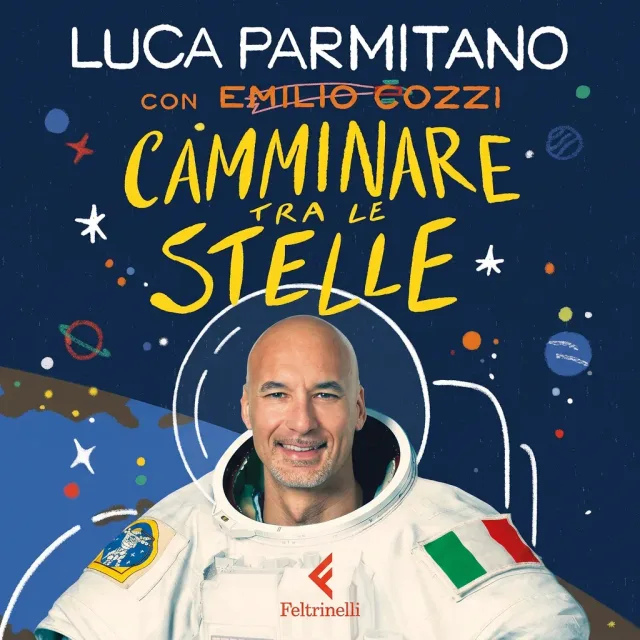
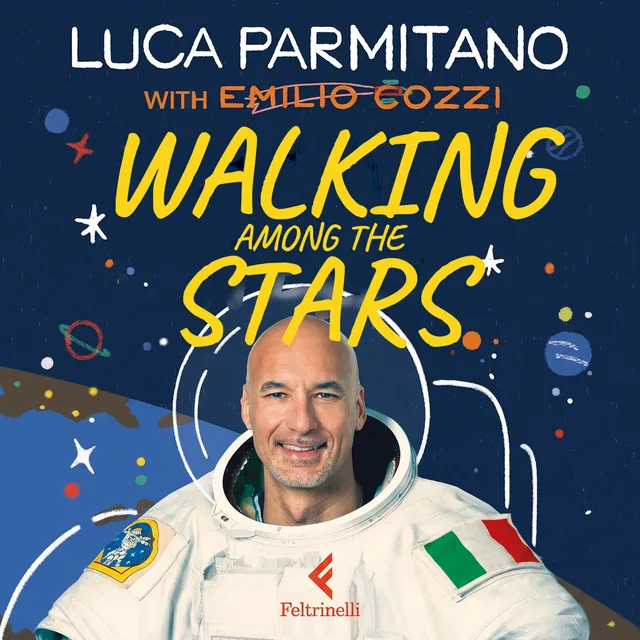
Try to picture this scene: you're 400 kilometers above the Earth, there's a tiny little man, an astronaut, and he's outside the space station. He's doing a spacewalk, which is called an EVA. At a certain point, inside his helmet, he feels the back of his head getting wet. The more he moves, the more the water grows, and he realizes it isn't sweat, it's actual water. And the helmet is filling up with water. And nobody understands where this water is coming from. And I'm trying to picture this tiny little man on the space station, hooked on by a cable, out there, at 28,000 km an hour, out there, about to drown. And he thinks about one thing only: "I can't go down in history as the first astronaut to drown in orbit." So what does he do? Today we'll tell you. This is a true story, it's the story of Luca Parmitano, and today in this episode of In Buona Compagnia we dove into the book called Camminare tra le stelle (Walking Among the Stars). It's a very short book compared to the last ones we did, by Carlo Rovelli and Samantha Cristoforetti, which are 400 pages. But it tells his story, and in my opinion there are some very, very important reflections in it. So, before we start, welcome to In Buona Compagnia. If you're new to this podcast, what Francesco, who's my brother, and I do is very simple. Every month we dive into the story of a person who, in our view, did beautiful work in their life, and we try to share ideas, principles and reflections that we can use in our own work. So welcome to this episode, which I think is number eleven. Eleven episodes, guys, eleven episodes, not bad!
02 Why it all starts with a child's curiosity
Okay, so, Luca has a lot of firsts, including, as we said, being the first Italian in history to have walked among the stars. But in my opinion everything has to start the way we started with Samantha, so from where this dream was born, from where it all began. I wouldn't go through the whole selection process again, partly because Luca doesn't actually talk about it in the book, but we covered it properly in the Samantha episode. And Luca, before he starts telling his story, opens with a reflection. What's the first thing you do when you wake up? He writes: "The first thing I do is try to get out of bed as quickly as possible. As soon as you wake up, the temptation is to stay lying under the covers, nice and warm. But if you set an alarm, it's because you had a reason: you have to go to school, you have to go to work, you have a commitment. So that's why the best thing to do is get rid of the temptation of the warm bed right away, expose yourself to the air and start the day." And one of the first sentences written in the book is: maybe you too sometimes wonder what drove really talented people to do something, to become who they are. That's what we're trying to understand right now. And in Luca's case it's this taste for adventure, the desire to discover the world, to explore. Also because exploration, so the desire to know, curiosity as you were saying, has only one purpose, which is to widen the horizon, to know more things, to learn, to discover the unknown. And so Luca starts with this anecdote: as a little kid, in Sicily, he goes to this place at his grandparents', a house near the woods. And as a little kid he'd gear up with a little scout-style backpack and go into the woods with walkie-talkies to explore, to have fun, to play.
Like a Junior Woodchuck.
03 The Star Wars poster that sparked the dream
Exactly. But it's interesting, because this connects with Samantha too: it all actually starts thanks to his grandfather, grandpa Salvatore. Because his grandfather was a passionate reader, and one day, while Luca was just flipping through his magazines, he finds the poster, the cover, of The Empire Strikes Back, so the fifth episode of Star Wars. He actually had no idea at all what Star Wars was. But thanks to that poster he starts to fall in love with that world, and it's a bit like what Samantha did with Star Trek.
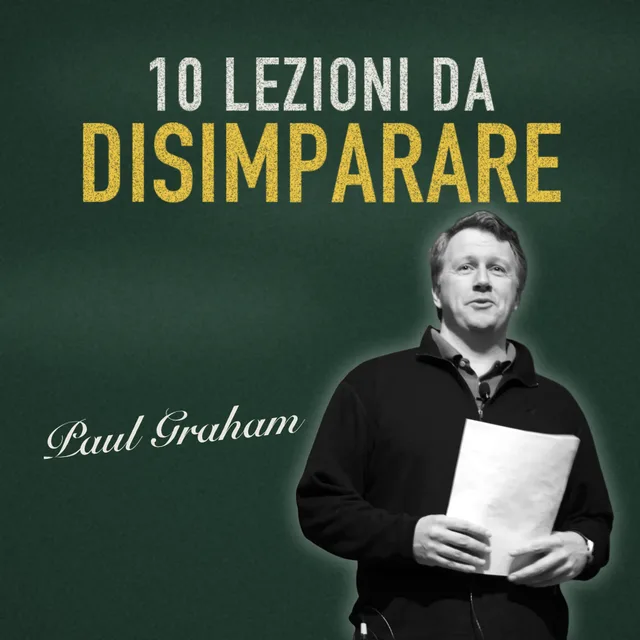
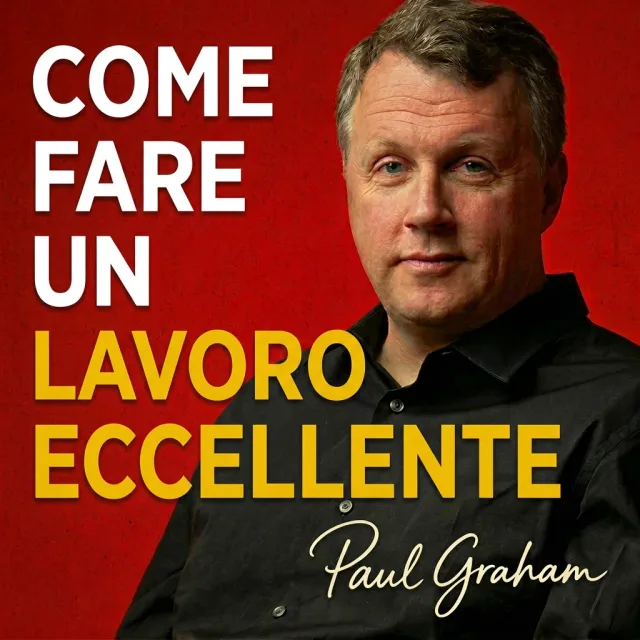
And here a line from Paul Graham came to mind, from the essay How to Do Great Work, where he writes: "When you read biographies of people who've done great work, it's remarkable how much luck is involved. They discover what to work on as a result of a chance meeting, or by reading a book they happen to pick up. So you need to make yourself a big target for luck, and the way to do that is to be curious. Try lots of things, meet lots of people, read lots of books, ask lots of questions." So both Luca's life and Samantha's life were literally shaped by a film.1
04 Can a film decide your future?
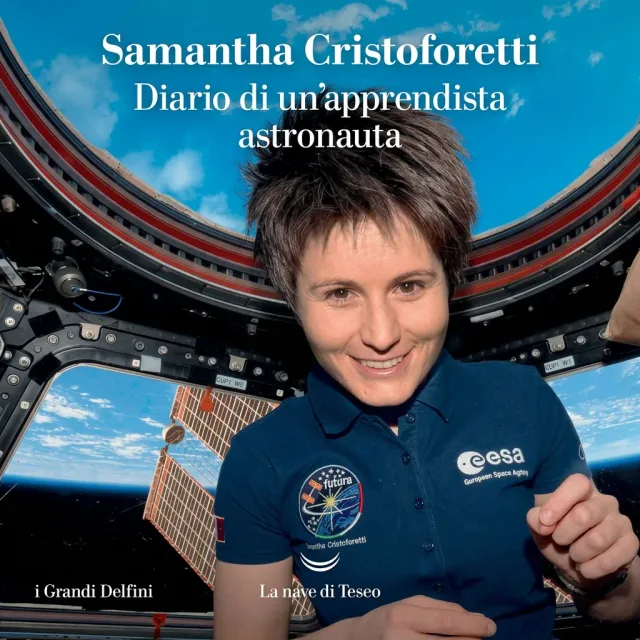
But now the question I asked myself is: okay, you're little, you're curious, but how is it possible that a simple film can influence the whole rest of your life? And here I'd take the way Samantha describes it: as I was saying, he falls in love with Star Wars, Samantha with Star Trek, and she writes in her book Diary of an Apprentice Astronaut: "I couldn't say how much my passion for Star Trek helped steer my choices. It may seem excessive and almost childish to attribute such a significant influence on one's life to a TV series, but sometimes a reaction needs a catalyst, and I can't rule out that in the case of my dream of going to space, the catalyst was precisely the adventures of Captain Kirk and Mr. Spock." Another important event is in 1984: he's walking past a used-book stall and finds this book, which came straight from America, about fairly complicated stories, stories of aliens, of astronauts, of time travel. They weren't children's tales, but they weren't too complicated either, though for a child they were complicated enough. But he takes it anyway, and he writes: "For an elementary school kid, that book blew my mind. Those stories made me understand that there's a world beyond what we can see, beyond what we can think." Then comes the period between middle school and high school, and he writes that he falls in love with two things, communication and music. But it was communication that added a piece. Why? Because his mom and dad were both teachers, his mom taught French and his dad electrical engineering, and in the spring when he was fourteen, so his first year of high school, his parents agree to host a girl from America for a week through a school cultural exchange, there in Sicily. He falls in love, she couldn't care less about him, but thanks to her he discovers America.
There's another world.
This world he didn't know. In fact he writes: "I fell in love with the idea of going to study abroad for a whole year. It wasn't easy to get my parents to accept, partly because back then there was no internet, no email, no phones, but above all it cost money, so I needed a scholarship. And yet my parents trusted me, on condition that I won the scholarship." And what happens?
He wins the scholarship and leaves for California.
At 16 you go to California.
05 "Discovering that I knew nothing was wonderful"
And here he has a very important encounter. Once again we see how life can be shaped by a chance encounter, completely random. The father of the family he was staying with was called Larry, and he was a Marine Corps navigator on an F-18, a fighter jet. And Luca knew nothing about that world. Like any sixteen-year-old, he was convinced he had all the answers, and he thought soldiers were fairly narrow-minded people. Instead Larry showed him the complete opposite and opened up this world to him. So let's try to imagine: if Luca had never met Larry, maybe his life would have been completely different.
Because it's interesting: he was there at the historical moment of the Iraq war, so he was super prejudiced about weapons, about the military, about soldiers. And instead, like you said, thanks to Larry he discovers another world.
And here he writes a really beautiful line: "Discovering that I knew nothing was wonderful. It was a bit like unearthing a treasure."
06 "It's like walking into a tornado": the Academy
"Suddenly the drawer where for years I had locked away a dream flew open, and my dream was still there, intact." In '94 he goes back to Italy, and he had decided that after his high school final exams he would enter the Air Force Academy to become a military pilot. So here another path begins, like Samantha's, at the Air Force Academy, which will later set him on the way to becoming an astronaut. He goes to the Air Force Academy in Pozzuoli, near Naples. And it's great because getting in is super hard: on top of a ton of psychological aptitude tests and medical tests, there are also sports tests. So he's on vacation after his final exams, he calls his mom, and his mom tells him: 23rd out of 104. So he gets in and...
The first day at the academy is August 18, 1995.
And one thing I thought is that, I don't know, you think of an astronaut as really the best of all, the strongest, the smartest. But he's twenty-third out of 104, and what we're about to tell you is really kind of absurd, and it shows that astronauts are actually human beings too, they're completely normal. And he writes: "The instant I set foot there, my life changed forever."
And he writes: "It's like walking into a tornado, all of reality gets turned upside down. They take you, they make you strip, they dress you in blue, they give you all the first-year books and they take you to your room. And that's only the end of the first day. You find yourself with a pair of boots, pants, a military shirt with stars and collar badges, and a sack with a jacket and winter sweaters inside. You don't know it yet, but that sack holds everything you'll need for the months that follow. Until the day before you were an ordinary person, hanging around with your friends. Once you enter the academy, you become a cadet. And every time someone calls you, you have to snap to attention and answer: at your orders, Cadet Parmitano, and wait for instructions."
So he was only 19, in a military college, at the Air Force Academy, and he's a cadet. Anyway, you no longer have the freedom you had before, because you can't go out when you want, you can't do whatever you like, while maybe people your age, your high school friends, are out there, free, so to speak, doing whatever they want. But he felt that was the right place for him, and he writes: "With a series of opportunities I would never have had anywhere else."
So the first step now is getting the license, which is called the BPA, very different from a license someone can get to become a private pilot.
Even just as an amateur, right? Exactly.
And so at 19 he gets into his first plane, an Aermacchi SF260, which he describes as kind of the Ferrari of single-engine propeller planes.
07 When he stopped imagining his future
It's interesting because the exam is structured in a complicated way. There are nine flight missions where the instructor's job is to teach the cadets the fundamental maneuvers of manual flying. But meanwhile the instructors, besides teaching, also have to figure out whether the cadet really has what it takes to stay in the Air Force. So it's not just that the cadet has to pass the exam: he also has to prove he's suited for it. And then whoever passes the exam takes off alone for the first time. And he writes: "The flight exams were the days when, for the first time in my life, I stopped imagining my future." And now let's see why. During the exams there are two checkpoints. The first, where the instructor has to check that the cadet has learned a certain number of maneuvers. The second, at the seventh flight, where the cadet makes a decision: at that moment he can leave, that's it; or, if he decides to stay, he has to take the exam, and if he fails it he still has to stay at the academy for a year. And if you think about it, that's not an easy thing: he's still a kid, he's 19. Right. During the tenth flight, every cadet has to show the examiner that he's able to fly the plane, to perform some aerobatic maneuvers, to fly safely. In September '95, on the day of the exam, he takes off, does the aerobatic maneuvers, perfect.
He also has to stay inside a flight area, so the area he's supposed to fly over.
And then he has to land. He makes the first landing and he can't do it. He goes around and he still can't do it. In short, he can't land. In the end he gets the plane on the ground, but not the way he should have. And he writes: "I fall into a sort of circle of despair, because you can be an ace in the sky, but if you can't land safely, everything else is irrelevant." When his plane finally gets to the ground, the examiner looks at him and tells him: "I don't feel I can let you take off solo, because you didn't show you can land safely, but you have potential, so I'm giving you an extension. So first an hour of flying with an instructor, and then you can take the exam again." Right. What happens?
08 The worst birthday of his life
The second exam falls on his birthday.
September 27, 1995, and he does terribly again. He does badly again. Again, after a bad first landing, he can't recover, he can't put what happened behind him, and so he goes into this sort of limbo that keeps him from performing well. So he lands, and this time he has to wait until the next day.
For the board's verdict. But he knows it won't be good news. He hopes for something, but...
In fact he writes: "In my heart, though, I know I've failed. The worst birthday of my life."
And here he writes: "That day I saw the end of the career I had imagined, and I couldn't blame anyone else for my mistakes. I couldn't point the finger at an instructor, at the bad weather, or blame my plane. The only one responsible for my failure was me, with my lack of proper preparation. Suddenly I had to face my real abilities, their consequences, my self-confidence. I asked myself who I was and who I would have wanted to be. Although I've always been inclined to imagine the future, for the first time I couldn't see anything in front of me. I felt that everything I had dreamed of was about to vanish. All I could see was a door flung open onto the void, a black void with no colors, because I had no idea what lay in front of me."
09 "You're not Frecce Tricolori material"
And what happens is he goes before the board, and in fact the board grants him yet another extension. And how does the extension go? He writes: "The worst extension of my life." During the practice hour with the instructor he does terribly again, and so he takes off for the third exam knowing that this time everything is really on the line, the future of his career and of his life. But he lands, finally, and the instructor tells him: "That wasn't a stellar performance. You're certainly not Frecce Tricolori material. But you flew safely. I'm passing you with 18 out of 30." In this story it's one event after another changing the direction of Luca's life. Because what happens now? What happens is it's time for the launch of the Space Shuttle Columbia. On board were two Italian astronauts: the astrophysicist Umberto Guidoni and Maurizio Cheli. Of course he follows the launch super interested, super curious. And then, during an ordinary study session, he couldn't study anymore, so to rest for a moment he picks up a novel and reads it. Someone else comes in and says: "Cadet Parmitano, what are you doing? You're supposed to be studying and you're reading a novel?" So he gets punished, with a session of forced study. And by chance this punishment coincides with the return of the shuttle Columbia. So he asks permission, he begs to be allowed to watch the return, it's granted, and he sees the shuttle come in and the two Italian astronauts come down the steps, Maurizio in particular.
Then Maurizio visits the academy and talks about his experience in orbit, shows all the photos. And here he writes: "After meeting Maurizio, I understood that becoming an astronaut was a possible path. Maybe not probable, but possible."
"Maybe it was his incredible story, or the obvious happiness of that moment, but an image was starting to take shape in my head."
10 "It's always worth seeking the limits"
"I wasn't really sure I was cut out for the Air Force, but I decided to commit myself to becoming the best pilot I was capable of being." And here he writes this beautiful line: "I had understood that it's always worth committing yourself to training. It's always worth seeking the limits of our abilities, even at the risk of failing. It's always worth giving it everything, both physically and mentally, to do something we believe is important."
11 Why "professional explorers" exist
"Throughout the history of our evolution, everything shows that, even if it can take years, centuries or even millennia, whatever women and men manage to imagine, someone after them turns into reality. All it takes is patience, will and commitment."
Before 1903, the idea of traveling in an airplane was completely crazy. It wasn't possible. But these two brothers prove instead that a motorized object heavier than air could lift off the ground, and once in flight it could also be steered. Something incredible.
And here there's a line that's really beautiful: "What would have happened if our ancestors had stopped in front of every obstacle? If instead of risking their lives crossing the sea or climbing a mountain for the first time, they had looked each other in the face and said: easy, we don't know what's on the other side, let's stop here, it's much safer. In that case, human beings would have gone extinct a long time ago. Sooner or later they would have used up all the available resources, and then, forget spaceships, we wouldn't even have gotten as far as building a raft out of tree trunks."
I liked this line Luca writes, that this human capacity is the one of "professional explorers." I had never thought: I'm a professional explorer. And here he writes that they're not just scientists, they're all those people, everyday people too, entrepreneurs, anyone. They're all those people who aren't satisfied with the things they already know. They're adults who never stopped looking at the world with the curious eyes of children, who've kept the desire to investigate, to discover, to understand. Thank goodness they exist: if they didn't, we'd all be in trouble.
12 Why we go to space
All of this is to answer a question: why do we go to space? Why spend so much money, billions and billions, that could be reinvested here on Earth to improve current conditions? Well. This, Luca writes, is the question of someone who understands nothing about science. And he gives a thousand reasons. First of all, because space is the frontier of the unknown, it's an invitation to knowledge, and it's thanks to this fascination that we're pushed to widen our boundaries. It's the same point you were making earlier about the airplane: it's not just space, it's something that can be applied here on Earth too. The fact that there are technologies developed in space that can help solve so many problems on Earth is another reason.
13 How a space probe created your phone's micro-camera
Also because space is a very dangerous place, so it forces you to find solutions to challenges that aren't just difficult, they're super difficult, even more so. And every time you win a challenge, what happens? Out of it come tools, equipment, more knowledge, which can then be used on Earth. Another example he gives is micro-cameras, the ones inside your phone. How did we get there? We got there because in the '90s NASA had a problem: it wanted to put a camera on a probe headed for Saturn, to understand and film what happens out there. But the existing technologies, these sensors, were very big, used too much power and were vulnerable to cosmic radiation. And in space it's important that everything be as small as possible, because every little gram counts. So what happens? An engineer at JPL, NASA's laboratory in Pasadena, invents a new chip that belongs to the whole family of chips used in computer processors, and manages to shrink a camera down to a single chip. It's called the camera-on-a-chip. So this microchip in your phone was created to be put on a probe going to Saturn. If that problem of shrinking a big sensor into something tiny had never existed, maybe we'd have gotten there anyway, but much later.2
Another everyday example is GPS, which of course is run by satellites in orbit. So if there were no satellites in orbit, we'd still be driving around with a TuttoCittà street atlas.3
And here he writes something beautiful: "When I know more, I'm able to do more things and to do them better. I broaden my skills in a positive cycle that improves the life of humanity on Earth." Here I wrote down: investing in knowledge becomes a multiplier in itself.
Exactly, super important.
14 Something we know less about than the Moon and Mars: our oceans
The even more interesting thing, in my opinion, is that right now we're thinking about space, about exploring space. But we know a lot about the Moon. We know a lot about Mars. The Moon is 100% mapped, at 7 meters per pixel. Mars, on the other hand, has been photographed with almost total coverage, close to 99%. Whereas there's something here on Earth that we don't know even a third of.
The ocean?
The ocean floor. And here, when I looked at some data, I said: holy cow. Think about it, in 2017 the ocean floor was only 6% mapped. Today, in 2026, it's 28.7% mapped, so still less than a third. So Mars and the Moon, which are astronomically far away, we know better than the ocean, which is basically right here. And the even more interesting thing is that NASA spends around 23 billion a year, while there's also an American agency that explores the ocean, called NOAA, and it spends around 5.7 billion a year, so basically a quarter. And it's incredible, also because there's an area called the hadal zone, more than 6,000 meters deep, and it's practically almost untouched. We know practically nothing about that area.4
15 The Space Station: the symbol of cooperation
And speaking of impossible things, so again of exploration, of the thirst for knowledge, of why it's important to explore space: the ISS is an incredible project, it really feels like science fiction, an international space station orbiting the Earth. And on top of that, it's an amazing example of international collaboration.
In fact he writes: "The space station is the most powerful and beautiful symbol of what different cultures and peoples can do when they work together in peace." It's incredible.
It's beautiful. The ISS was assembled by launching different modules into orbit, mostly using the space shuttle, which had a huge cargo capacity. And from '98 they started putting it together and sending parts into orbit. So think how old the ISS is, it's been in orbit since '98. And it's great because then, when the pieces arrived in orbit, there were other astronauts on EVAs who actually went out there to screw things together, to tighten the bolts. And from November 2, 2000 until today, there have always been at least two people on the ISS. This connects to something I heard Samantha say in an interview, which is so true, again on why it's important to explore space: she says that if from now on humanity stopped having people in space, thinking about it feels strange, you feel an emptiness. Because even if you don't closely follow the news about the ISS, about space, about exploration every day, you still know there's someone up there. So if you think that all of humanity is down here, and there's nobody in space, I at least feel a bit of emptiness, of strangeness, of unease.
Speaking of engineering stuff: if you watch astronauts' videos, they're always in short sleeves, because inside the station there's a stable temperature between 18 and 26 degrees Celsius. But outside, the external surfaces go through extreme temperature swings: on the sun side they reach 120 degrees, on the shaded side minus 150 degrees Celsius. So just imagine. And on top of that the station travels at 28,000 km an hour. Imagine the genius of it. Another interesting thing is that the space station completes one orbit around the Earth every 90 minutes. I didn't know this. So the crews see 16 sunrises and 16 sunsets every day. Their full day up there lasts an hour and a half.5
Now, of course, they don't watch 16 sunrises, because they're working anyway.
16 How the brain rewires itself in 72 hours on the Space Station
But it's incredible. Still on the space station: life there is hard all the same. I mean, life in space isn't "oh, I'll go for a spacewalk." No, life is hard. And he writes that adapting to living in weightlessness can be fun, because it's something new and fascinating, but it's also a constant challenge. All the normal laws of physics we take for granted no longer apply. And the incredible thing, which I didn't know, is that the brain literally rewires itself in 72 hours. When you're on Earth, okay, my eyes see everything around me. Then there's proprioception: the sensors inside the muscles and joints that, even if I close my eyes, tell me this arm is here, this arm is like this. Then there's the vestibular system, which is the most important thing: a part of the inner ear that works like a little biological spirit level. Inside the ear there are tiny little stones of calcium carbonate called otoliths. And these otoliths, when I tilt my head like this, give me the sense of up and down. But in orbit these little stones no longer have any weight, so they float, they move around randomly by inertia when you move your head, and they send the brain signals that make no sense. And so the brain, thanks to its neuroplasticity, rewires itself in 72 hours, and says: okay, your vestibular system doesn't make sense anymore, so now...6
I'm not listening to you anymore.
Exactly. Now we turn up your vision and your proprioception. And so it rewires itself, and as a result after three days an astronaut moves smoothly. So the human body really is an extraordinary machine, which can adapt to any situation.
17 How Parmitano saved himself from drowning in space
This is a beautiful line, and it all ties in with a line by Buzz Aldrin, who was the second man to walk on the Moon after Neil Armstrong, in '69. Buzz wrote: "As man perfects the tools and the abilities to extend his sphere of action ever farther, there's no doubt he will feel compelled to go as far as he is able." So this human desire to explore, to know. It's interesting, because people are always saying "humanity sucks, humanity shouldn't exist," but actually we're good, we know how to do so many things. Any problem, in the end, can be solved, from climate change to anything else. And the one thing, in my opinion, really the key, especially reading this story of the ISS, is international cooperation between different peoples: all together, what we can really do. So, after this whole huge digression, just kidding, let's explain how Luca managed to save himself from drowning in space. He's in a panic, because he tries to call his colleagues inside the ISS but nobody answers him, because the water has soaked the headphones and the microphone. And he doesn't know what to do, and he knows that whatever decision he makes is the only one, because he can't go back: again, he's out there at 28,000 km an hour, surrounded by space. And then he remembers that every astronaut, from the airlock they go out of for EVAs, is attached to a cable. The problem is that you don't actually see this cable, because it's coiled up so it doesn't get in your way, but it exerts a pull of about one kilo, and Luca feels it toward his left. So it occurs to him to follow the cable. Why? Because in the meantime, you were talking earlier about 16 sunrises and 16 sunsets, in the middle of this whole mess an orbital sunset comes, and so he's plunged into darkness, he can't see anything, absolutely nothing. But with all the training he's done, he knows these things by heart, even in a moment of panic.
When I read this, I pictured it: maybe I was having a coffee at a café, on Earth, and there was a man, Luca, out there in space, completely wrapped in darkness, who was drowning.
Incredible. So it occurs to him to follow the tension of the cable, back to the airlock, and he gets there safe. The problem is that when he arrives, yes, his colleagues are there waiting for him, but nobody had grasped how serious what was happening was. He writes that it feels like he's out there for an eternity, but in reality it only takes him eight minutes. And another thing that's even crazier: picture this scene. Throughout the whole process of getting back to the airlock, his heart rate never goes above 85.
Which is the heart rate you'd have on a light jog.
He says: "I'm safe thanks to my training, and to the engineers who planned my EVA, to my colleagues on the ISS, to the people in Houston who monitored my mission." And it's beautiful, because in the aerospace world, in the aviation world, one accident can then save dozens, if not hundreds, of other people.
In fact this becomes a case that gets studied.
18 What the AMS is, and the mission with a 25% chance of success
Because nobody had ever thought you could drown in space. So now this problem of water in the helmet has been added to the training of all new astronauts. Another thing I didn't know about Luca is that, still on the subject of EVAs, he carried out what's considered the second hardest EVA in the world, after the one done for the Hubble telescope. The Hubble telescope was sent into orbit "nearsighted," because it had a micro-scratch on the lens, and so they did an EVA to fix it. And the second hardest EVA is the one he does, to repair this instrument called AMS-02.
It was the brainchild of a man named Samuel Ting, an American physicist from MIT, who won the Nobel Prize in Physics in 1976. In the '90s he convinces, and to me this is a really beautiful story, he convinces NASA, the US Department of Energy, CERN and 16 countries to build something that had never been done before: the biggest particle detector ever put into orbit. The most important thing, in my opinion, is that this instrument also measures the amount of dark matter, which is one of the biggest open issues and questions in physics. And so thanks to this instrument, which is piling up data, maybe we'll be able to find some answers about dark matter.7
The problem is that this instrument, first of all, hadn't been designed to be repaired. And on top of that it's broken. So he, together with another astronaut, is given the task of carrying out this EVA to repair it, and Houston gives them a 25% probability of success. So in short, they think three times out of four it'll fail. The point is that, first, it isn't easy to reach, because it was placed on a part of the ISS where there are no cameras. So the only way to reach it is to hook onto the robotic arm. Picture the ISS.
For anyone who doesn't know what the robotic arm is, it's this arm that's operated by an astronaut on the ISS, and it's the one that's also used to attach the various modules.
And the incoming spacecraft too.
Cargo spacecraft.
So Luca, in a spacesuit, in this huge, super heavy suit, attached to a robotic arm, on the ISS, 400 km from the Earth, at 28,000 km an hour, and meanwhile you're grabbing yourself a coffee. So they have to attach themselves to this arm to reach the AMS. And like you said earlier, even just closing your hand is really hard. What they actually have to do is unscrew some bolts, but doing it out there is super complicated. They have to unscrew 27 kinds of bolts, which have 27 kinds of washers and 27 different kinds of nuts. And on the ground they had predicted that, if they did well, they would limit the damage and lose only 10% of the things taken apart in orbit, let's say two or three bolts, nuts and screws. The result is they don't lose a single one. So they go back into the ISS, pumped for the next EVA, where they have to swap some tubes. No, what do they have to do?
Yes, in the second EVA the goal is to cut the tubes so they can be routed to the new cooling pump.
Perfect. So the second EVA goes well too. In the third they have to lay out these new tubes, the joints, the seals, and check that the tube doesn't leak. He told this story at the event where I met him.
Ah, okay.
Now I can't remember if it's in the book. Anyway, this blessed tube leaks, and nobody knows what to do. Imagine, in space: some people are thinking of the hardest, most complicated solutions, and he says: "Guys, hand me a blessed wrench." He goes back out, tightens the bolt on the tube, and it works. And he writes: "I remember every single minute of that EVA, because I trained myself mentally to record what was happening. I was aware that I was living something that would be unique in my life. I remember the emotions of finding myself outside the ISS, six years after the previous time." And this is interesting, it's something you don't know: here he writes "I trained myself mentally to record." He does it because, when he comes back to Earth from his first mission, he was wrecked.
Physically?
No, mentally. Because on the ISS, as we also saw with Samantha, you work a huge amount. He had spent so much time doing so many things that he hadn't enjoyed the moment. So when he comes back to Earth, it feels to him as if he'd never been in space. And he says that in the evening he was afraid to look at the sky, because it reminded him of this opportunity that had slipped away, this dream he hadn't actually enjoyed. So when he goes back the second time he wants to remember everything, and that's what he does here. Now he writes a paragraph about sacrifices, it's beautiful. Also because we haven't said it, but this book is written with Emilio Cozzi.
19 "Sacrifices? Not at all"
Who's a journalist.
Yes, he's the one who asks him the questions in the book, and Luca answers. So the question is: did this dream, this job, all this preparation require sacrifices?
And he writes: "Sacrifices? Not at all. I never talk about sacrifice, because when you choose a path in tune with what you want, there are no sacrifices. I don't want a life of sacrifice, but an intense, full life, with all the steps needed to make it happen." This made me think of something, referring to Paul Graham: the difference between work and life, work-life balance. For someone else, doing all this training, hours and hours of preparation, might be a sacrifice, but for Luca it isn't. This line, in my opinion, is beautiful: "I never talk about sacrifice, because when you choose a path in tune with what you want, there are no sacrifices."
And here Paul writes: "It's a mistake to insist dogmatically on work/life balance."
Indeed, the mere expression "work/life" embodies a mistake: it assumes work and life are distinct. For those to whom the word work automatically implies the dutiful plodding kind, they are. But for the skaters, he's referring to skaters, these people who skate fluidly toward what they want to do, the relationship between work and life would be better represented by a dash than a slash. "I wouldn't want to work on anything that I didn't want to take over my life."
20 "Drowning in joy": the three-dimensionality of the cosmos
That's the previous episode we did, How to Do What You Love. One of the last stories we want to tell you about is this one, which Luca calls "drowning in joy," and it's really beautiful. On the AMS mission he was hanging from the robotic arm, upside down, even though there's no up or down, lying in total darkness. And he writes that he feels he perceived the three-dimensionality of the cosmos: this little gift from something so big to someone so small, like a human being. He writes: "I felt like a tiny, and yet important, part of something infinitely bigger and incomprehensible." It's the same experience Samantha describes when she arrives at the ISS on the Soyuz: from the window, since she was the flight engineer, on the side of the spacecraft, she sees the ISS, and behind it there's the sunset, this orange-red sun lighting up the ISS and all its panels perfectly. And she writes about this beautiful moment, like a gift from the cosmos to something infinitely small, like human beings are. And Luca writes: "I've never been able to have the same perception again looking at the sky, but since then, when I turn my gaze to the stars, I know in my gut that that's where I want to go back." The idea is to close with the last letter he writes to his daughters. It's a letter he writes to Sara and Maia, his two daughters, about the future.
21 The letter to his daughters Sara and Maia
And Luca writes: "The world is incredibly beautiful. Maybe I had forgotten it, but I've seen it from far away, and now I have the proof. But up close it can be wonderful too, if you look at it with the right eyes, eyes like yours, which observe with the gift of curiosity, lit by the light of wonder. Eyes that still believe in enchantment and aren't ashamed of it, that understand without needing explanations."
"It's the only world we have, and it holds something extremely precious: the future. Every future is as big as the whole world. The future, like the world, doesn't belong to you, but it's in your hands. It's unique, but it's never the same. It seems infinite, but it's only infinitely fragile. I wish I could show you the road that leads to your future, but that isn't a father's job. What I'd like to give you instead is the map that holds all the roads, so that you can choose your path."
"You're still too little to understand it, but you children are much richer than us adults. You have at your disposal a capital that even the richest of men envies you: time. You've only just started school, and without knowing it you've begun to invest this treasure of yours to make it grow, turning it into knowledge, into experience, into memories. This is the only baggage you'll be able to carry with you as you travel following that map I wish I could give you."
"Soon you'll meet your first problems, your first challenges. At every fork on that map you'll have to rely on what you've brought with you to choose a road. At first there won't be any difference: many roads will lead you to the same destination, and only the landscape will change, or maybe the distance. But sooner or later the path you choose will diverge from the previous one irreversibly, and there won't be many chances to turn back. I've learned this: you'll have enough time to choose your path. Sometimes you'll discover that the path didn't exist until you took the first step. It doesn't matter. The only thing that counts is loving to walk. Choose what you love, love what you've chosen."
"And if the fork is rough going, when the obstacles seem insurmountable, when the light can't reach to light your step, know that sometimes you have to get lost in the dark in order to find yourself. Embrace difficulties, they'll make the path more precious. Seek out challenges, they'll make your step surer."
"Finally, you'll have travel companions, who will sometimes follow the same trail, and other times will drift away from it only to come back, or to disappear forever. You'll love their company, and you'll miss them when they leave. And if they take part of your baggage away with them, look closely: you'll realize that not only will you be missing nothing, but you'll have been enriched."
Well, that's how we want to close this episode. I hope you enjoyed it, and if you did, well, share it with someone it might help. And above all subscribe to our podcast, on Spotify, YouTube, depending on where you're listening. Thank you so much, and see you in the next episode. Bye bye!