







Episode 9 · Sources
Sources cited
Carlo Rovelli: Everything You Know About Time Is Wrong · Carlo Rovelli
39 sources cited in this episode
"Everything you know about time is wrong"
- 1
Carlo Rovelli
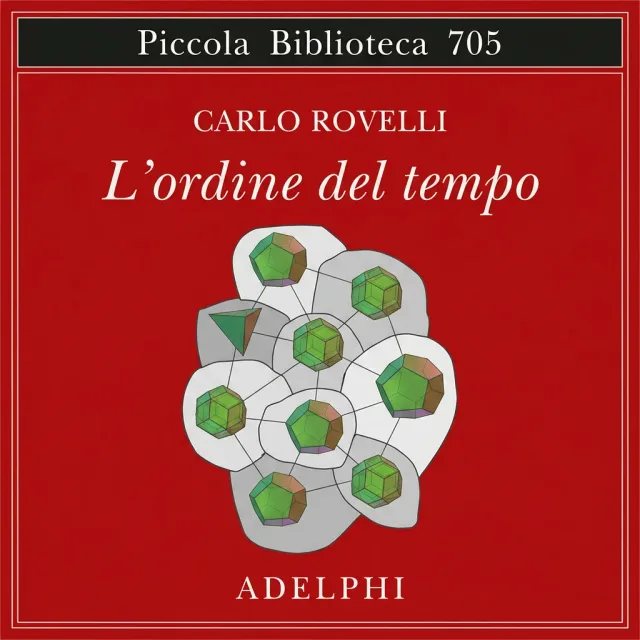
L'ordine del tempo (Adelphi, 2017)
Read more Close
The properties that fall away, chapter by chapter
Chapter Property lost Physical argument 1: The loss of uniqueness A single time valid everywhere General relativity: time depends on position in the gravitational field (it slows down near masses). 2: The loss of direction A preferred arrow, past → future Statistical thermodynamics: the direction of time emerges from the growth of entropy + blurring. It is not written into the fundamental laws. 3: The end of the present A universal, shared "now" Special relativity: simultaneity is relative to the frame of reference. For spatially separated events there is an "extended present", not a shared instant. 5: The loss of independence Time and space as a stage independent of things General relativity: time and space are the gravitational field, a physical substance that deforms with matter. 6: The quanta of time Continuity and objectivity of time Quantum mechanics + quantum gravity: time is granular (Planck scale), probabilistic, relational. The intuitions that get demolished
Each chapter takes on an intuition present in ordinary experience:
- "There is only one time, the same for everyone": demolished by Ch. 1.
- "Time always goes in the same direction": demolished by Ch. 2.
- "Now is one and the same everywhere in the universe": demolished by Ch. 3.
- "Time and space exist independently of things": demolished by Ch. 5.
- "Time flows continuously": demolished by Ch. 6.
The "onion" structure
Rovelli presents time as a set of layers. The outer layer (that of common experience) has the intuitive properties: uniformity, direction, simultaneity, independence, continuity. Physics removes them one by one, starting from the outside and moving toward deeper layers. What remains at the center is something different from everyday time.
Rovelli makes clear that he is not claiming that "time does not exist". He argues that it exists, but in a form different from the one intuition presents. Everyday time is a local approximation, valid in our corner of the universe at human scales, not a fundamental property of reality.
en.wikipedia.org
Back to the paragraph (2:58)
Why time flows differently in the mountains than on the plain
- 2
Gravitational time dilation
Experimentally verified effect: time runs faster at altitude, demonstrated with atomic clocks (Hafele-Keating 1971, NIST 2010)
Read more Close
The equivalence principle (Einstein, 1907)
Einstein formulates the equivalence principle in 1907, eight years before the complete publication of general relativity (1915). Publication: "Über das Relativitätsprinzip und die aus demselben gezogenen Folgerungen", Jahrbuch der Radioaktivität und Elektronik, 4, 411-462.
Statement: locally, mechanical experiments cannot distinguish the effect of a uniform gravitational field from the effect of an accelerated frame of reference. Inertial mass and gravitational mass coincide numerically, a coincidence that Einstein raises to a structural principle of the theory.
The thought experiment of the accelerating rocket
Einstein derives gravitational time dilation from a thought experiment:
- A rocket in deep space accelerates uniformly at
g = 9.81 m/s²(the gravitational acceleration at the Earth's surface). For an observer inside the rocket, the experience is indistinguishable from standing still on the Earth's surface. - From the floor, a beam of light sets off toward the ceiling.
- While the light travels, the rocket keeps accelerating. When the light reaches the ceiling, the ceiling is moving faster than when the light set off.
- For the observer at the ceiling, the light arrives at a lower frequency (relativistic Doppler effect).
- The conclusion, by analogy through the equivalence principle: in a gravitational field too, light that climbs loses frequency, and clocks lower down tick more slowly than those higher up.
Experimental test: Pound-Rebka (1959-1960)
Experiment by Robert V. Pound and Glen A. Rebka Jr. in Harvard's Jefferson tower, height 22.5 meters.
- Source: emitter of 14.4 keV gamma rays from iron-57 nuclei (Mössbauer effect)
- Detector: another iron-57 sample 22.5 m above or below
- Measured result: relative frequency shift Δf/f = (2.56 ± 0.25) × 10⁻¹⁵, in agreement with the prediction Δf/f = gh/c² to within about 10%
Publication: Pound, R. V. & Rebka, G. A. (1960). "Apparent Weight of Photons". Physical Review Letters, 4(7), 337-341.
It is the first test of gravitational time dilation in a laboratory on Earth.
Application: GPS
The Global Positioning System has been a continuous operational test of general relativity since 1995.
- Satellite altitude: ~20,200 km
- Orbital speed: ~14,000 km/h (two orbits a day)
- General effect (weaker gravity up high): +45 µs/day
- Special effect (orbital speed): −7 µs/day
- Net: GPS clocks in orbit run +38 µs/day faster than clocks on the ground
Without correction, the accumulated position error would be on the order of 10-11 km a day. The correction is built into the system: the clocks on board the satellites are set to a slower frequency before launch, so that they run at the "Earth" rate once in orbit.
en.wikipedia.org
Back to the paragraph (5:15) - A rocket in deep space accelerates uniformly at
How Einstein explained gravity without a force
- 3
Aristotle and Newton on time
Two opposing ideas of time and space before Einstein
Read more Close
Aristotle: time as the number of motion
Primary source: Aristotle, Physics (Φυσική), Book IV, chapters 10-14 (~350 BC).
Exact definition: time is "ἀριθμὸς κινήσεως κατὰ τὸ πρότερον καὶ ὕστερον", "the number of motion with respect to before and after" (Phys. IV 11, 219b1-2).
Implications for Aristotle:
- Time is not an autonomous entity: it is the measure of the change of things.
- Without change, no time.
- "I'll be back in three days" means "between my departure and my return the sun will go around the sky three times": "time" refers to the motion of a concrete thing.
The objection from sleep (Phys. IV, 11, 218b21-219a1)
Aristotle cites the case of the "sleepers in Sardinia", those who after a deep sleep join the "before" directly to the "after" without perceiving any change.
Aristotle's answer: even in sleep there is movement of the soul: heartbeat, dreams, unconscious processes. The time perceived in sleep measures this inner movement. If the inner motion stopped too, there would be no more time.
Space for Aristotle
Source: Physics IV, chs. 1-9.
Definition of place (τόπος): "the boundary of the containing body at which it is in contact with the contained" (Phys. IV 4, 212a20).
Consequences:
- Space is a relation, not a substance.
- The void does not exist as a coherent concept (chs. 6-9): Aristotle argues that in a perfect void a body would move at infinite speed, an absurd conclusion; hence the horror vacui.
Newton: absolute time and space
Primary source: Isaac Newton, Philosophiae Naturalis Principia Mathematica (1687), Scholium to the Definitions (right after Definition VIII).
Absolute time
"Tempus absolutum, verum et mathematicum, in se et natura sua absque relatione ad externum quodvis aequabiliter fluit."
Newton, Principia, Scholium
Translation: "Absolute, true and mathematical time, of itself and from its own nature, flows equably without relation to anything external."
Newton distinguishes:
- Absolute, true, mathematical time: it flows uniformly, independent of everything. Even if nothing changed, it would flow just the same. It is the time of physics.
- Relative, apparent, common time: measured with clocks, days, months. It is a practical approximation of the first.
Absolute time cannot be perceived directly: it can only be deduced through calculation, by correcting the irregularities of natural days (elliptical orbit, tilt of the Earth's axis).
Absolute space
"Spatium absolutum, natura sua absque relatione ad externum quodvis, semper manet similare et immobile."
Translation: "Absolute space, in its own nature, without relation to anything external, remains always similar and immovable."
Space is a container that exists even where there is no matter: the "stage" on which physics plays out.
Why the Newtonian picture held for two centuries
On the framework of absolute time and space Newton builds:
- The second law of motion: F = m·a, where t is absolute time.
- The law of universal gravitation.
- All of the classical physics of the eighteenth and nineteenth centuries.
Newton's equations describe with precision the motion of the planets, the fall of bodies, the tides. The absolute conception goes unchallenged until Mach (late nineteenth century) and then Einstein (1905-1915).
Leibniz's reply: relationalism
Source: the Leibniz-Clarke correspondence (1715-1716), mediated by Caroline, Princess of Wales.
Gottfried Wilhelm Leibniz (1646-1716): time is an "order of successions" between happenings; space is an "order of coexistences" between things. Neither time nor space is an autonomous entity: they exist only as relations.
Samuel Clarke (1675-1729), Newton's disciple and spokesman, defends absolutism. The Leibniz-Clarke debate breaks off with Leibniz's death in November 1716.
Torricelli's experiment (1643-1644)
Evangelista Torricelli (1608-1647), a pupil of Galileo, carries out the mercury barometer experiment in Florence in 1643 (it was physically performed by Vincenzo Viviani). The letter to Michelangelo Ricci documenting the experiment is dated 11 June 1644.
Result: above a column of mercury in a closed tube, a region without air forms. It is the first empirical evidence of a stable vacuum in the laboratory, and it is interpreted as support for Newtonian absolute space.
The quantum vacuum in modern physics
Twentieth-century physics shows that the "vacuum" is not empty of physical entities:
- It contains field fluctuations (zero-point energy of the electromagnetic field and of other fields).
- Virtual particle-antiparticle pairs that appear and disappear.
- Fields present everywhere, even where matter is absent.
Measured effects:
- Casimir effect: an attractive force between two parallel metal plates in a vacuum, predicted by Hendrik Casimir (1948) and measured experimentally by Steve Lamoreaux (1997).
- Lamb shift: a quantum correction to the spectral lines of hydrogen, measured by Willis Lamb (1947).
- Spontaneous emission: photons emitted by excited atoms without any external stimulus.
A vacuum free of every physical entity has never been observed. Newtonian absolute space remains a theoretical construction.
plato.stanford.edu
Back to the paragraph (5:58) - 4
Einstein's general relativity
Spacetime as a gravitational field that curves under masses
Read more Close
The synthesis
Einstein presents the field equations of general relativity to the Prussian Academy on 25 November 1915. What is new: time and space are real, as Newton postulated, but they are not an independent stage; they are made of the gravitational field, a concrete physical substance that deforms in the presence of matter and energy. The curvature of the field determines the local geometry of spacetime.
The concept of a field in physics
A field is a physical quantity that takes a value at every point in space and at every instant of time. Modern physics has several fundamental fields:
- Electromagnetic field (Maxwell, 1864): describes light and electric and magnetic forces.
- Dirac spinor fields (Dirac, 1928): describe the spin-1/2 particles of matter: electrons, quarks, neutrinos.
- Yang-Mills fields (Yang & Mills, 1954): describe the strong interaction (QCD, gluons) and the weak interaction (W and Z bosons).
- Gravitational field: spacetime itself, in Einstein's formulation.
The field equations (1915)
Einstein, "Die Feldgleichungen der Gravitation", Sitzungsberichte der Preussischen Akademie der Wissenschaften, presented 25 November 1915, published 2 December 1915. The equations of the gravitational field in compact form:
G_μν + Λ g_μν = (8π G / c⁴) T_μνwhere G_μν is the Einstein tensor (which describes the curvature of spacetime), Λ the cosmological constant, g_μν the metric, T_μν the stress-energy tensor (the source of the field), G the universal gravitational constant, c the speed of light.
Left-hand side: the geometry of spacetime (Einstein tensor, cosmological constant, metric). Right-hand side: the distribution of matter and energy (stress-energy tensor).
John Wheeler's paraphrase: "matter tells spacetime how to curve, spacetime tells matter how to move".
How the curvature shows up
The gravitational field can:
- Be approximately flat: spacetime with Euclidean geometry, uniform time; the Newtonian limit.
- Be curved by mass: near stars, planets, black holes. Time slows down where the field is more contracted.
- Oscillate: gravitational waves. Predicted by Einstein (1916), detected experimentally on 14 September 2015 (event GW150914, LIGO observatory).
Gravitational time dilation
In terms of the field: near a mass, the geometry of the field is more "contracted". Where the field is contracted, proper time runs more slowly for local observers.
Continuous operational test: GPS. Satellites orbiting at ~20,200 km record proper times that run faster by about +38 microseconds a day compared to clocks on the ground. The correction has been built into the system from the design stage.
The ontological consequence
The gravitational field is not the stage of physics: it is one of the actors, like the other fields (electromagnetic, Dirac, Yang-Mills). It overlaps with the others, interacts with them, deforms.
Rovelli, The Order of Time, Chapter 5:
"The world is a superposition of canvases and layers, of which the gravitational field is just one among the others. Like the others, it is neither absolute, nor uniform, nor fixed."
Carlo Rovelli, L'ordine del tempo (Adelphi, 2017)
What Einstein grants to whom
- To Newton: there is something beyond ordinary things, and that something is the gravitational field, a real physical substance.
- To Aristotle: time and space are ways of locating ourselves with respect to things; the "thing" with respect to which we locate ourselves can be the gravitational field itself, a dynamic and concrete entity.
Time and space turn out to be real but not absolute: one thing among things.
Einstein's remark on quantizing the gravitational field (1916)
The year after publishing general relativity, Einstein publishes "Näherungsweise Integration der Feldgleichungen der Gravitation" (Sitzungsberichte, June 1916), and notes that the classical theory of gravitation will have to be modified by quantum effects, by analogy with what had happened in electrodynamics.
A year after writing the equations of the gravitational field, Einstein recognizes that they are not the last word: the gravitational field, like the other physical fields, will have to have quantum properties. It is the research program later known as quantum gravity.
en.wikipedia.org
Back to the paragraph (7:41) - 5
Real-World Relativity: the GPS system
How the relativistic correction of satellites demonstrates time slowing down near masses
Read more Close
The equivalence principle (Einstein, 1907)
Einstein formulates the equivalence principle in 1907, eight years before the complete publication of general relativity (1915). Publication: "Über das Relativitätsprinzip und die aus demselben gezogenen Folgerungen", Jahrbuch der Radioaktivität und Elektronik, 4, 411-462.
Statement: locally, mechanical experiments cannot distinguish the effect of a uniform gravitational field from the effect of an accelerated frame of reference. Inertial mass and gravitational mass coincide numerically, a coincidence that Einstein raises to a structural principle of the theory.
The thought experiment of the accelerating rocket
Einstein derives gravitational time dilation from a thought experiment:
- A rocket in deep space accelerates uniformly at
g = 9.81 m/s²(the gravitational acceleration at the Earth's surface). For an observer inside the rocket, the experience is indistinguishable from standing still on the Earth's surface. - From the floor, a beam of light sets off toward the ceiling.
- While the light travels, the rocket keeps accelerating. When the light reaches the ceiling, the ceiling is moving faster than when the light set off.
- For the observer at the ceiling, the light arrives at a lower frequency (relativistic Doppler effect).
- The conclusion, by analogy through the equivalence principle: in a gravitational field too, light that climbs loses frequency, and clocks lower down tick more slowly than those higher up.
Experimental test: Pound-Rebka (1959-1960)
Experiment by Robert V. Pound and Glen A. Rebka Jr. in Harvard's Jefferson tower, height 22.5 meters.
- Source: emitter of 14.4 keV gamma rays from iron-57 nuclei (Mössbauer effect)
- Detector: another iron-57 sample 22.5 m above or below
- Measured result: relative frequency shift Δf/f = (2.56 ± 0.25) × 10⁻¹⁵, in agreement with the prediction Δf/f = gh/c² to within about 10%
Publication: Pound, R. V. & Rebka, G. A. (1960). "Apparent Weight of Photons". Physical Review Letters, 4(7), 337-341.
It is the first test of gravitational time dilation in a laboratory on Earth.
Application: GPS
The Global Positioning System has been a continuous operational test of general relativity since 1995.
- Satellite altitude: ~20,200 km
- Orbital speed: ~14,000 km/h (two orbits a day)
- General effect (weaker gravity up high): +45 µs/day
- Special effect (orbital speed): −7 µs/day
- Net: GPS clocks in orbit run +38 µs/day faster than clocks on the ground
Without correction, the accumulated position error would be on the order of 10-11 km a day. The correction is built into the system: the clocks on board the satellites are set to a slower frequency before launch, so that they run at the "Earth" rate once in orbit.
www.astronomy.ohio-state.edu
Back to the paragraph (7:41) - A rocket in deep space accelerates uniformly at
Anaximander and the fragment that gives the book its name
- 6
Anaximander of Miletus
The Greek philosopher who 26 centuries ago understood that the Earth floats in space. Rovelli devoted an entire book to him
Read more Close
Anaximander (c. 610-546 BC)
Greek philosopher from Miletus (Ionia, in today's Turkey), a member of the Milesian school founded by Thales. His dates of birth and death are historians' reconstructions; the ancient sources converge on this range.
Anaximander is the first figure in the Western tradition whose own writings survive (a single fragment, preserved indirectly through Simplicius in the sixth century AD). His other ideas are known through the testimony of Aristotle, Theophrastus and later doxographers.
Documented contributions:
- The concept of ἄπειρον (apeiron), "the boundless": the original principle of all things
- The first map of the known world attributed by ancient tradition
- The first cosmological theory with an Earth supported by nothing
- An embryonic theory of the origins of animal species (cited by Aetius)
The insight of the unsupported Earth
The dominant cosmology of the seventh and sixth centuries BC (Egyptian, Mesopotamian, Homeric) assumed a flat Earth supported by something: water, ocean, a mountain, a mythical animal, a giant.
Anaximander proposes a different model: the Earth is a squat cylinder (its height about a third of its diameter), suspended at the center of all things, with no support at all. The inhabited surface is the upper disc of the cylinder. The justification, reported by Aristotle in De Caelo (II, 13, 295b10), is geometric: being equidistant in every direction, there is no reason for it to fall in one direction rather than another.
The implicit consequence is that the sky continues beneath the Earth: after sunset the sun passes through a region below to reappear at dawn. A view that comes about 2,000 years before the experimental demonstration of the Earth's sphericity (the circumnavigations of the fifteenth and sixteenth centuries).
Rovelli's book (2011)
In Che cos'è la scienza. La rivoluzione di Anassimandro (Mondadori, 2011), Carlo Rovelli argues that Anaximander inaugurates the scientific method in the modern sense: forming rational hypotheses about the structure of the world, based on arguments that can be criticized and replaced, without resorting to mythical entities.
For Rovelli, "the intellectual movement that leads from Thales to Galileo and beyond begins with Anaximander": the first to replace a mythical explanation with a physical and geometric argument.
Einstein and thought experiments (Gedankenexperimente)
Albert Einstein is known for his systematic use of Gedankenexperimente (thought experiments) as a tool of theoretical research:
- Chasing a beam of light (Einstein, Autobiographical Notes, 1949): Einstein recounts that at 16 he imagined traveling at the speed of light and wondered what he would see. Reflecting on that paradox leads, more than a decade later, to special relativity (1905).
- The free-falling elevator: a person in a freely falling elevator cannot locally tell their own state apart from the absence of gravity. This is the basis of the equivalence principle between inertial mass and gravitational mass, the foundation of general relativity.
- The rotating disc: studying the geometry on a disc rotating at relativistic speeds, Einstein concludes that spacetime must be curved, anticipating the tensor formalism.
Einstein's aphorism "Imagination is more important than knowledge" appears in an interview in the Saturday Evening Post of 26 October 1929, and later in Cosmic Religion and Other Opinions and Aphorisms (1931).
The common thread Rovelli proposes
Rovelli presents the idea of "understanding before seeing" as a recurring pattern in the history of science: hypotheses formed through theory before measuring technology is able to confirm them directly.
Thinker Hypothesis Direct experimental confirmation Anaximander (6th c. BC) Earth suspended in space Circumnavigation (15th-16th c.): a gap of ~2,000 years Copernicus (1543) The Earth orbits the Sun Direct observation of the Earth's orbit from space (Apollo 8, 1968): a gap of ~425 years Einstein (1915) Gravitational time dilation Pound-Rebka (1960, 22.5 m, ~45 years); NIST (2010, 33 cm) iep.utm.edu
Back to the paragraph (8:55) - 7
Anaximander's fragment
The only surviving fragment, from which the book takes its title
Read more Close
Origin and transmission of the fragment
Anaximander (c. 610-546 BC) is the first figure in the Greek tradition for whom a prose text is documented. No direct manuscripts of that text exist: all textual knowledge of Anaximander comes through indirect quotations in later authors.
The main fragment is handed down by Simplicius of Cilicia (c. 490-560 AD), a Neoplatonist philosopher and commentator on Aristotle, in his In Aristotelis Physicorum Libros Commentaria (24, 13-25). The chain of transmission runs through Theophrastus (~371-287 BC), Aristotle's pupil, on whom Simplicius draws.
The fragment is cataloged as DK 12 B 1 in the canonical collection of the Presocratics: Hermann Diels, Die Fragmente der Vorsokratiker, first edition 1903, revised by Walther Kranz in 1952 (cited in abbreviated form as "Diels-Kranz" or "DK").
The Greek text
Extract from Simplicius, In Phys. 24, 13-25:
"…ἐξ ὧν δὲ ἡ γένεσίς ἐστι τοῖς οὖσι, καὶ τὴν φθορὰν εἰς ταῦτα γίνεσθαι κατὰ τὸ χρεών· διδόναι γὰρ αὐτὰ δίκην καὶ τίσιν ἀλλήλοις τῆς ἀδικίας κατὰ τὴν τοῦ χρόνου τάξιν…"
Philological problems
Three textual questions, open after more than two centuries of scholarly debate:
-
Where paraphrase ends and literal quotation begins. Simplicius's text is in oratio obliqua (indirect speech). Ancient Greek does not use quotation marks: it cannot be settled unambiguously where Simplicius's paraphrase ends and Anaximander's direct quotation begins. The portion that most scholars consider "certainly Anaximander's" is the closing formula κατὰ τὴν τοῦ χρόνου τάξιν ("according to the order of time").
-
Manuscript variant on ἀλλήλοις. The word ἀλλήλοις ("to each other / to one another") is present in the main manuscripts but missing from some minor ones. It matters philologically: its presence gives the fragment a tone of reciprocity (things render justice to one another).
-
Contested translation. The fragment is one of the most debated texts in Presocratic philosophy. There are dozens of modern translations with different shades of meaning. A historiographical survey of the translations: Dirk L. Couprie, "Two Centuries of Translating the Anaximander Fragment" (a review of the versions from 1802 to today).
Translations compared
Standard academic translation (English, Charles H. Kahn 1960):
"Whence things have their origin, there their destruction happens as it is ordained. For they give justice and reparation to one another for their injustice according to the ordering of time."
Carlo Rovelli's Italian translation (in L'ordine del tempo, 2017), in our English rendering:
"Things transform into one another according to necessity, and render justice to one another according to the order of time."
Rovelli's rendering is an interpretive translation: where the standard version keeps the "origin → destruction" structure (γένεσις → φθορά), Rovelli condenses it into "mutual transformation". The closing formula κατὰ τὴν τοῦ χρόνου τάξιν ("according to the order of time"), on the other hand, is rendered faithfully, and it is from this formula that Rovelli takes the title of the book.
Connection to Rovelli's book
The title L'ordine del tempo (Adelphi, 2017) comes directly from the closing formula of the fragment. Rovelli had earlier devoted a whole book to Anaximander: Che cos'è la scienza. La rivoluzione di Anassimandro (Mondadori Università, 2011), in which he argues that Anaximander inaugurates the scientific method in the modern sense.
iep.utm.edu
Back to the paragraph (9:10) -
Proper time: everyone has their own clock
- 8
Proper time (τ)
A fundamental concept of relativity: every observer has their own time, measured along their own world line
Read more Close
Formal definition
In relativity, proper time is the time measured by a clock that follows a timelike world line in spacetime. It is denoted by the Greek letter τ (tau) to distinguish it from the coordinate time t of an external frame of reference.
Standard definition:
"Proper time along a timelike world line is defined as the time as measured by a clock following that line."
Mathematically, τ is the line integral of the metric along the world line. In special relativity (Minkowski metric), for two events separated by intervals dt, dx, dy, dz:
dτ² = dt² − (dx² + dy² + dz²)/c²
The three fundamental properties
-
Personal. Every observer has their own proper time τ. There is no universal τ: there are τ_observer-A, τ_observer-B, τ_cesium-atom, τ_GPS-satellite-number-N.
-
Lorentz invariant. The value of τ between two events does not depend on the frame of reference used to describe it. It is a Lorentz scalar, a geometric property of the world line.
-
Path-dependent. If two observers start from the same event and meet again at another event, but have followed different paths through spacetime, their τ are different. This is the geometric basis of the twin paradox.
The two causes of divergence
Two proper times that start out equal diverge because of two physically distinct effects, which often overlap:
Kinematic effect (special relativity)
- Cause: relative motion between observers
- Formula: τ_moving = τ_at-rest / γ, where γ = 1/√(1−v²/c²) is the Lorentz factor
- Numerical example: at v = 0.5c, γ ≈ 1.155 → the moving clock accumulates about 13.4% less time than a clock at rest
Gravitational effect (general relativity)
- Cause: position in a gravitational field
- Formula (for spherically symmetric fields, exterior Schwarzschild metric): τ_near-mass = τ_far-from-mass × √(1 − 2GM/(rc²))
- Numerical example: on the Earth's surface, compared with an observer at infinity, the dilation is about 7×10⁻¹⁰ (~0.02 seconds less per year on the Earth's surface than "at infinity"). Close to the Schwarzschild radius of a black hole the ratio tends to zero (proper time frozen from the point of view of the distant observer).
SR vs GR asymmetry
- In special relativity, kinematic dilation is symmetric: from A's frame, B's clock slows down, and vice versa. The asymmetry of the twin paradox only appears when one of the two changes inertial frame (acceleration).
- In general relativity, gravitational dilation is asymmetric: whoever is lower down (stronger field) always has a slower proper time than whoever is higher up. Both observers agree on who is running slower.
Experiments measuring proper time
Proper times have been measured in many experiments:
- Pound-Rebka (1959-1960): gravitational redshift over 22.5 m in Harvard's Jefferson tower, accuracy ~10%
- Hafele-Keating (1971): cesium atomic clocks on intercontinental flights, differences of up to 273 ns
- NIST (Boulder, 2010): single aluminum-ion optical clocks with a height difference of 33 cm and speeds of 10 m/s
- GPS (operational since 1995): the satellites record proper times that differ by +38 µs/day from the ground; the correction is built into the system
In each case, the effect predicted by relativity was measured in agreement with the theory within experimental error.
A distinction: proper time vs subjective time
Proper time (a relativistic physical concept) is distinct from subjective time (a neuroscientific concept, time perception or chronoception):
Proper time (physics) Subjective time (neuroscience) What it measures Duration along a world line Mental perception of the passing of time Discipline General relativity Neuroscience, psychology Instrument Physical clock Conscious experience Determinants Speed + gravitational field Attention, emotion, age, activity Neurologically, the brain has no single organ devoted to perceiving time: the phenomenon is generated in a distributed way across the prefrontal cortex, cerebellum, basal ganglia and striatum (Wittmann, The Inner Sense of Time, 2014).
The distinction is explicit in the academic literature: Gruber, Wagner & Block, "Subjective Time Versus Proper (Clock) Time", in R. Buccheri et al. (eds.), Studies on the Structure of Time (Springer, 2000).
The role of proper time in Rovelli's book
In chapter 1 of The Order of Time, Rovelli writes:
"Einstein's equations have no single t, no single quantity of time… Physics does not describe how things evolve in time, but how things evolve in their own times, and how the times evolve relative to one another."
Carlo Rovelli, L'ordine del tempo (Adelphi, 2017)
The passage sums up the transition from the Newtonian conception of a single coordinate time (t) to the Einsteinian one based on a multiplicity of proper times (τ), one for each world line.
en.wikipedia.org
Back to the paragraph (10:38) -
When the equations of physics don't tell past from future
- 9
T-symmetry (time symmetry)
The elementary equations of physics do not distinguish past from future
Read more Close
Definition of T-invariance
A physical law is T-invariant (or "time-symmetric") if it remains true when
tis replaced by−tin the equations. In practice: if you film a physical phenomenon and play the film backward, the reversed film obeys the same laws as the film played forward.The T-invariant laws
Almost all the fundamental laws of classical and quantum physics are T-invariant:
- Newton's laws (F = m · a): T-invariant. A ball in free fall, filmed and played backward, rises upward while still obeying F = m · a (with the same parabolic trajectory traveled in the opposite direction).
- Maxwell's equations (classical electromagnetism): T-invariant (under a suitable transformation of the fields).
- Einstein's equations (general relativity): T-invariant.
- The Schrödinger equation (non-relativistic quantum mechanics): T-invariant (under complex conjugation).
At the level of the fundamental equations, past and future cannot be told apart.
The only macroscopic exception: the second law
The second law of thermodynamics (ΔS ≥ 0 in an isolated system) is the only law of fundamental physics that is asymmetric in time at the observable macroscopic level. It is the origin of the arrow of time we perceive.
The subnuclear asymmetry: CP violation
A very small time asymmetry exists in the weak interactions, discovered indirectly through CP violation (the combined Charge-Parity symmetry).
- 1964: James Cronin and Val Fitch discover CP violation in the decay of neutral kaons (K⁰_L mesons). Publication: Christenson, J. H., Cronin, J. W., Fitch, V. L., Turlay, R. (1964). "Evidence for the 2π Decay of the K⁰_2 Meson". Physical Review Letters, 13(4), 138-140. Nobel Prize in Physics 1980.
- CPT theorem (Pauli, Lüders, 1954-1957): local, Lorentz-invariant quantum field theory must be symmetric under the combination of the three transformations C (charge), P (parity), T (time). A violation of CP therefore implies a violation of T.
The T asymmetry derived from CP violation is quantitatively small (on the order of 10⁻³ in the kaon system) and is not relevant to the macroscopic arrow of time observed in thermodynamics.
An elementary example of T-invariance: uniform straight-line motion
A ball in deep space, subject only to F = m · a (zero force, zero acceleration), moves at constant velocity in a straight line. If you film the motion and project the film backward, the equation holds identically. Knowing the position and velocity at any one instant, you can calculate the position at any other instant, past or future, from the same equations.
The equations of classical mechanics describe geometric correlations between successive positions, not asymmetric causal relations. The direction "cause → effect" is assigned by the observer on the basis of the entropy gradient; it is not imposed by the equations.
en.wikipedia.org
Back to the paragraph (17:09) - 10
Bertrand Russell, "On the Notion of Cause" (1913)
Russell anticipates by a century Rovelli's argument that causality is an illusion
Read more Close
Bertrand Russell (1872-1970)
British philosopher, mathematician and logician. Co-author, with Alfred North Whitehead, of Principia Mathematica (1910-1913), a foundational treatise of mathematical logic. Nobel Prize in Literature in 1950 "in recognition of his varied and significant writings". Author of hundreds of essays and books on logic, philosophy, politics and ethics.
The 1913 essay
In 1913 Russell delivers his presidential address to the Aristotelian Society in London, titled "On the Notion of Cause". The text is published the same year: Russell, B. (1913). "On the Notion of Cause". Proceedings of the Aristotelian Society, 13, 1-26. Later collected in Mysticism and Logic and Other Essays (Longmans, Green & Co., 1917).
The best-known line
"The law of causality, I believe, like much that passes muster among philosophers, is a relic of a bygone age, surviving, like the monarchy, only because it is erroneously supposed to do no harm."
Bertrand Russell, On the Notion of Cause (1913)
This is Russell's original English wording.
Russell's argument
Russell observes that the laws of mathematical physics (he has Newton and Maxwell particularly in mind) describe functional correlations between quantities:
- F = m · a does not say "force causes acceleration" or "acceleration causes force"; it says that the two quantities are in constant proportion (given the mass).
- Maxwell's equations link electric and magnetic fields symmetrically; no "cause → effect" direction is privileged.
For Russell, the notion of cause is a pre-scientific convention that modern physics does not use in its calculations. Causality is a category of everyday language, not a structure of nature.
Rovelli takes it up
Rovelli, in Chapter 11 of The Order of Time, develops the argument in two steps:
-
Extended confirmation: more than a hundred years after Russell, the fundamental laws (general relativity 1915, quantum mechanics 1925-1928, quantum field theory) remain time-symmetric. Causality does not emerge from the laws.
-
Thermodynamic origin: Rovelli adds a thermodynamic explanation. The "cause → effect" direction emerges from the second law of thermodynamics. We call "cause" the lower-entropy event of a correlation, and "effect" the higher-entropy one. It is a statistical, perspectival property, not a fundamental category of nature.
The Rovelli + Russell position in short: causality is real as a macroscopic phenomenon, but it is not written into the laws of physics; it emerges from the thermodynamic configuration of the universe (Past Hypothesis + the growth of entropy).
en.wikipedia.org
Back to the paragraph (17:16)
Entropy: the heart of it all (and counting the cards)
- 11
Sadi Carnot
The first to understand steam engines, and the founder of thermodynamics (1824)
Read more Close
Biography (1796-1832)
Nicolas Léonard Sadi Carnot is born on 1 June 1796 in Paris. He dies of cholera on 24 August 1832, during the Paris epidemic, at the age of 36.
Father: Lazare Carnot (1753-1823), mathematician, general and politician of the French Revolution, nicknamed "the Organizer of Victory". Lazare names his son "Sadi" in honor of the Persian poet Saʿdī of Shiraz (1210-1291).
Education:
- École Polytechnique (1812-1814), Paris
- École du Génie (École d'Application de l'Artillerie et du Génie), Metz
- Officer in the Engineering Corps of the French army
Réflexions sur la puissance motrice du feu (1824)
At 28 Carnot publishes his only book in Paris: "Réflexions sur la puissance motrice du feu et sur les machines propres à développer cette puissance" (Bachelier, 1824). 118 pages.
The theoretical framework: the caloric theory
Carnot works within the caloric theory, the dominant paradigm of the time (before Joule's revolution in the 1840s and Boltzmann's molecular kinetics). According to this theory, heat is a weightless fluid (caloric) that flows from hot bodies to cold ones. The working analogy: a heat engine works like a water wheel, extracting work from the "fall" of caloric from a hot reservoir to a cold one.
Carnot's theorem
Within the caloric theory, Carnot proves a result that remains valid in modern thermodynamics too: the maximum efficiency of a reversible heat engine depends only on the temperatures of the hot reservoir and the cold reservoir, and is independent of the working substance.
For two reservoirs at absolute temperatures T_hot and T_cold, the ideal (maximum) efficiency is:
η = 1 − T_cold / T_hot
This is Carnot's theorem, one of the foundations of thermodynamics.
Death and the survival of his work
Carnot dies of cholera in August 1832. Because of the health regulations for the epidemic, most of his manuscripts and personal belongings are buried with him. A few notebooks survive thanks to the engineer Émile Clapeyron, who in 1834 publishes "Mémoire sur la puissance motrice de la chaleur", a reworking and popularization of Carnot's work.
The work remains marginal until the 1840s and 1850s, when it is rediscovered by William Thomson (Lord Kelvin) and Rudolf Clausius, who build it into the modern formulation of thermodynamics.
en.wikipedia.org
Back to the paragraph (19:19) - 12
Rudolf Clausius
He turned Carnot's insight into the Second Law of Thermodynamics
Read more Close
Biography (1822-1888)
Rudolf Julius Emanuel Clausius is born on 2 January 1822 in Köslin, Pomerania (today Koszalin, Poland). He dies on 24 August 1888 in Bonn, Germany.
Education and academic career:
- University of Berlin (doctorate at Halle, 1847)
- Successive chairs: Berlin, Zurich (Federal Polytechnic), Würzburg, Bonn (from 1869 until his death)
The formulation of the Second Law
Clausius reformulates Sadi Carnot's work, abandoning the caloric theory, on the basis of Joule's experimental work on the equivalence of heat and work.
Key publications:
- 1850: "Über die bewegende Kraft der Wärme und die Gesetze, welche sich daraus für die Wärmelehre selbst ableiten lassen". Annalen der Physik, 79, 368-397, 500-524. The first complete exposition of the mechanical theory of heat.
- 1854: "Über eine veränderte Form des zweiten Hauptsatzes der mechanischen Wärmetheorie". Annalen der Physik, 93. States the Second Law in a form that later became canonical.
Clausius's statement (1854):
"Wärme kann nie von selbst aus einem kälteren in einen wärmeren Körper übergehen."
Heat can never pass by itself from a colder body to a warmer body.
The term "entropy" (1865)
In his paper of 24 April 1865, "Über verschiedene für die Anwendung bequeme Formen der Hauptgleichungen der mechanischen Wärmetheorie" (Annalen der Physik, 125), Clausius introduces the term Entropie (entropy), derived from the ancient Greek τροπή (tropḗ), "transformation, conversion".
The reason for his choice of word (Clausius, 1865):
"I have chosen the word 'entropy' because it sounds like the word 'energy', since the two quantities are so closely connected in their physical significance that it seemed to me appropriate to give them similar names."
In the same paper, Clausius sums up the two laws of thermodynamics in two sentences:
"Die Energie der Welt ist konstant. Die Entropie der Welt strebt einem Maximum zu."
The energy of the universe is constant. The entropy of the universe tends toward a maximum.
Physical meaning and the arrow of time
Among the fundamental laws of classical physics (Newton, Maxwell) and modern physics (Schrödinger, Einstein), the Second Law of thermodynamics is the only one that intrinsically distinguishes the past from the future: the entropy of an isolated system never decreases (ΔS ≥ 0).
Carlo Rovelli identifies this as the only fundamental ingredient of the arrow of time in physics.
en.wikipedia.org
Back to the paragraph (19:19) - 13
Ludwig Boltzmann
The Austrian physicist who understood what entropy really is, in terms of microscopic configurations
Read more Close
Biography (1844-1906)
Ludwig Eduard Boltzmann is born on 20 February 1844 in Vienna, in the suburb of Erdberg. His father is an imperial tax official; his mother comes from Salzburg. He dies on 5 September 1906 in Duino (near Trieste, then part of the Austro-Hungarian Empire), by suicide.
Education and career:
- University of Vienna (doctorate 1866, supervised by Josef Stefan, the physicist of the Stefan-Boltzmann law of black-body radiation)
- Full professor of Mathematical Physics at the University of Graz at 25 (1869)
- Later academic career in Vienna, Munich, Leipzig, and Vienna again
Main scientific contributions
-
Boltzmann equation (1872): an integro-differential equation that describes how the velocity distribution function of a gas of interacting molecules evolves over time.
-
H-theorem (1872): under the assumption of the Stosszahlansatz ("molecular chaos hypothesis", the statistical independence of velocities before collisions), Boltzmann proves that a quantity H never increases. It was later identified with −S/k.
-
Maxwell-Boltzmann distribution: describes statistically the molecular velocities at a given temperature.
-
Statistical interpretation of entropy (1877): the entropy of a macrostate is proportional to the logarithm of the number of microstates compatible with it. The formula engraved on his tomb: S = k log W.
The anti-atomist opposition
For much of his career Boltzmann is in intellectual conflict with two dominant figures of scientific positivism:
- Ernst Mach (1838-1916), Austrian physicist and philosopher
- Wilhelm Ostwald (1853-1932), German chemist, Nobel Prize in Chemistry 1909
Both reject the physical reality of atoms on the positivist principle that science should deal only with what can be directly observed. Boltzmann defends the reality of atoms as an inferential hypothesis supported by the predictive successes of statistical mechanics.
Death and the posthumous confirmation of atomism
Boltzmann takes his own life on 5 September 1906, during a holiday in Duino, in a period of chronic depression. The causes have been attributed to multiple personal and professional factors; historians do not identify a single triggering event.
In the years immediately after his death, the existence of atoms is confirmed experimentally:
- 1905: Albert Einstein publishes his paper on Brownian motion (Annalen der Physik, 17), providing a statistical theoretical basis for verifying the existence of atoms
- 1908-1909: Jean Perrin carries out experiments on colloids (Annales de Chimie et de Physique, 1909) that experimentally confirm the Einstein-Boltzmann predictions
Ostwald and Mach later modify their positions. Perrin receives the Nobel Prize in Physics in 1926.
The tomb in Vienna
Boltzmann is buried in Vienna's Zentralfriedhof (Group 14C, no. 1), in one of the city's graves of honor. In the 1930s the tomb is adorned with a marble bust. Engraved at the top is the formula:
S = k · log W
en.wikipedia.org
Back to the paragraph (19:19) - 14
Boltzmann's formula S = k log W
The equation that links macroscopic entropy to the count of microscopic configurations, carved on Boltzmann's tomb
Read more Close
How the formula came about
The credit is shared:
- Boltzmann 1877: in the paper "Über die Beziehung zwischen dem zweiten Hauptsatze des mechanischen Wärmetheorie und der Wahrscheinlichkeitsrechnung" (Sitzungsberichte Akademie der Wissenschaften Wien, 76, 373-435), Boltzmann formalizes the idea that the entropy of a macrostate is proportional to the logarithm of the number of possible microstates. In his notation the constant of proportionality is R/N (R: the gas constant; N: Avogadro's number).
- Planck 1900-1901: in his work on black-body radiation, Max Planck rewrites the relation in the compact form
S = k log Wand introduces the symbolkas "Boltzmann's constant". Publication: Planck, M. (1901). "Über das Gesetz der Energieverteilung im Normalspektrum". Annalen der Physik, 4, 553-563.
What the terms mean
- S: entropy (in J/K), the same quantity defined by Clausius (1865)
- k: Boltzmann's constant, k = 1.380649 × 10⁻²³ J/K. Since 20 May 2019, following the redefinition of the International System of Units (SI), k is an exact constant by definition, like the speed of light.
- W: the number of distinct microstates compatible with the observed macrostate
- log: natural logarithm (base e). The logarithm is needed to make entropy additive: for two independent systems, the total entropy is the sum of the individual entropies, a condition equivalent to log(W₁·W₂) = log W₁ + log W₂.
A worked teaching example
Four molecules in four positions, two hot + two cold:
- Macrostate "hot on the left, cold on the right" → W = 1 → S = k · ln(1) = 0
- Macrostate "uniformly lukewarm" (hot and cold mixed) → W = 6 (combinations C(4,2)) → S = k · ln(6) ≈ 1.79 · k
In real systems (Avogadro numbers of particles), W is an astronomical number, and entropy grows by large amounts during mixing processes.
Boltzmann's tomb
The formula is engraved on Boltzmann's tomb in Vienna's Zentralfriedhof (Gruppe 14C, no. 1). The bust and the inscription were installed in the 1930s, decades after Boltzmann's death (1906).
en.wikipedia.org
Back to the paragraph (21:24)
How the Big Bang explains the arrow of time
- 15
Past Hypothesis
The mystery of the extremely low initial entropy of the Big Bang, one of the biggest open questions in cosmology
Read more Close
The problem
If the entropy of an isolated system never decreases, then going back in time the entropy of the universe was progressively lower. At the Big Bang (~13.8 billion years ago), entropy was orders of magnitude lower than today: a highly ordered, statistically improbable state.
The open question: why did the universe begin in such a special state?
The name "Past Hypothesis"
The term Past Hypothesis was introduced by the philosopher of physics David Z. Albert in the book Time and Chance (Harvard University Press, 2000), Chapter 4. Albert formalizes an idea already implicit in Boltzmann: to derive the growth of entropy in a cosmological system, the low initial entropy has to be postulated as a boundary condition independent of the dynamics.
Penrose's calculation
Roger Penrose (Nobel Prize in Physics 2020) estimates the probability of a universe with an initial entropy as low as the one actually observed. In the book The Emperor's New Mind (Oxford University Press, 1989), Chapter 7, Penrose obtains:
P ≈ 1 in 10^(10^123)
where 10^123 is the ratio between the maximum entropy of the observable universe (estimated through the Bekenstein-Hawking bounds for black holes) and the observed entropy. The double exponent comes from inverting the formula S = k log W.
For a sense of scale: 10^123 has 123 zeros in decimal notation; 10^(10^123) has 10^123 zeros, a number beyond any physically conceivable magnitude.
Three proposed explanations
-
Cosmic inflation (Guth, 1981). In the paper "Inflationary universe: A possible solution to the horizon and flatness problems" (Physical Review D, 23, January 1981), Alan Guth proposes a phase of exponential expansion of the universe in the very first ~10⁻³⁶ s after the Big Bang. The resulting dilution of entropy explains the observed homogeneity. Criticism: inflation itself needs finely tuned initial conditions to start, so it moves the problem without eliminating it.
-
Anthropic principle. Only universes with low initial entropy produce complex observers. The selection of observers is automatic: whoever can ask the question necessarily finds themselves in a "lucky" universe. Criticism: for many physicists this is a tautological explanation.
-
Rovelli's proposal (2019). In the paper "Where Was Past Low-Entropy?" (Entropy, 21(5), 466), Rovelli proposes that the low entropy of the past is a feature of the observed subsystem (the corner of the universe that contains us) and of the blurring perspective adopted, not an objective property of the universe as a whole. The direction of the entropy gradient would therefore depend on the observer.
Where the problem stands
None of the three proposals is accepted as definitive by the physics community. The Past Hypothesis remains an open problem at the intersection of cosmology, statistical physics and the philosophy of physics.
en.wikipedia.org
Back to the paragraph (23:30) -
- 16
Solar constant and cosmic thermodynamics
The energy balance between the Sun and the Earth as the engine of the rise in cosmic entropy
Read more Close
The numbers in the balance
Every second, at the edge of the Earth's atmosphere:
- Photons coming in from the Sun: on the order of 10³⁶ per second, high energy (short wavelength, peaking in the visible green).
- Photons going out from the Earth: on the order of 2 × 10³⁷ per second (about 20 times more), low energy (long wavelength, thermal infrared).
The total energy coming in equals the total energy going out (apart from long-term climate variations): the Earth is in radiative thermal equilibrium with space. The average surface temperature stays stable over millions of years.
The temperatures involved
- The Sun's photosphere: effective temperature ≈ 5,778 K (~5,500 °C).
- The Sun's core: ~15 million K (the region of nuclear fusion).
- Average surface temperature of the Earth: ~288 K (≈ 15 °C).
Wien's law
The photons emitted by a black body at temperature T have a wavelength distribution that peaks at:
λ_max · T = 2.898 × 10⁻³ m·K(Wilhelm Wien, 1893, Nobel Prize in Physics 1911.)
- Sun (~5,778 K): λ_max ≈ 500 nm → visible light (green-yellow), with a tail in the infrared and the ultraviolet.
- Earth (~288 K): λ_max ≈ 10 µm → thermal infrared.
The ratio of the temperatures (5,778 / 288 ≈ 20) means that an average solar photon carries about 20 times the energy of an average terrestrial photon. To give back the same energy it receives, the Earth emits about 20 times more photons.
Spectral distribution of the incoming solar energy
Solar radiation at the top of the atmosphere is split roughly as follows:
- Infrared (near and mid): ~50%
- Visible: ~43%
- Ultraviolet: ~7%
Indicative values; they vary with altitude and with the Sun's zenith angle.
What this means for entropy
Total energy (in) ≈ total energy (out). Number of outgoing photons ≈ 20 × number of incoming photons. From Boltzmann's formula S = k log W, it follows that the outgoing entropy is about 20 times the incoming entropy.
This "entropy jump" is the flow of low entropy that runs through the Earth system, and it is the thermodynamic source of every atmospheric, geological and biological process:
- Plants intercept high-energy (visible) photons → photosynthesis → they release energy in a more dispersed form (biomass, oxygen, heat).
- Animals consume biomass → cellular metabolism → release of heat.
- The ocean evaporates, the wind blows, rocks erode: all processes fed by the entropy gradient.
The Earth does not live on energy (the energy balance is zero). It lives on the low entropy that flows through the system.
en.wikipedia.org
Back to the paragraph (24:28)
"Entropy exists only for us, because of our blurring"
- 17
Second Law of Thermodynamics
The only law of physics that distinguishes past from future
Read more Close
The two laws of thermodynamics
Thermodynamics has two laws that behave in opposite ways with respect to the direction of time:
- First law (conservation of energy): the energy of an isolated system is neither created nor destroyed, only transformed. Standard form: ΔU = Q − W (change in internal energy = heat absorbed minus work done). The first law is symmetric in time: it holds identically if you reverse the time axis.
- Second law (growth of entropy): the entropy of an isolated system cannot decrease. Standard form: ΔS ≥ 0. The second law distinguishes past from future.
Among the fundamental laws of physics (Newton, Maxwell, Einstein, Schrödinger, Dirac), the second law of thermodynamics is the only one that is asymmetric in time.
The statistical definition of entropy
The entropy S of a system measures the number of microstates (microscopic configurations of the particles) compatible with a given macrostate (the macroscopic description of the system, e.g. "a liter of gas at 20 °C").
Boltzmann's formula
Ludwig Boltzmann (1844-1906) formalizes the statistical definition of entropy in his 1877 paper ("Über die Beziehung zwischen dem zweiten Hauptsatze des mechanischen Wärmetheorie und der Wahrscheinlichkeitsrechnung", Sitzungsberichte der Akademie der Wissenschaften Wien, 76, 373-435). The compact modern form is due to Max Planck (1900-1901):
S = k · ln W
where:
- S = entropy (in J/K)
- k = Boltzmann's constant ≈ 1.380649 × 10⁻²³ J/K (an exact constant by definition since the SI revision of 20 May 2019)
- W = the number of microstates compatible with the observed macrostate
- ln = natural logarithm (base e)
The logarithm is needed to make entropy additive across independent systems: S_total = S₁ + S₂ corresponds to ln(W₁ · W₂) = ln W₁ + ln W₂.
Physical meaning
- Low entropy: few microstates compatible with the macrostate, a system in a macroscopically "ordered" configuration (e.g. gas concentrated in a corner, heat localized in one place).
- High entropy: many compatible microstates, a system in a macroscopically "disordered" configuration (e.g. gas spread out evenly, heat distributed).
Spontaneous evolution goes from low-entropy macrostates (small W) toward high-entropy macrostates (large W), because there are many more microstates in the high-entropy macrostates. It is a statistical argument, not a causal one.
Boltzmann's tomb
The formula S = k log W is engraved on Boltzmann's tomb in Vienna's Zentralfriedhof (Gruppe 14C, no. 1). The marble bust with the inscription was installed in the 1930s, decades after Boltzmann's death (1906) and after his ashes were moved to Vienna's central cemetery.
The role of the second law in Rovelli's thesis
In Chapter 11 Rovelli argues that the whole "arrow of time" we experience emerges from the second law of thermodynamics combined with the low initial entropy of the universe (the Past Hypothesis). The fundamental laws of physics are symmetric in time; the arrow is a statistical, emergent property tied to the initial configuration of the universe.
en.wikipedia.org
Back to the paragraph (27:12) - 18
Coarse-grained modeling (blurring)
The most philosophically radical idea in the book: entropy exists only for whoever describes the world at a coarse grain
Read more Close
Definition
Coarse-graining (blurring) is the procedure of describing a physical system in terms of average macroscopic variables, ignoring the microscopic details. Typical "blurred" variables: temperature, pressure, density, total magnetization.
Microstates vs macrostates
- Microstate: the complete state of the system, specified by the position and momentum of every particle (in classical mechanics) or by the state vector (in quantum mechanics).
- Macrostate: an average description through a few thermodynamic variables (temperature, volume, pressure).
Many distinct microstates correspond to the same macrostate. The number of such microstates is written W (from the German Wahrscheinlichkeit, probability).
The link with Boltzmann's H-theorem
In his 1872 paper, Boltzmann derives the H-theorem by relying on the molecular chaos hypothesis (Stosszahlansatz): the velocities of two molecules before a collision are assumed to be statistically independent. This hypothesis is a blurring choice: you give up following the detailed microscopic correlations in order to treat collisions as average statistical processes.
The link with Shannon's information (1948)
In 1948 Claude Shannon introduces the concept of information entropy (A Mathematical Theory of Communication, Bell System Technical Journal). The formula:
H = −Σ p_i log p_i
has the same structure as the Boltzmann-Gibbs entropy of statistical mechanics. Both quantify the uncertainty, or ignorance, about the microscopic details given the observed macrostate.
Rovelli's position
In the paper "Where Was Past Low-Entropy?" (Entropy, 21(5), 466, 2019) and in the book L'ordine del tempo, Rovelli argues that coarse-graining is not an artifact of human description laid over an "objective" reality, but a constitutive feature of the relationship between observer and system. Without blurring there would be no distinction between microstates and macrostates, and so no concept of entropy at all.
en.wikipedia.org
Back to the paragraph (28:26) - 19
Erwin Schrödinger, What Is Life? (1944)
Life as a local "pocket" of order in a universe heading toward chaos
Read more Close
Schrödinger's question
In February 1943, Erwin Schrödinger gives a series of lectures at Trinity College Dublin. He publishes them in 1944 as "What Is Life? The Physical Aspect of the Living Cell" (Cambridge University Press, 90 pages).
The underlying question: how do living organisms avoid decaying toward thermodynamic equilibrium (= heat death), that is, how do they maintain ordered structures in a universe that evolves toward maximum entropy?
The answer: open systems
Schrödinger observes that living organisms are open systems: they exchange matter and energy with the environment. To keep their internal entropy low, they import organized energy (food, sunlight) and export entropy (dispersed heat, metabolic waste). The total balance (organism + environment) respects the Second Law: global entropy grows; the organism's local entropy is maintained.
Schrödinger uses the term "negative entropy" to describe the imported flow of order. The term is rhetorically effective but technically imprecise: Schrödinger himself, in notes added to later editions, admits that "free energy" would have been more correct. The physicist Léon Brillouin introduced the short form "negentropy" in 1953 (Science and Information Theory, Academic Press, 1956).
The next step: Prigogine and dissipative systems
Ilya Prigogine (1917-2003), a Belgian physical chemist of Russian origin, develops non-equilibrium thermodynamics. He introduces the concept of dissipative structures: macroscopically ordered systems that self-organize far from thermodynamic equilibrium through a continuous exchange of matter and energy.
Prigogine receives the Nobel Prize in Chemistry in 1977 "for his contributions to non-equilibrium thermodynamics, particularly the theory of dissipative structures".
Examples of dissipative systems
- Bénard cells: in a fluid heated from below, organized convection cells form out of a disordered state.
- Tornadoes: an organized structure maintained by the flow of atmospheric energy.
- The Belousov-Zhabotinsky reaction: periodic chemical oscillations.
- Living organisms: the body's structure is maintained by cellular metabolism.
How this fits the Second Law
Living organisms do not violate the Second Law of thermodynamics. They respect it: the entropy of organism + environment always grows. Locally, the organism is a "pocket" of low entropy actively maintained through metabolic work.
en.wikipedia.org
Back to the paragraph (28:26)
"We are time": Rovelli's real thesis
- 20
Summary of Rovelli's Part 1
The central thesis: time is not a property of the world, it is our way of describing it
Read more Close
The properties of time that are lost, chapter by chapter
Chapter Property lost Physical argument 1: The loss of uniqueness A single time for everything General relativity: time flows faster in the mountains than on the plain. 2: The loss of direction A preferred arrow, past → future Statistical thermodynamics: the arrow of time emerges from the growth of entropy and from macroscopic blurring. 4: The end of the present A universal "now" Special relativity: there is no shared "present" instant for spatially separated events; there is only an "extended present". 5: The loss of independence Time and space as an independent stage General relativity: time and space are the gravitational field, a physical substance that deforms with matter. 6: The loss of continuity and objectivity Continuity and definite values Quantum mechanics + quantum gravity: time is granular, in superposition, relational. The closing passage of Part 1
Rovelli, L'ordine del tempo, end of Part 1:
"Time is not unique. There is a different duration for every trajectory. It passes at different rhythms according to place and according to speed. It is not oriented. The difference between past and future is not there in the elementary equations of the world. The notion of the present does not work. In the vast universe there is nothing we can reasonably call the present. The substratum that determines the durations of time is not an independent entity. It is an aspect of a dynamic field. This field jumps, fluctuates, becomes concrete only by interacting, and is not defined below a minimum scale."
Carlo Rovelli, L'ordine del tempo (Adelphi, 2017)
What is left of time
"What is left of time? Better to throw the watch on your wrist into the sea and try to understand that the time it wants to capture is nothing but the movement of its hands. Let us enter the world without time."
Carlo Rovelli, L'ordine del tempo
With this transition Part 2 of the book begins, titled "The World Without Time", in which Rovelli rebuilds a different notion of time, based on a network of quantum interactions and on statistical correlations.
en.wikipedia.org
Back to the paragraph (29:58) - 21
Saint Augustine, Confessions Book XI
The first to notice that time exists in the mind: Rovelli's philosophical forerunner
Read more Close
Aurelius Augustine (354-430 AD)
Christian philosopher and theologian, born in Thagaste (today Souk Ahras, Algeria), son of Patricius (a pagan) and Monica (a Christian). Bishop of Hippo Regius (today Annaba, Algeria) from 395 until his death in 430 AD. A Father of the Latin Church, author of one of the largest philosophical and theological bodies of work of late antiquity.
Main works:
- Confessions (Confessiones, ~397-400 AD): 13 books of spiritual autobiography and philosophical reflection.
- The City of God (De Civitate Dei, 413-426 AD): 22 books on the philosophy of history and political theology.
- On the Trinity (De Trinitate, 399-419 AD): 15 books of Trinitarian theology.
The Confessions and Book XI
The Confessions have an asymmetrical structure: Books I-IX are autobiographical (from childhood to his conversion to Christianity and the death of his mother Monica in 387 AD); Books X-XIII are philosophical and theological. Book XI is devoted to analyzing the nature of time, prompted by the exegesis of Genesis 1:1 ("In the beginning God created the heaven and the earth").
The riddle of time
Augustine asks his famous question:
"Quid est ergo tempus? Si nemo a me quaerat, scio; si quaerenti explicare velim, nescio."
Augustine, Confessions XI, 14, 17
Translation: "What, then, is time? If no one asks me, I know. If I want to explain it to someone who asks, I do not know."
The problem of the three times
Augustine points out three paradoxes about the ontology of time:
- The past no longer exists (it is gone).
- The future does not exist yet (it has not come).
- The present is an instant with no duration: if it had duration, it could be divided into a past (already gone) and a future (not yet come).
And yet we measure durations, remember past events, foresee future ones. How is that possible?
The resolution: time as distensio animi
Augustine concludes (Book XI, chapters 27-30) that time is a distensio animi: an extension, a stretching of the soul. Time is not a property of the external world: it is a structure of the mind. Augustine sets it out like this:
- The "past" exists as memory (memoria) in the mind's present.
- The "future" exists as expectation (expectatio) in the mind's present.
- The "present" is current perception (contuitus).
"In te, anime meus, tempora metior."
Augustine, Confessions XI, 27, 36
Translation: "In you, my mind, I measure time."
The argument of the sung hymn
Augustine develops the argument through the example of singing a hymn (canticum). When you sing a hymn:
- The syllables already sung are in the past.
- The syllables not yet sung are in the future.
- Only the syllable being sung is in the present.
And yet the hymn is experienced as a coherent whole, because the mind holds on to the past syllables (memory) and anticipates the future ones (expectation). The temporal unity of the hymn is not in the world: it is in the mind's synthesis of memory + perception + expectation.
Influence
Augustine's analysis is one of the most influential texts in the philosophy of time. It was taken up and developed by:
- Edmund Husserl (Lectures on the Phenomenology of Internal Time-Consciousness, lectures 1904-1905, published 1928): retention and protention.
- Henri Bergson (Essai sur les données immédiates de la conscience, 1889): duration (durée) as lived time, distinct from measured time.
- Martin Heidegger (Sein und Zeit, 1927): the temporality of Dasein.
- Paul Ricœur (Temps et récit, 1983-1985): narrative and time.
Rovelli, L'ordine del tempo, Chapter 12: he cites Augustine as the philosophical forerunner of the thesis that lived time is a structure of the mind, not an objective property of the world.
en.wikipedia.org
Back to the paragraph (29:58) - 22
Edmund Husserl, the phenomenology of time
The modern developer of Augustine's analysis, with the retention/protention diagram
Read more Close
Edmund Husserl (1859-1938)
German philosopher of Moravian Jewish origin, born in Prossnitz (Moravia, then part of the Austro-Hungarian Empire, today Prostějov, Czech Republic). He first trained in mathematics with Karl Weierstrass in Berlin (doctorate 1883), then moved to philosophy with Franz Brentano in Vienna.
He held chairs in Göttingen (1901-1916), then in Freiburg (1916-1928). Famous students: Martin Heidegger, Edith Stein, Eugen Fink. He was excluded from the university under the racial laws of 1933.
His work on the consciousness of time: Vorlesungen zur Phänomenologie des inneren Zeitbewusstseins, lectures given in the winter semester of 1904-1905, edited by Heidegger and published in 1928 in the Jahrbuch für Philosophie und phänomenologische Forschung, vol. 9.
The structure of time-consciousness
Taking up and formalizing Augustine's analysis, Husserl proposes a structure of time-consciousness made of three components:
Primal impression (Urimpression)
The living now: the point of current perception where a new datum arrives (e.g. the note that is sounding right now).
Retention (Retention)
The note just heard does not vanish instantly from consciousness: it is held on to in a faded form. Husserl distinguishes:
- First-degree retention: the note just played, still "present" in a close-by way.
- Second-degree retention: the retention of the previous note, already more faded.
- And so on, in successive shadings, forming a retentional trail in the present.
Retention is not explicit recollection (memoria in Husserl's terminology), but a pre-reflective persistence in the lived present.
Protention (Protention)
The mind anticipates the next datum based on the structure of the perceptual flow: someone listening to a melody anticipates the next note. Protention is the pre-conscious expectation of the immediate future.
The diagram of time
Husserl proposes a diagram to visualize the synthetic structure of conscious time. Rovelli cites it explicitly in Chapter 12.
A E o-----------o ← Horizontal axis: objective time . . ← The retentions of earlier points . . . . fade gradually at moment E . . . . . . . . A'- The horizontal axis represents the objective flow of time.
- The diagonal lines represent the retentions of earlier points, which persist in the present as a fading trail.
- Moment E thus contains retained traces of all the recent instants, down to a vanishing point A'.
Husserl's thesis
For Husserl, conscious time is not the passive perception of a time already structured in the world: it is the structure of consciousness (impression + retention + protention) that constitutes time as a phenomenon.
"Phenomena constitute time." (a paraphrase of Husserl's thesis)
The time of consciousness does not lie on the horizontal axis of events in the world, but in the vertical synthesis (pre-reflective memory and anticipation) carried out by the mind.
Rovelli's use of it
Rovelli, L'ordine del tempo, Chapter 12: he cites Husserl as the modern developer of Augustine's analysis. For Rovelli, Husserl's phenomenology correctly describes the structure of subjective time, even in a naturalistic framework where "objective" time is not a single flow but a local network of interactions, because lived time is in any case organized by the neural traces generated by the growth of entropy.
en.wikipedia.org
Back to the paragraph (29:58) - 23
Immanuel Kant
Time as the "form of inner sense", a structure of the mind before it is a property of the world
Read more Close
Immanuel Kant (1724-1804)
German philosopher, the leading figure of the German Enlightenment and of transcendental idealism. He lived his whole life in Königsberg (East Prussia, today Kaliningrad, a Russian exclave).
Main works (the "three Critiques"):
- Critique of Pure Reason (1781; revised second edition 1787): the foundations of knowledge.
- Critique of Practical Reason (1788): the foundations of ethics.
- Critique of Judgment (1790): the foundations of aesthetics and teleology.
The Transcendental Aesthetic
In the first section of the Critique of Pure Reason (Transzendentale Ästhetik), Kant analyzes the foundations of sense perception. His thesis: space and time are not properties of "things in themselves" (Dinge an sich), but forms of our sensibility, necessary ways in which the mind orders its representations.
Space = the form of outer sense (äusserer Sinn)
Space is the way we order representations of external objects (sight, touch, hearing). Everything we perceive outside ourselves is organized in three dimensions, not because space is a property of things, but because it is the structure through which human sensibility reads whatever is presented to it.
Time = the form of inner sense (innerer Sinn)
Time is the way we order the inner states of consciousness: thoughts, emotions, sensations. Indirectly, time also structures the entire experienced world, because every representation (spatial ones included) passes through temporal consciousness.
The epistemological consequences
For Kant:
- Time and space are subjective in the sense that they are structures of the mind.
- They are objectively valid for all rational beings: universal and necessary, not arbitrary ("transcendental" in Kant's vocabulary).
- Things in themselves (reality as it is independently of the human cognitive apparatus) might be neither temporal nor spatial.
This position is called transcendental idealism: our knowledge of the world is always filtered through the a priori forms of sensibility (space, time) and the categories of the understanding (causality, substance, etc.).
Rovelli's distance from transcendental idealism
Rovelli, L'ordine del tempo, Chapter 12: he cites Kant within the tradition that grasped the subjective, structural dimension of time. But Rovelli distances himself from transcendental idealism in its strong sense.
For Rovelli:
- Thermodynamic time (the entropy that grows in the world) is real and independent of the subject.
- Time as a conscious "flow" is a construction of the mind (on this, Kant was right).
The two dimensions coexist: there is an objective thermodynamic structure of the world (the entropy gradient), and there is the mental construction of "flowing" based on memory and anticipation.
en.wikipedia.org
Back to the paragraph (29:58) - 24
William of Ockham, Heidegger, Reichenbach
Other thinkers in the tradition that sees time as a structure of the subject
Read more Close
William of Ockham (~1287-1347)
English philosopher, theologian and logician, a Franciscan friar. He studied at Oxford; his academic career was cut short by his disputes with the papal curia in Avignon (he defended evangelical poverty against John XXII). He spent his last years in Munich under the protection of Emperor Louis IV.
Known for Ockham's razor (attributed formulation: entia non sunt multiplicanda praeter necessitatem, "entities must not be multiplied beyond necessity"), a methodological principle of ontological parsimony.
In his works of natural philosophy (commentaries on Aristotle's Physics, Quaestiones in libros physicorum Aristotelis), Ockham discusses the nature of time. His position: time is a notion that emerges from the relationship between observer and world. Humans perceive time because they observe both external motions (the sun, the seasons) and their own inner states (thoughts, sensations). Time is neither a property of things nor a purely subjective state: it is a relational structure.
Martin Heidegger (1889-1976)
German philosopher, a student of Husserl in Freiburg. His fundamental work: Sein und Zeit (Being and Time), 1927.
In Sein und Zeit Heidegger develops the idea that time is structurally tied to the mode of being of the human being (Dasein, "being-there"). Time "temporalizes itself" (sich zeitigen) in the modes of care (Sorge): the way Dasein relates to the world through projects for the future, retention of the past, presence to the present.
For Heidegger time is the horizon of being for Dasein: not a neutral container in which things happen, but the structure through which being-there finds itself in the world.
Rovelli, L'ordine del tempo, Chapter 12: he cites Heidegger as part of the tradition that highlighted the structural (not merely perceived) nature of time in human experience, while finding Heidegger's language "deliberately obscure".
Hans Reichenbach (1891-1953)
German philosopher of science, a leading figure of logical empiricism (the Berlin Circle, founded in 1928). He studied in Stuttgart, Berlin, Munich and Göttingen (doctorate in philosophy in 1915 under Paul Hensel). An indirect disciple of the Vienna Circle.
He emigrated from Nazi Germany in 1933: first to Istanbul (1933-1938), then to the United States, where he taught at the University of California, Los Angeles (UCLA) from 1938 until his death in 1953.
Posthumous work: The Direction of Time (University of California Press, 1956), edited by his wife Maria Reichenbach. It is one of the most influential twentieth-century texts on the arrow of time.
Central thesis: the directionality of time (the past/future distinction) emerges from the second law of thermodynamics and from the statistical structure of macroscopic processes. Causality follows the same entropy gradient.
Reichenbach also suggests that many earlier philosophical traditions (Parmenides, Plato, Hegel) tried to deny the reality of time in response to the existential anguish that temporal finiteness produces.
The tradition of denying time
At the close of Chapter 13, Rovelli traces a brief genealogy of thinkers who tried to deny the reality of time:
- Parmenides of Elea (5th century BC): true being is unchanging; change is an illusion. Fragments collected in Diels-Kranz 28.
- Plato (5th-4th century BC): the world of Ideas is outside time, eternal; the sensible world is a changeable and ontologically inferior copy (Timaeus 37c-38c: time as the "moving image of eternity").
- G. W. F. Hegel (1770-1831): in dialectical development, Absolute Spirit transcends temporality and realizes itself as an eternal totality.
Rovelli, following Reichenbach, suggests that these philosophies arose partly as responses to the emotional unease we feel in the face of temporal finiteness. Modern physics allows a different approach: understanding time as an emergent phenomenon, real but not fundamental, with no need to deny it.
en.wikipedia.org
Back to the paragraph (29:58)
Why "now" means nothing: the trip to Proxima b
- 25
Proxima Centauri b
The planet 4.24 light-years away that Rovelli uses to show how inadequate "now" is
Read more Close
The speed of light as a limit
The speed of light in a vacuum is c = 299,792,458 m/s (~300,000 km/s). Since 1983 it has been an exact constant by definition in the International System of Units. It is the maximum propagation speed for any physical signal that carries information.
Causal structure: the light cone
For every event in the universe, all other events fall into three regions relative to its light cone:
- Past cone: events whose signals (light or matter) have had time to reach us. They may have influenced us.
- Future cone: events we can still reach with a signal of our own. We can still influence them.
- Elsewhere (the spacelike region, the extended present): events we can neither observe nor influence. Their light has not reached us yet; a signal of ours can no longer get there in time.
How long the "extended present" lasts
For two events separated by a spatial distance d, the mutual "Elsewhere" interval is ~2d/c (light there and back):
- Mars: average distance ~12 light-minutes → extended present ~12-15 minutes (ranging ~6-40 minutes depending on orbital position)
- Proxima Centauri b: 4.2426 light-years → extended present ~8 years
- The Andromeda galaxy: 2.537 million light-years → extended present ~5 million years
The relativity of simultaneity
For events with spacelike separation (interval s² = c²t² − x² − y² − z² < 0), there is no absolute time ordering: observers in relative motion agree that the events are not causally connected, but they may order them differently in time. There is always a reference frame in which the two events are simultaneous.
This is a direct consequence of the Lorentz transformation, and therefore of special relativity (Einstein, "Zur Elektrodynamik bewegter Körper", Annalen der Physik, 1905).
Experimental confirmations
- Solar eclipse of 29 May 1919: Arthur Eddington's expedition (Príncipe and Sobral) measures the deflection of light from stars near the Sun's disk during the total eclipse. GR prediction: 1.75″ at the limb. Measurements: 1.98″ ± 0.12″ (Sobral) and 1.61″ ± 0.30″ (Príncipe). Newtonian prediction: 0.87″. The measurements confirm general relativity.
- The Scott/Mark Kelly experiment (NASA, 2015-2016): Scott Kelly spends 340 days on the ISS; on his return he is about 5 milliseconds younger than his twin brother Mark, who stayed on the ground. The ISS orbits at ~27,600 km/h, at an altitude of ~400 km. Kinematic (SR) and gravitational (GR) effects combined: the velocity effect wins, and astronauts age ~14 ms less per year.
en.wikipedia.org
Back to the paragraph (32:03)
The bubble of the present: where your now ends
- 26
Light cones, gravitational waves, black holes
The causal structure of relativity that defines past, future and the "bubble of the present"
Read more Close
Light cones
The light cone of an event E is the geometric representation of E's causal relations with the rest of spacetime. There are three regions:
- The future cone of E: events that a signal leaving E, at or below the speed of light, can reach.
- The past cone of E: events from which a signal may have reached E.
- The elsewhere of E: events outside the two cones, not causally connected to E.
The edges of the cones are null geodesics (light rays). In a spacetime diagram with the time axis scaled by c, these edges are tilted at 45°.
The tilting of the cones in general relativity
Einstein presents the field equations of general relativity to the Prussian Academy on 25 November 1915. Mass-energy curves spacetime. Two immediate geometric consequences:
- Gravitational time dilation (clocks run slower near masses).
- Light cones tilt toward masses: the local causal structure changes in the presence of a gravitational field.
Gravitational waves
Gravitational waves are perturbations of the spacetime metric that propagate at the speed of light. Einstein predicted them in 1916 in "Näherungsweise Integration der Feldgleichungen der Gravitation" (Sitzungsberichte der Preussischen Akademie der Wissenschaften).
The first direct detection came on 14 September 2015 at the LIGO observatory (event GW150914, the merger of two black holes of ~36 and ~29 solar masses, about 1.3 billion light-years away). The public announcement came on 11 February 2016.
Rovelli uses the image of local light cones swaying "like ears of wheat in the wind": a gravitational wave passing through a region changes the local metric, tilting the light cones in a coordinated, oscillating way.
Black holes
A black hole is a region of spacetime where curvature is so intense that beyond a boundary (the event horizon) no signal can escape, not even light.
In Schwarzschild coordinates (a non-rotating black hole), at the horizon the radial coordinate r and the time coordinate t swap their causal roles:
- Outside: t is timelike (one-way), r is spacelike.
- Inside: r becomes timelike (one-way, decreasing toward 0), t becomes spacelike.
Inside the horizon, "moving toward the center" is as unavoidable as "moving toward tomorrow" is for us. All future world lines converge on the singularity.
Hamilton and Lisle's "river model"
Andrew J. S. Hamilton and Jason P. Lisle, in "The river model of black holes" (American Journal of Physics, 76(6), 519, 2008), propose an intuitive model: space "flows" toward the center like a river, at the speed of light at the horizon and faster than light inside. Objects locally obey special relativity with respect to this flow. It is a useful teaching reformulation, not the standard formulation of the Schwarzschild metric.
The observational asymmetry of falling into a black hole
From the point of view of an outside observer, an object falling into the black hole appears to:
- Slow down progressively in its own proper time (increasing gravitational redshift).
- At the horizon: time "seems" to stop (infinite gravitational redshift, with the brightness of the source tending to zero).
From the point of view of the falling object:
- It crosses the horizon in a finite proper time, with no local sign of the crossing (the horizon is a global property of the geometry, not a local barrier).
Kurt Gödel and closed timelike curves
Kurt Gödel (1906-1978), the Austrian logician, is a close friend of Einstein's at Princeton (Institute for Advanced Study). For Einstein's 70th birthday in 1949, Gödel publishes a solution of the field equations: the Gödel universe, rotating, with a negative cosmological constant.
Publication: Gödel, K. (1949). "An example of a new type of cosmological solution of Einstein's field equations of gravitation". Reviews of Modern Physics, 21(3), 447-450.
The solution contains closed timelike curves (CTCs): paths through spacetime that, while always heading toward the future, return to their starting point. In principle, time travel allowed by Einstein's equations.
The Gödel universe does not correspond to ours (there is no evidence of a global rotation of the universe of the kind required). It remains a formal example of the fact that the field equations admit solutions with pathological time structures.
en.wikipedia.org
Back to the paragraph (36:58) - 27
Presentism and Eternalism
The classic philosophical debate on the existence of time, and Rovelli's middle position
Read more Close
Presentism
Thesis: only the present is real. The past no longer exists (it is gone), the future does not exist yet (it is still to come).
Origin: a position traditionally associated with Saint Augustine (Confessions, Book XI) and other medieval thinkers. It reflects the common intuition that "only what exists now exists".
The physical objection: it is incompatible with special relativity, which showed that simultaneity is relative to the frame of reference. There is no "global present" valid for all observers. Without an "absolute now", presentism loses its operational reference point.
Eternalism (block universe)
Thesis: past, present and future are equally real. Reality is the entire history of the universe, describable as a four-dimensional block of spacetime that is already "complete".
Modern formulation: associated in particular with the Australian philosopher J. J. C. Smart (1949), "The River of Time", Mind, 58(232), 483-494. Considered by many commentators the most natural ontological reading of special relativity (Minkowski, 1908; Putnam, 1967).
Consequence: the "flow of time" is described as a perceptual phenomenon of the observer, not as a physical property of the world. Change, in the strong ontological sense, does not exist: there is only a four-dimensional geometric structure.
Rovelli's objection: eternalism denies a central fact of physical experience, namely that things happen. For Rovelli becoming is real, not illusory; the world is a network of correlated events, not a static block.
Rovelli's position (temporal relationalism)
Thesis: neither presentism nor eternalism. The temporal relations between events are real, but they do not form a single, globally ordered line. They are a local structure, organized as a network.
Key points:
- Change is real (against eternalism).
- There is no "global now" (against presentism).
- Temporal relations make up a partial order: well defined locally, impossible to synchronize globally.
The analogy Rovelli uses in Chapter 8: the universe is a great conversation with many parallel exchanges. Each exchange is real and has its own internal "before and after", but there is no global transcript that puts all the events on a single line.
en.wikipedia.org
Back to the paragraph (37:46)
The silent band: events that are neither past nor future
- 28
The partial order of time
The generations analogy: past and future are not linear but have a partial structure
Read more Close
The family of Leonidas (historical sources)
Leonidas I (c. 540-480 BC), king of Sparta, commander of the Spartans at Thermopylae (480 BC). His family is documented by Herodotus in the Histories, Book V (chapters 39-41) and Book VII (chapters 204-205, 239).
- Anaxandridas II (father of Leonidas and Cleomenes): king of Sparta. On the orders of the ephors he married two wives at the same time (documented as the only exception to Spartan monogamy), because the first was thought to be barren.
- Cleomenes I (king c. 519-490 BC): son of Anaxandridas's second wife. Half-brother of Leonidas (same father, different mother).
- Dorieus, Leonidas, Cleombrotus: sons of Anaxandridas's first wife.
- Gorgo: daughter of Cleomenes I, married Leonidas (her paternal uncle). She made possible the deciphering of Demaratus's wax tablet (Herodotus, VII, 239).
- Pleistarchus: son of Leonidas and Gorgo, succeeded Leonidas as king of Sparta.
The "same generation" problem
Two reasonable criteria for defining the relation "same generation":
- Same father → Cleomenes and Leonidas are in the same generation (both sons of Anaxandridas).
- Same child → Leonidas and Gorgo are in the same generation (both parents of Pleistarchus).
By the transitivity of a hypothetical total relation of "same generation":
- Leonidas = same generation as Cleomenes (criterion 1)
- Leonidas = same generation as Gorgo (criterion 2)
- Therefore: Cleomenes = same generation as Gorgo
But Cleomenes is Gorgo's father: father and daughter cannot belong to the same generation. Contradiction.
Conclusion: partial order
There is no linear numbering of generations (1, 2, 3, …) that works for every member of the family. The direct relations (parent-child, siblings, marriage) are well defined, but a global sequence of "generations" does not exist.
In mathematics, a structure of comparison in which some pairs are comparable and others are not is called a partial order (partially ordered set, "poset"). Examples: the relation "is an ancestor of" among the members of a lineage, the relation of inclusion among the subsets of a set.
Extension to the time of the universe
Rovelli uses the family of Leonidas as an analogy for the temporal structure predicted by special relativity:
- For pairs of causally connected events (timelike interval): there is an absolute "before/after" order.
- For pairs of spatially separated events (spacelike interval): there is no universal order; observers in relative motion can order them differently.
The time of the universe is therefore a partial order, not a total order like Newton's.
Rovelli's words
"Special relativity is the discovery that the temporal structure of the universe is like kinship. It defines an order among the events of the universe that is partial, not complete."
Carlo Rovelli, L'ordine del tempo
en.wikipedia.org
Back to the paragraph (40:22)
The world is made of events, not things: stones vs kisses
- 29
Process philosophy (events vs things)
The tradition that sees reality as process rather than substance
Read more Close
The distinction
Things (ontology of substances) Events (ontology of processes) They exist and last in time They happen and end They have a position in space They have a position in spacetime "Where is X?" is the right question "When did X happen?" is the right question Stone, mountain, planet Kiss, wave, storm, cloud Rovelli's thesis
Even the entities that look stable to us (a stone, a mountain) are in reality slow events. A stone is a system of quantum fields in temporary equilibrium, before it breaks apart. The difference between a "thing" and an "event" is a matter of characteristic duration, not of ontological nature.
Rovelli, The Order of Time, Chapter 7:
"The world is not made of things, it is made of events."
Carlo Rovelli, L'ordine del tempo (Adelphi, 2017)
Physics as a description of becoming
The fundamental equations of physics are equations of evolution:
- Newton's equations: how things move in time.
- Maxwell's equations: how electromagnetic fields evolve.
- The Schrödinger equation: how the wave function evolves.
- Einstein's equations: how spacetime deforms in response to matter.
There is no such thing as a "physics of static things". Physics always describes dynamics.
The philosophical tradition of process thought
Process ontology has well-established precedents:
- Heraclitus (c. 535-475 BC): "πάντα ῥεῖ", everything flows. The famous fragment about the river you cannot step into twice (reported by Plato, Cratylus 402a).
- Early Buddhism: anicca (impermanence). Everything that is compounded is impermanent. It is one of the three marks of existence (tilakkhana), together with dukkha (suffering) and anatta (non-self).
- Alfred North Whitehead (1929): Process and Reality. Macmillan. Reality is made of "occasions of experience" (actual occasions), not of substances.
- Carlo Rovelli (2017): L'ordine del tempo. Physical reality is a network of correlated events, not a collection of persistent things.
plato.stanford.edu
Back to the paragraph (42:13) - 30
Relational quantum mechanics (RQM)
Rovelli's own theory: properties exist only in the relations between systems
Read more Close
Rovelli's proposal (1996)
Rovelli, C. (1996). "Relational Quantum Mechanics". International Journal of Theoretical Physics, 35(8), 1637-1678. (Also arXiv:quant-ph/9609002.)
Thesis: quantum states are relative to the system that describes them. The physical properties of things exist only in the interactions between systems. There is no universal "true" wave function, valid independently of who is describing the system.
Differences from other interpretations
- Copenhagen interpretation (Bohr, Heisenberg, 1925-1930): measurement causes the "collapse" of the wave function. The collapse mechanism is postulated, not derived.
- Many-Worlds (Hugh Everett III, 1957, Reviews of Modern Physics, 29, 454): there is no collapse. The universe "branches" into parallel versions at every measurement.
- QBism (Fuchs, Mermin, Schack, 2010s): the wave function represents the agent's subjective beliefs; quantum states are personal and epistemic.
- RQM (Rovelli, 1996): there is no absolute collapse. Properties exist only in interactions. Different observers can attribute different states to the same system, all equally valid.
The relational principle
"The physical properties of things do not exist in an absolute way. They exist only in the relations between systems that interact."
Consequence: time emerges from a network of quantum interactions between systems; it is not an independent external parameter.
Experimental status
Rovelli's interpretation is consistent with all known experimental data (it is an interpretation, not a distinct empirical theory). Recent experiments on entanglement (extended Bell tests, "Wigner's friend" scenarios) are compatible with RQM, but do not single it out from the other interpretations.
Quantum decoherence
A concept related to RQM but independent of it: quantum decoherence explains why superpositions are not observed at macroscopic scales. Continuous interactions with the environment (thermal photons, air molecules, background radiation) produce entanglement with a large number of inaccessible degrees of freedom, reducing the density matrix to diagonal form in the preferred "classical" states.
History of the concept:
- H. Dieter Zeh (1970), "On the Interpretation of Measurement in Quantum Theory". Foundations of Physics, 1(1), 69-76. First formulation.
- Wojciech Zurek (1980s-1990s): development of decoherence as the mechanism of "quantum Darwinism".
Rovelli's popular books on the subject
Rovelli, C. (2020). Helgoland. Adelphi. A popular book devoted to RQM, with historical references to Heisenberg's work on Helgoland in 1925.
en.wikipedia.org
Back to the paragraph (42:35) - 31
Plato, Kepler and the mistake of "things"
Classical philosophy looked for permanent substances where there are only events
Read more Close
Plato and the Platonic solids (c. 360 BC)
In the dialogue Timaeus (c. 360 BC, 53c-55c), Plato associates each of the five regular polyhedra with an elementary substance:
- Tetrahedron (4 equilateral triangular faces) → fire
- Cube (6 square faces) → earth
- Octahedron (8 equilateral triangular faces) → air
- Icosahedron (20 equilateral triangular faces) → water
- Dodecahedron (12 pentagonal faces) → the structure of the whole cosmos (in the later tradition, the "ether" or "quintessence")
The five solids are the only convex regular polyhedra. The classification is proved by Euclid in the Elements, Book XIII (Propositions 13-18).
Plato's hypothesis is empirically wrong: atoms do not have the shape of the Platonic solids. It remains a historical example of the attempt to explain reality through the geometry of static forms.
Kepler and the Mysterium Cosmographicum (1596)
Johannes Kepler (1571-1630), aged 24-25, published his first book in 1596: Mysterium Cosmographicum (Tübingen).
The book's thesis: the radii of the orbits of the six planets then known (Mercury, Venus, Earth, Mars, Jupiter, Saturn) are determined by the five regular polyhedra nested one inside the other, separated by spheres whose radii are proportional to the semi-axes of the orbits.
The model is aesthetically consistent with the Platonic tradition. Empirically it does not work: the real orbits do not fit the model within the accuracy of Tycho Brahe's data.
Kepler's three laws (1609, 1619)
Kepler reached his lasting results by abandoning the approach of static forms and analyzing how the planets move, on the basis of Tycho Brahe's observational data (c. 1576-1601):
- First law (Kepler, 1609, Astronomia Nova): the orbits of the planets are ellipses, with the Sun at one of the two foci.
- Second law (Kepler, 1609, Astronomia Nova): the law of areas. The line joining the Sun and a planet sweeps out equal areas in equal times, so the planet moves faster when it is closer to the Sun.
- Third law (Kepler, 1619, Harmonices Mundi): T² ∝ a³, where T is the orbital period and a the semi-major axis.
The three laws describe motions (events), not forms (things). They are the empirical basis of celestial mechanics and, later, of Newton's universal gravitation.
The Schrödinger equation and atomic orbitals
Erwin Schrödinger published the equation that bears his name in 1926: Schrödinger, E. (1926). "Quantisierung als Eigenwertproblem". Annalen der Physik, 79, 361-376; 384, 489-527.
Atomic orbitals (the probability distributions of electrons around the nucleus, labeled s, p, d, f) are not shapes given a priori: they are solutions of the Schrödinger equation for the Coulomb potential. The geometric shapes emerge as eigenfunctions of an equation of evolution, not as ontological postulates.
The shapes Plato was looking for in the regular solids do turn up, but as solutions of an equation of motion of quantum fields, not as given forms.
plato.stanford.edu
Back to the paragraph (42:35) - 32
Quantum gravity
Rovelli's field: the theory that unites general relativity and quantum mechanics
Read more Close
The structural problem
Twentieth-century physics produced two fundamental theories:
- General relativity (Einstein, 1915): describes gravity through the curvature of spacetime. Confirmed for astrophysical and cosmological phenomena (planetary orbits, gravitational lensing, redshift, gravitational waves, GPS).
- Quantum mechanics (Heisenberg, Schrödinger, Dirac et al., 1925-1928): describes the behavior of elementary particles. Confirmed for atomic and subatomic phenomena (spectra, transitions, quantum electrodynamics, the Standard Model).
The two theories are incompatible when one tries to treat the gravitational field with the methods of quantum field theory: the Feynman integral for gravity diverges, and the theory is non-renormalizable in the conventional sense.
The situations where both are needed
Most observable phenomena fall within the domain of just one of the two theories. There are, however, regimes in which the two frameworks have to coexist:
- The central singularities of black holes: mass concentrated at extremely small scales.
- The Big Bang: the entire mass-energy of the observable universe concentrated in volumes close to the Planck scale.
- The structure of spacetime at the Planck scale (~10⁻³⁵ m, ~10⁻⁴⁴ s).
In these regimes the predictions of the two theories diverge or lose meaning.
The two main candidate approaches
-
String theory. It postulates that elementary particles are vibration modes of extended "strings". It requires 10 spacetime dimensions (with the extra dimensions compactified). Historically dominant in American theoretical physics departments. No direct experimental confirmation.
-
Loop quantum gravity (LQG). It postulates that spacetime itself is discrete at the Planck scale, made of "loops" and nodes that form a spin network. Developed by Abhay Ashtekar, Lee Smolin and Carlo Rovelli from the late 1980s. Rovelli works at the Centre de Physique Théorique of Aix-Marseille Université in Marseille.
To date neither approach has decisive experimental confirmation.
Rovelli's books on the subject
Rovelli, C. (2004). Quantum Gravity. Cambridge University Press. The standard technical text on LQG.
Rovelli, C. (2014). La realtà non è come ci appare. Raffaello Cortina. A popular account of loop quantum gravity (in English: Reality Is Not What It Seems).
en.wikipedia.org
Back to the paragraph (42:35) - 33
Granularity and Planck time
At microscopic scales time is not continuous but discrete: the minimum duration is the Planck time
Read more Close
The Planck time
The Planck time is the smallest time scale that can be derived from the three fundamental constants:
t_P = √(ℏ G / c⁵) ≈ 5.39 × 10⁻⁴⁴ swhere ℏ is the reduced Planck constant, G is the universal gravitational constant and c is the speed of light. Below this scale, the equations of general relativity and of quantum mechanics both enter a non-classical regime at the same time, and the very concept of "continuous time" loses operational meaning.
The Planck length
Similarly, the Planck length:
ℓ_P = √(ℏ G / c³) ≈ 1.62 × 10⁻³⁵ mBelow this scale, the concept of length or distance also loses operational meaning in the known theoretical frameworks.
Comparing scales
- In 1 second: about 10⁴⁴ Planck times.
- Age of the universe: ~13.8 billion years ≈ 4.4 × 10¹⁷ s.
- The ratio second/Planck time (~10⁴⁴) is larger than the ratio age of the universe/second (~10¹⁷).
Discreteness in nature: precedents
The idea that apparently continuous physical quantities are actually discrete has well-established precedents in twentieth-century physics:
- Light: discrete photons (photoelectric effect, Einstein 1905; Nobel Prize 1921).
- The energy of atoms: discrete quantized levels (Bohr model, 1913; atomic spectra).
- Electric charge: a whole multiple of the elementary charge (Millikan, 1909-1913, oil-drop experiment; Nobel Prize 1923).
- Matter: discrete atoms (Boltzmann, molecular statistics; Einstein 1905 on Brownian motion; Perrin 1908-1913, Nobel 1926).
In loop quantum gravity, space and time are also postulated to be discrete: made of loops and nodes of a spin network at the Planck scale.
Pre-modern philosophers of discrete time
Rovelli notes that the idea of discrete time was anticipated in medieval philosophy:
- Isidore of Seville (c. 560-636 AD), in the Etymologiae, argues that time is made of minimal indivisible units.
- The Venerable Bede (c. 672-735 AD), in De divisionibus temporum, discusses the subdivision of time.
- Maimonides (c. 1138-1204 AD), in the Guide for the Perplexed (Part I, ch. 73), writes: "Time is composed of atoms, that is, of many parts that cannot be divided further because of their short duration."
The roots probably go back to classical Greek atomism (Leucippus, Democritus, 5th-4th century BC), of which only indirect fragments survive.
en.wikipedia.org
Back to the paragraph (42:35)
Why these discoveries change everything (like Copernicus)
- 34
Pliny the Elder and the inadequacy of grammar
Like Copernicus, radical discoveries force us to rewrite our language
Read more Close
The linguistic problem
Modern Indo-European languages (Italian, English, French, German, etc.) conjugate verbs according to three main tenses (past, present, future), with aspectual and modal variants. This grammatical structure implicitly assumes a "present" shared by all speakers: an instant that separates "what has already happened" from "what will happen".
Special relativity (Einstein, 1905) showed that simultaneity is relative to the frame of reference. There is no "now" valid for all observers. The grammar of European languages is therefore a local approximation, not a universal structure of reality.
The classical text on the spherical Earth
Rovelli quotes an ancient text that illustrates the attempt to express the local nature of the directions "up" and "down" on the Earth's surface. The passage appears in Pliny the Elder's Naturalis Historia (Book II, c. 77 AD) and in other ancient and late-antique sources that discuss the sphericity of the Earth (Aristotle, De Caelo II 14; Ptolemy, Almagest I).
The sense of the passage: for those who live at the antipodes from us, "up" points in the opposite direction to ours. The categories "up" and "down" are directions local to the point of observation, not absolute in space.
The parallel with time
Rovelli develops the analogy:
- Before the 16th century: most European speakers had not internalized the sphericity of the Earth. The categories "up/down" were used as if they were absolute. The discovery of the spherical Earth (Eratosthenes had already measured its radius in the 3rd century BC, but the notion spread into common culture through the circumnavigation of Magellan and Elcano, 1519-1522) required reinterpreting them as local.
- Today: after relativity, the categories "past/future" are still used in everyday language as if they were absolute. Physics has shown that they are local. Language has not yet adapted.
Macbeth and the witches
At the opening of Shakespeare's Macbeth (1606), Act I Scene I, the three witches chant in chorus:
"Fair is foul, and foul is fair: / Hover through the fog and filthy air."
William Shakespeare, Macbeth, Act I Scene I
In plain terms: what looks beautiful is ugly and what looks ugly is beautiful, as the witches hover in the fog and the dirty air.
Rovelli quotes the line as a literary image of an apparently paradoxical formulation that expresses a truth ordinary language cannot represent.
www.perseus.tufts.edu
Back to the paragraph (44:01)
Who are we? Identity mirrored in others
- 35
Milinda Pañha
Nagasena's chariot dialogue: the self is not a substance but a name for an assemblage of parts
Read more Close
The text
The Milinda Pañha (Pali for "The Questions of Milinda") is one of the most important texts of the non-canonical Buddhist literature of the Theravada tradition. Composed in Pali, roughly dated to the 2nd-1st century BC (some scholars date the later layers of the text as late as the 2nd century AD).
The work is structured in seven books of dialogues between King Milinda and the monk Nagasena.
The characters
Menander I Soter (reigned c. 165-130 BC) was an Indo-Greek king of the Greco-Bactrian kingdom, ruling a territory around today's northern Pakistan and Afghanistan, a legacy of the conquests of Alexander the Great (327-325 BC) and his successors. The coins of his reign, with inscriptions in Greek and in Kharosthi script, are widely attested archaeologically.
Nagasena is the Buddhist monk who is his interlocutor. Ancient sources on him as a historical figure are scarce; some scholars (Tarn 1938) regard him as partly or entirely a literary character.
The chariot dialogue (Book II)
Rovelli quotes this dialogue explicitly in Chapter 12 of The Order of Time. Its essential structure:
- The king asks the monk to introduce himself.
- Nagasena replies that "Nagasena" is only a conventional name; there is no substantial subject corresponding to it.
- The king tries to locate the "real" Nagasena in the parts of the body: hair, bones, organs, sensations, thoughts.
- Nagasena agrees that he is not to be found in any of the parts, nor in the whole.
- Nagasena turns the question around: what is a chariot? Is it the wheels, the pole, the axle, the seat? None of these parts is "the chariot".
- The king admits that "chariot" is the conventional name given to the functional whole of the parts.
- Nagasena concludes: "Nagasena" is likewise the name of an aggregate of parts and processes (body, sensations, perceptions, mental formations, consciousness).
The doctrine of anatta (non-self)
The dialogue illustrates the Buddhist doctrine of anatta (in Pali) or anātman (in Sanskrit), non-self: there is no substantial "I" essence behind the components of experience. The "I" is a conventional label for an aggregate of the five skandhas (in Pali khandha):
- Rupa (material form)
- Vedanā (sensation)
- Saññā (perception)
- Saṅkhāra (mental formations)
- Viññāṇa (consciousness)
Anatta is one of the three marks of existence (tilakkhana) in Buddhism, together with anicca (impermanence) and dukkha (suffering).
How Rovelli uses it
Rovelli uses the dialogue to illustrate the convergence between ancient Buddhist doctrine and the perspective of modern physics: identity is not a permanent substance but a configuration of processes in continuous becoming.
en.wikipedia.org
Back to the paragraph (49:55) - 36
Marcel Proust, À la recherche du temps perdu
Reality takes shape in memory: a literary illustration of Rovelli's thesis
Read more Close
Marcel Proust (1871-1922)
French writer, considered one of the most important of the twentieth century. Born in Paris to a well-off family: his father, Adrien Proust, was a physician specializing in public hygiene; his mother, Jeanne Weil, came from an Alsatian Jewish family.
He suffered from asthma and other chronic illnesses from childhood. In the last 10 years of his life he withdrew to an apartment at 102 Boulevard Haussmann (later 44 rue Hamelin), in a cork-lined room to muffle the noise, writing À la recherche du temps perdu mostly at night. He died on 18 November 1922, leaving the last three volumes of the novel still under revision.
À la recherche du temps perdu
"In Search of Lost Time", a novel in seven volumes, published between 1913 and 1927. Total length: about 3,200 pages (the Pléiade edition runs to 4 volumes and 4,300 pages including the critical apparatus).
Publication timeline:
- Du côté de chez Swann: 1913 (Grasset, later Gallimard).
- À l'ombre des jeunes filles en fleurs: 1919 (Gallimard). Prix Goncourt 1919.
- Le Côté de Guermantes: 1920-1921 (Gallimard).
- Sodome et Gomorrhe: 1921-1922 (Gallimard).
- La Prisonnière: 1923 (posthumous, Gallimard).
- Albertine disparue (originally La Fugitive): 1925 (posthumous, Gallimard).
- Le Temps retrouvé: 1927 (posthumous, Gallimard).
The last word of the novel is Temps ("Time").
The narrator
The narrator of the Recherche speaks in the first person and is unnamed for most of the novel. Only in two passages of volume V (La Prisonnière) is he called "Marcel", hence the critical convention of calling him that. The narrator is not Proust the author: the Recherche is not an autobiography in the strict sense, even though many elements are drawn from his life.
The madeleine scene
In the first few dozen pages of Du côté de chez Swann (volume 1, "Combray"). The adult narrator, back home one winter evening, is given a cup of tea by his mother with small shell-shaped cakes, madeleines. He dips the madeleine in the tea and tastes it.
An intense feeling of happiness overwhelms him with no apparent explanation. He tries to analyze where it comes from. After several attempts he recognizes it: the taste of the madeleine soaked in tea brings back to his consciousness the childhood mornings in Combray, when his aunt Léonie used to offer him the same thing.
From this sensory trigger whole regions of memory open up: the aunt, the house, the garden at Combray, the people, the habits, a world the narrator thought was lost.
Involuntary memory (mémoire involontaire)
Proust distinguishes two kinds of memory:
- Voluntary memory (mémoire volontaire): deliberate recollection, consciously reconstructed. For Proust it is poor and schematic.
- Involuntary memory (mémoire involontaire): the memory that rises spontaneously from a sensory stimulus (a taste, a smell, a sound, a touch). For Proust it is authentic and rich, and gives back the past in its original density.
The Recherche is built around a series of experiences of involuntary memory (the madeleine; the uneven paving stones in the Guermantes courtyard; the sound of a spoon; the starched napkin): each one opens access to a period of the narrator's life.
The most quoted line
"La réalité ne se forme que dans la mémoire."
Marcel Proust, Du côté de chez Swann (1913)
Translation: "Reality takes shape in memory alone."
Lived reality is not the pure present as perceived, but the present filtered and reconstructed through memory. Lost time is not lost: it is preserved in hidden traces, and can be found again only through the specific experience of involuntary memory.
How Rovelli uses it
Rovelli, The Order of Time, Chapter 12: he uses Proust as a literary illustration of the thesis that personal identity and lived time are structured by memory. Neural traces are the physical substrate of Proustian memory; involuntary memory shows how whole states of consciousness are contained in a few traces; a novel of 3,200 pages can unfold almost entirely inside one mind.
en.wikipedia.org
Back to the paragraph (49:55)
"Finiteness is the gift": Bach, kisses and life as a note
- 37
Einstein's letter on the death of Michele Besso (1955)
"For us physicists the distinction between past, present and future is only an illusion, however persistent"
Read more Close
Michele Besso (1873-1955)
Michele Angelo Besso (1873-1955) was an Italian-Swiss engineer and Einstein's closest friend. The two had met at the Swiss Federal Polytechnic in Zurich (ETH) during their student years.
Einstein called him "the best sounding board in Europe". Besso was important to Einstein in working out special relativity: the 1905 paper on the electrodynamics of moving bodies (Annalen der Physik, 17, 891-921) closes with an explicit acknowledgment of him.
The Einstein-Besso correspondence comprises 229 letters from 1903 to 1955, published in Albert Einstein–Michele Besso. Correspondance 1903-1955 (Hermann, Paris, 1972).
Besso's death and the letter
Michele Besso died on 15 March 1955 in Geneva, aged 81.
Einstein, then 76 and in poor health (an aortic aneurysm had already been diagnosed), heard the news and on 21 March 1955 wrote a letter of condolence to Besso's sister and son. The letter contains Einstein's most quoted line about time:
"Für uns gläubige Physiker hat die Scheidung zwischen Vergangenheit, Gegenwart und Zukunft nur die Bedeutung einer wenn auch hartnäckigen Illusion."
Albert Einstein, letter of 21 March 1955 to the Besso family
Translation: "For us believing physicists, the distinction between past, present and future has only the meaning of an illusion, albeit a stubborn one."
The context of the line
The sentence immediately before it in the same letter is:
"Now he has departed from this strange world a little ahead of me."
Albert Einstein, letter of 21 March 1955
In other words: "Now he has left this strange world a little before me."
Einstein is writing to a sister who has just lost her brother, knowing that he himself is close to death. It is not a scientific essay on the nature of time: it is a letter of condolence between two families bound by decades of friendship.
Rovelli's reading
Rovelli, in Chapter 9 of The Order of Time, argues that the line should not be taken as a philosophical statement in favor of eternalism. The "stubborn, persistent illusion" Einstein refers to, in context, concerns not only the time of physics but also separation, loss, the finiteness of human life. It is a formula of consolation, not an ontological argument.
Einstein's death
Einstein died on 18 April 1955 at Princeton Hospital, about five weeks after Besso. Cause: the rupture of an abdominal aortic aneurysm he had refused to have operated on. He was 76.
en.wikipedia.org
Back to the paragraph (52:42) - 38
Bach, Ecclesiastes, the book's ending
The synthesis: finiteness is the gift. A life is a note in a symphony that begins and ends
Read more Close
The structure of the book
Part 1 (chs. 1-6): "The crumbling of time"
Chapter by chapter, Rovelli shows how the intuitive picture of time (uniform, universal, flowing from past to future, independent of things, continuous) is transformed under the analysis of physics:
- Ch. 1: uniqueness (time is not uniform: gravity).
- Ch. 2: direction (the arrow of time is statistical, not fundamental).
- Ch. 3: the present (there is no global "now": special relativity).
- Ch. 5: independence (time is the gravitational field).
- Ch. 6: continuity (time is granular at the Planck scale).
Conclusion of Part 1: at the fundamental level, "time" as a unitary entity does not exist. There are only quantum correlations between processes.
Part 2 (chs. 7-13): "The world without time"
If time is not fundamental, how is it that we experience it? Rovelli reconstructs:
- Ch. 7: the world is made of events, not things (process ontology).
- Ch. 8: presentism, eternalism, and the relational position.
- Ch. 9: thermal time (entropy and blurring).
- Ch. 10: perspective (observer + system).
- Ch. 11: particularity (entropy, life, traces, causality).
- Ch. 12: the scent of the madeleine (memory, identity).
- Ch. 13: the sources of time (synthesis).
Conclusion of Part 2: lived time emerges from the interaction between us (beings of memory and anticipation) and the cosmic flow of entropy.
The synthesis in Chapter 13
"We human creatures are the effect of this great story of increasing entropy, held together by the memory these traces make possible. Each of us is an identity because we reflect the world, because we have formed a unified image of our identity by interacting with our fellow humans, and because each of us is a perspective on the world unified by memory. From this unification arises what we call the flow of time."
Carlo Rovelli, L'ordine del tempo (Adelphi, 2017), chapter 13
Identity and subjective time arise together from the same root: memory, supported by neural traces, which are ordered by the cosmic entropy gradient.
The reference to Qohelet
Rovelli closes with a reference to Qohelet (Ecclesiastes), a wisdom book of the Hebrew Bible and of the Christian Old Testament, traditionally attributed to "the Preacher" (Hebrew qoheleth; Greek, in the Septuagint, ekklesiastes). The passage quoted is Ecclesiastes 3:1-8 (the famous "To every thing there is a season"):
"A time to be born, and a time to die."
Ecclesiastes 3:2
The final meditation
The book ends with a meditation on accepting what is fleeting. Rovelli, on the last page:
"We can smile. We can return to immersing ourselves serenely in time, in our finite time, to savor the clear intensity of every fleeting, precious moment of this brief circle."
Carlo Rovelli, L'ordine del tempo (Adelphi, 2017), chapter 13
The closing message: after analyzing time as an emergent phenomenon (not an absolute stage, not an eternal entity, not a total illusion), accepting finiteness becomes the precondition for living the duration of each moment intensely.
en.wikipedia.org
Back to the paragraph (52:42) - 39
The Buddha and the Four Noble Truths
The first Noble Truth, on suffering (dukkha), as acceptance of impermanence
Read more Close
Siddhārtha Gautama
Siddhārtha Gautama, the Buddha ("the Awakened One"). Traditional dating: 563-483 BC; many modern scholars propose later dates (c. 480-400 BC, the "short chronology"). Born in Lumbinī (in today's Nepal), in the region of the Shakya clan. Son of Suddhodana, the clan's local chief.
After the experience of awakening (bodhi) under a Ficus religiosa tree at Bodh Gayā (Bihar, India), at around 35, he preached for about 45 years in northern India (the Ganges region). His words, at first preserved orally, form the basis of the Pali Canon (written down in Sri Lanka in the 1st century BC).
The first discourse (Dhammacakkappavattana Sutta)
Soon after his enlightenment, the Buddha delivered his first discourse to the five ascetics who had been his companions, in the Deer Park (Mṛgadāva, today Isipatana/Sarnath), near Varanasi. The discourse is called the Dhammacakkappavattana Sutta, "The discourse on setting in motion the wheel of the Dhamma" (Samyutta Nikaya 56.11).
In this discourse the Buddha sets out the Four Noble Truths (in Pali: Cattāri Ariyasaccāni).
The Four Noble Truths
- The Truth of suffering (Dukkha-sacca): conditioned existence is marked by dukkha.
- The Truth of the origin of suffering (Samudaya-sacca): suffering arises from craving and attachment (taṇhā).
- The Truth of the cessation of suffering (Nirodha-sacca): suffering can cease if attachment is extinguished.
- The Truth of the path (Magga-sacca): the Noble Eightfold Path leads to the cessation of suffering.
The First Noble Truth: dukkha
The term dukkha (Pali; Sanskrit duḥkha) is hard to translate into modern Indo-European languages. "Suffering" is the classic translation, but a reductive one. The term covers:
- Physical suffering (dukkha-dukkha): bodily pain, illness.
- The suffering of change (viparināma-dukkha): the loss of pleasant states.
- Structural, existential suffering (saṅkhāra-dukkha): the intrinsic instability of everything that is conditioned.
The forms of suffering in the original text
In the Dhammacakkappavattana Sutta (Samyutta Nikaya 56.11), the first Noble Truth is set out as follows:
"Idaṃ kho pana, bhikkhave, dukkhaṃ ariyasaccaṃ: jātipi dukkhā, jarāpi dukkhā, byādhipi dukkho, maraṇampi dukkhaṃ, appiyehi sampayogo dukkho, piyehi vippayogo dukkho, yampicchaṃ na labhati tampi dukkhaṃ, saṃkhittena pañcupādānakkhandhā dukkhā."
Translation (based on the versions by Bhikkhu Bodhi and Thanissaro Bhikkhu):
- Birth is dukkha (jāti dukkhā).
- Old age is dukkha (jarā dukkhā).
- Illness is dukkha (byādhi dukkho).
- Death is dukkha (maraṇaṃ dukkhaṃ).
- Union with what one does not love is dukkha (appiyehi sampayogo dukkho).
- Separation from what one loves is dukkha (piyehi vippayogo dukkho).
- Not getting what one wants is dukkha (yampicchaṃ na labhati tampi dukkhaṃ).
- In short, the five aggregates of clinging are dukkha (pañcupādānakkhandhā dukkhā).
Some versions include as a separate item "soka-parideva-dukkha-domanassupāyāsā" (sorrow, lamentation, pain, grief, despair), bringing the number of items to 8-9. In the book Rovelli lists seven, grouping or leaving out some items.
The link with time
Rovelli observes in Chapter 12 that the forms of dukkha share a common structural root in time: birth begins a journey destined to end; old age is the gradual loss of what one was; death is total loss; separation from what one loves is loss in time; not getting is desire aimed at a future that does not come true. The human condition, according to Rovelli, is the condition of beings who exist in time, exposed to continual change and loss.
en.wikipedia.org
Back to the paragraph (55:10)