




01 Intro
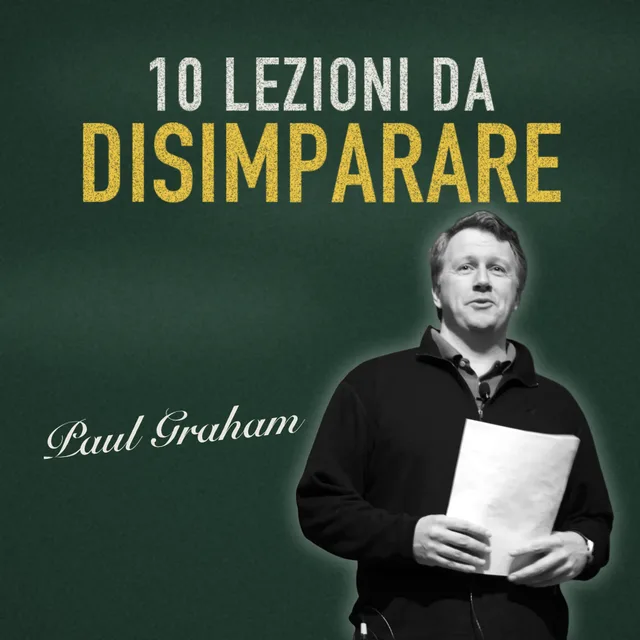
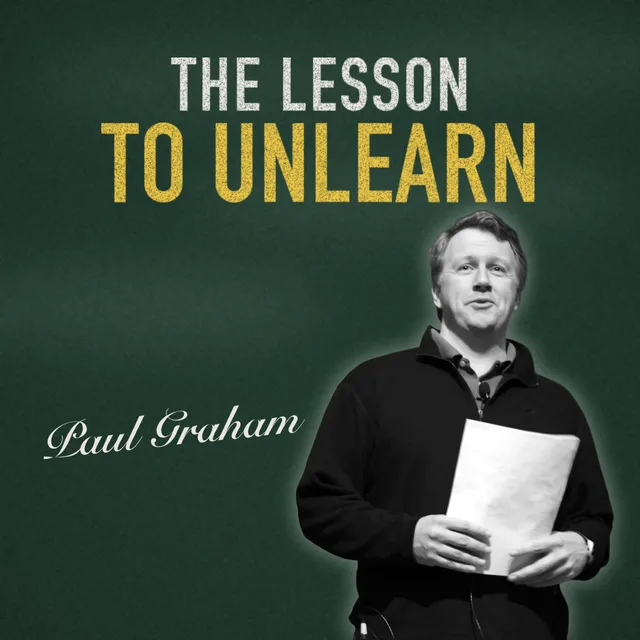
Right, today we're continuing our reading of Paul Graham's essays. We've already done two in the past, How to Do Great Work and How to Do What You Love. And today we're carrying on with our reading. We'd like to read the essays every month, two or three at a time, until we've finished them all. If you're new to this project, my name is Marco, he's Francesco, he's my brother, and every month we dive into a story, an essay, a biography of someone who in our view did excellent work in their life, and we try to share reflections, principles, ideas that we can use in our own lives and that we hope can be useful to you too, especially in your work. Right, let's begin. So, I'd start with this essay that was published recently, I mean recently compared to the others, in December 2019, called The Lesson to Unlearn.
02 The lessons to unlearn
So, what are the lessons, the most damaging things a young student, or really any young person, learns that then become damaging for their future, in this case for people doing startups and for people starting something from scratch? So, Paul opens this essay by saying that the most damaging thing you learned in school wasn't something you learned in any specific class: it was learning to get good grades. "When I was in college," Paul writes, "a philosophy student told me that he never cared what grade he got in a class, only what he learned in it." And he writes: "This stuck in my mind because it was the only time I ever heard anyone say such a thing." Meaning that the most important thing in school, naturally, is getting a good grade. It isn't learning as much as you can about what you're studying. And then Paul writes: "In theory, tests are merely what their name implies: tests of what you've learned in the class. In theory you shouldn't have to prepare for a test in a class any more than you have to prepare for a blood test. In theory you learn from taking the class, from going to the lectures and doing the reading and/or assignments, and the test that comes afterward merely measures how well you learned."
03 Is it bad that learning is conflated with grades?
So the question he then asks is: is it so bad if the learning we do at school or at university is so conflated with grades? And he answers: "Yes, it is bad. And it wasn't till decades after college that I realized how bad it is. Because the real problem is that most tests don't come close to measuring what they're supposed to."
04 The medieval history experiment
In fact here he writes: let's do an experiment, let's take a medieval history exam. "Suppose you're taking a class on medieval history and the final exam is coming up. The final exam is supposed to be a test of your knowledge of medieval history, right?" Perfect. So if you have a couple of days before the exam, or you're studying for the exam, what's the best thing to do? It's to read as much as you can about medieval history. Read as many books as possible, read anything at all to understand as much as you can of history, of medieval history. Makes sense, right? But is that the right answer or the wrong one? It's right, but it's wrong in the context of school. And here he writes: "No, no, no, experienced students are saying to themselves. If you merely read good books on medieval history, most of the stuff you learned wouldn't be on the test. It's not good books you want to read, but the lecture notes and assigned reading in this class." Now, let's try to think about it. If the final exam in medieval history, instead of being a written test with standardized questions, were a long conversation with the professor, then the best way to prepare would go back to being reading the best books on medieval history. Why? Because in an hour-long conversation you can't cheat. There's no multiple-choice test, I mean there's no... you can't just repeat what the professor explained. But that can't be done. It can't be done because if there are 25, 200 students, you can't have 200 conversations. So what happens? There's a system: there's one test that's the same for everyone, a standardized test to assess whether the student has understood or not. So he points to this organizational choice of creating a standardized test as the main cause of what he calls hackability, hacking a test. Hacking a test means, one, copying, but also knowing exactly what you need to study to then get a good grade on the exam. So the end goal, the most important thing, is getting a good grade. How do I get a good grade on this exam? Well, I work backwards and try to hack it. So one, I can copy. Two, if I can't copy, or I copy but I can also do something else instead, you study exactly what the professor explained, because that will definitely be on the exam.
Or also having the old exams.
Exactly, which you can go back over, that's another kind of hackability.
So, on the problem of this hackability, Paul writes: "If grades were merely a way for teachers to tell students what they were doing right and wrong, like a coach giving advice to an athlete, students wouldn't be tempted to hack tests," so to copy, what we said before.
Paul writes: "You can't blame students if they choose grades. Everyone judges them by their grades: graduate programs, employers, scholarships, even their own parents."
I mean, the future in general, from getting into university to getting into a master's or anything else, in the end it's only your grade average that counts.
"Anyone who cares about getting good grades has to play this game, or they'll be surpassed by those who do. And at elite universities, that means nearly everyone, since someone who didn't care about getting good grades probably wouldn't be there in the first place. The result is that students compete to maximize the difference between learning and getting good grades." So you can't blame the students, but you can't blame the teachers either. Because here he writes: "You can't blame teachers if their tests are hackable. Their job is to teach, not to create unhackable tests. The real problem is grades, or more precisely, that grades have been overloaded."
05 Why the education system is harmful for people who want to start something
And so the question is: why is this so damaging for people when they finish high school, university, and go to work, and in this case start something from scratch, start a startup?
And he explains it. Why? But he explains it in a very real way, because Paul founded Y Combinator, which is the most important startup accelerator in the world, and so, as he started working with lots of founders, he realized this problem.
"The worst thing the educational system does is to train you that the way to win is by hacking bad tests. This is a much subtler problem that I didn't recognize until I saw it happening to other people. When I started advising startup founders at Y Combinator, especially young ones, I was puzzled by the way they always seemed to make things overcomplicated. How, they would ask, do you raise money? What's the trick for making venture capitalists want to invest in you?" My answer was very simple. "The best way to make VCs want to invest in you, I would explain, is to actually be a good investment. Even if you could trick VCs into investing in a bad startup, you'd be tricking yourselves too. You're investing time in the same company you're asking them to invest money in. If it's not a good investment, why are you even doing it?" And they'd keep going: "Ok, fine, but what makes a startup a good investment?" Growth, Paul would answer. "Ideally in revenue, but failing that in usage." You need to get lots of users.
06 How you really get lots of users
And they'd ask: "Ok, how does one get lots of users? Maybe a big launch that would get us exposure, influential people talking about us, launching on a Tuesday, yes, yes, because that's when one gets the most attention."
"No, I would explain, that is not how to get lots of users. The way you get lots of users is to make the product really great. Then people will not only use it but recommend it to their friends, so your growth will be exponential once you get it started."
They should make a good company by making a good product. And then he writes: "Their reaction would be something like the reaction many physicists must have had when they first heard about the theory of relativity: a mixture of astonishment at its apparent genius, combined with a suspicion that anything so weird couldn't possibly be right. Ok, they would say, dutifully. And could you introduce us to such-and-such influential person? And remember, we want to launch on Tuesday." So they couldn't believe the answer was that simple. And why is that? Because their whole lives... they've been trained a different way. All of us have been trained to hack tests. Hacking tests, so looking for a shortcut, whether that's copying or looking for the right answers. I mean when, as I said before, a standardized test already has answers I can go and get, so I look for the right answers. But in this case, when you're doing a startup or when you're designing your own life, there's no way to hack it. I mean, it's that simple: make a good product that users want. It's very simple, but it seems like a question, it seems like something so hard to understand, because we're always thinking: but how can we hack this? What's the shortcut? And that's the most damaging thing we carry around with us.
"There are certainly big chunks of the world where the way to win is to hack the test. This phenomenon isn't limited to schools. And some people, either due to ideology or ignorance, claim that this is true of startups too. But it isn't. In fact, one of the most striking things about startups is the degree to which you win by simply doing good work. There are edge cases, as there are in anything, but in general you win by getting users, and what users care about is whether the product does what they want."
And that's the only thing that counts: the users. And so you can't get around the users. They decide, there's no test you have to take. And then Paul writes: "Why did it take me so long to understand why founders made startups overcomplicated?
07 Why founders make startups overcomplicated
Because I hadn't realized explicitly that schools train us to win by hacking bad tests. And not just them, but me! I'd been trained to hack bad tests too, and hadn't realized it till decades later.
08 Why Paul hates big companies
I had lived as if I realized it, but without knowing why." For example, Paul hates big companies. "But if you'd asked why, I'd have said it was because they were... because they were bogus, or bureaucratic. Or just yuck. I never understood how much of my dislike of big companies was due to the fact that you win by hacking bad tests. The fact that the tests were unhackable was a lot of what attracted me to startups. But again, I hadn't realized that explicitly."
So the point is always the same: in startups there's no mapped-out path where you do point A, point B, point C, boom, you've made it.
09 The difference between bad tests and good tests
It doesn't exist, whereas it does exist in big corporations. So if you want to reach that position, you need a top grade average, a top master's, you need to have had that particular experience, so it's a path where technically you already know what you have to do, so it's more hackable than something where you have no idea where to even start.
But he makes a distinction between bad tests and tests that aren't bad. So bad tests are hackable because they're imposed by authorities. And the authority itself is a human being. So all I need is to figure out what that human being really wants, work backwards... and you've made it. I work backwards, figure out what that person wants, and I hack it. Tests that aren't bad are the ones that aren't imposed by authorities, so a startup: you can create, the only thing is to make a good product.
I mean, the test is set by the public, not by a single person.
Exactly.
So it's very, actually, it's impossible to hack it.
10 The question for sorting the kinds of work you want to do
He gives an example, especially in America, where there are the elite universities, Stanford, Harvard, Princeton, all those universities. And lots of students train for years and years, study for years and years, a whole lifetime, just to get into the university. Now that test, imposed by 10 to 15 people, there are 10 to 15 people on the committee, is extremely hackable. Those people want me to be a good musician, to have so many hours of volunteering, so much of this, all of that: I work backwards, I do all those things, and I hack it. But in a startup you're building, you can't do all those things, there's no predefined track. The thing that struck me most in this essay is this: "Instead of looking at all the different kinds of work people do and thinking of them vaguely as more or less appealing, you can now ask a very specific question that will sort them in an interesting way: to what extent do you win at this kind of work by hacking bad tests? It would help if there was a way to recognize bad tests quickly. Is there a pattern here? It turns out there is. Tests can be divided into two kinds: those that are imposed by authorities, and those that aren't," as we've already said. In other words, the test is... is this test hackable? Yes, because it's imposed by an authority. No, because it isn't imposed by an authority. So if I look at all the kinds of work I want to do in my life, and let's think about designing your own life, I look at that kind of work, and instead of saying do I like that kind of work, yes or no, or is it appealing, yes or no, the interesting question Paul asks is: maybe I should ask myself, in that kind of work, do you win by hacking bad tests?
11 Hacking bad tests
And is that really how I want to spend the rest of my life? And that's a question I'd never thought about. But I did think: well, if I work at a big corporation I'll naturally manage to earn lots of money, rather than doing something like what Paul did, which worked for him but maybe won't work for me. So climbing the corporate ladder, or doing something where in the end you have to get around, to hack, bad tests, is the way to make lots of money. And here he writes: "I suspect many people implicitly assume that working in a field with bad tests is the price of making lots of money. But that, I can tell you, is false. It used to be true. In the mid-twentieth century, when the economy was composed of oligopolies, the only way to the top was by playing their game. But it's not true now. There are now ways to get rich by doing good work. And that's part of the reason people are so much more excited about getting rich than they used to be. When I was a kid, you could either become an engineer and make cool things, or make lots of money by becoming an 'executive.' Now you can make lots of money by making cool things," and there are loads of examples of people who got rich doing things that weren't ordinary.
So hacking bad tests is becoming less important.
And he writes: "Imagine what happens as more and more people start to ask themselves if they want to win by hacking bad tests, and decide that they don't. The kinds of work where you win by hacking bad tests will be starved of talent, and the kinds where you win by doing good work will see an influx of the most ambitious people."
12 The price of success
And that's interesting too, because in the startup world you see ambitious people, different people, who could never work in another ecosystem.
So the ending goes back to the beginning, to the idea that education changes, evolves, to break us of this habit of hacking the test. And he writes: "Imagine what the world could look like if that happened. This is not just a lesson for individuals to unlearn, but one for society to unlearn. And we'll be amazed at the energy that's liberated when we do." The next essay is Life is Short.
13 Life is short
And then he starts writing: "Life is short, as everyone knows. When I was a kid I used to wonder about this: is life actually short? Or are we really complaining about its finiteness?" So interesting. "Would we be just as likely to feel life was short if we lived 10 times as long?" I mean, if we knew our life, our lifespan, was going to be 300 years, would we still say it was short? Because we'd be used to living to 300. "Since there didn't seem any way to answer this question, I stopped wondering about it. Then I had kids. That gave me a way to answer the question, and the answer is that life actually is short." But the point is: fine, ok, we get that it's short, but does it make any difference to know that? "It has for me," he writes. "It means arguments of the form 'Life is too short for x' have great force. It's not just a figure of speech to say that life is too short for something. It's not just a synonym for annoying. If you find yourself thinking that life is too short for something, you should try to eliminate it if you can."
14 Life is too short for nonsense
So, for example: "For me, life is too short for bullshit. I realize that answer is somewhat tautological. It's almost the definition of bullshit that it's the stuff that life is too short for. And yet bullshit does have a distinctive character: there's something fake about it, it's the junk food of experience. If you ask yourself what you spend your time on that's bullshit, you probably already know the answer." And he writes: "Unnecessary meetings, pointless disputes, bureaucracy, traffic jams, addictive but unrewarding pastimes."
I mean, you're hooked, but then when you're done you know you've wasted all that time. Yeah, they give you no satisfaction at all. Anyway, this nonsense is exactly the stuff we need to eliminate. So, I don't know, life is too short to eat junk all day. Great, then the junk has to go.
But then he writes: "There are two ways this kind of thing gets into your life: it's either forced on you, or it tricks you." To some extent, and this part is fair, "you have to put up with the bullshit forced on you by circumstances. You need to make money, and making money consists mostly of errands." And then he writes: "Indeed, the law of supply and demand ensures that the more rewarding some kind of work is, the cheaper people will do it. It may be that less bullshit is forced on you than you think, though. There has always been a stream of people who opt out of the default grind and go live somewhere where opportunities are fewer in the conventional sense, but life feels more authentic." What comes to mind for me is, I don't know, let's go to the South of Italy, let's go to, I don't know, Puglia, ok? Opportunities in the conventional sense are far fewer than if you go to London, New York, Milan. But there, maybe life is more authentic, maybe there you're surrounded by your family, or anyway the opportunities are fewer, but life is more unique, it's more authentic. And he writes: "This could become more common. But if you consciously prioritize bullshit avoidance over other factors like money and prestige, you can probably find employers that will waste less of your time."
15 The three questions for sorting kinds of work
So in this case, looking at all the kinds of work I'd like to do, I can ask myself: do I want to do this knowing that I'll win by hacking bad tests imposed by another human being? Ok, first question. The second question that comes to mind now is: would I like to do this knowing that I'll have to put up with, or be part of, a lot of nonsense? Of course it's not like we can simply decide yes or no, but they're good questions that I keep asking myself.
On this very question of being able to decide or not, Paul makes a reflection that's really interesting. So: "While some amount of bullshit is inevitably forced on you, the bullshit that sneaks into your life by tricking you is no one's fault but your own.
16 The nonsense that sneaks into your life
And yet the bullshit you choose may be harder to eliminate than the bullshit that's forced on you." That's so true.
For example?
Well, it can be anything, from using social media every day, to smoking, to alcohol. Nobody forces that on you, you decided it. So, in the world of work, if you're forced to sit through 5 hours of meetings, which is a massive pain, you just have to do it, but it's much easier to get rid of. Not in the sense of changing jobs, but in the sense of saying: well, I don't actually have to do this. Whereas the other nonsense is nonsense you chose yourself, and so it has also turned into an addiction.
Yes, let's say that maybe when you work at a big corporation you can't exactly decide: no, I'm not doing this five-hour meeting.
No, no, but I'm saying for you, from a subjective point of view, it's much easier to say: well, I wouldn't do this, it isn't necessary. But saying: come on, I won't smoke this cigarette, that's much more complicated.
17 The heuristic for telling what matters
"One heuristic for distinguishing stuff that matters is to ask yourself whether you'll care about it in the future. Fake stuff that matters usually has a sharp peak of seeming to matter. That's how it tricks you." So the things we care about hold our interest steadily, while with other things maybe there's the initial interest, so there's this peak of interest that then disappears.
Shall we give an example?
"The things that matter aren't necessarily the ones people would call 'important.' Having coffee with a friend matters. You won't feel later like that was a waste of time." For example, you like playing some sport, any sport, it's an interest you keep over time, I want to do it every day, but going to the Apple Store and buying yourself a new phone, you get the peak at the start when you're super pumped, maybe you wake up in the morning like: "Oh wow, the new phone, let me use it," but then over time it's normal, that initial interest isn't there anymore, so there's the peak of interest when you go buy the iPhone, in the first days you have it, but then it fades because it becomes a normal thing, you don't really care about it.
So "one heuristic for distinguishing stuff that matters is to ask yourself whether you'll care about it in the future. Fake stuff that matters usually has a sharp peak of seeming to matter. That's how it tricks you." That's why he brings up arguing online. Why? Yes, because at first you want... they have a peak of importance, I mean so important that I have to reply to this guy, my God... Because you want to defend yourself...
Exactly! Then in the future... But in the future it doesn't matter, it's complete nonsense! What do you care? That random guy number 879 insulted you under the video... Exactly!
Or when you have an argument at dinner, ok? I mean, enough, it's not like... that thing doesn't really matter, why do you need to have that argument at dinner? So the things that don't really matter have a peak of importance in that situation, but it's only apparent, because in the future they really don't matter at all. Whereas with having coffee with a friend, that peak of importance isn't just apparent, it lasts over time.
18 Life is short, so don't wait
"If life is short, we should expect its shortness to take us by surprise. And that is just what tends to happen. You take things for granted, and then they're gone. You think you can always write that book, or climb that mountain, or whatever. And then you realize the window has closed."
"The usual way to avoid being taken by surprise by something is to be consciously aware of it." And to me this is the most important thing, I mean being aware of something, whether it's right or wrong. Maybe what Paul writes isn't always 100% right. But at least if you're aware, you say: ah, what a great question. And maybe that question can open up other thoughts, other ideas for you. And then he writes: "Back when life was more precarious, people used to be aware of death to a degree that would now seem a bit morbid. I'm not sure why, but it doesn't seem the right answer to be constantly reminding oneself of the grim reaper hovering at everyone's shoulder. Perhaps a better solution is to look at the problem from the other end." So learning, and this is really beautiful, to "cultivate a habit of impatience about the things you most want to do." I'd add: learning to be impatient about the things that really matter to us. "Don't wait before climbing that mountain or writing that book or visiting your mother. You don't need to be constantly reminding yourself why you shouldn't wait. Just don't wait."
"I can think of two more things one does when one doesn't have much of something: try to get more of it, and savor what one has. Both make sense here," so, precisely, as a way to deal with this problem.
19 "Is this really how I want to spend my time?"
I'd add here a question, a reflection he makes earlier that I forgot, which is: we should always stand outside ourselves and ask, "is this how I want to be spending my time?"
20 The four questions for sorting kinds of work
Now I'd add another question when looking at the different kinds of work, I think it's really interesting. Let's look at all the kinds of work again. We're trying to design our lives, trying to find what could be considered the work of our lives, what could be called your life's work. Let's look at all these kinds of work and, instead of deciding whether we like them or not, whether they're appealing or not, or whether other people will see us differently if we do that thing, whether that job is prestigious and so people see us differently because we're doing something prestigious, now we can ask ourselves three questions. The first question is: do I want to do this knowing that I'll win tests by doing, that I'll win by hacking really bad tests? The second question is: do I want to do that job knowing that I'll be part of a whole lot of nonsense? Life is too short for nonsense. And now the third question is: do I want... is this really how I want to spend my time? I mean, if I have 80,000 hours in my life and most of them go to work, I mean there's a statistic that we spend 80,000 hours at work over the course of our lives.
21 What doesn't seem like work
These 80,000 hours, if I look at all the activities I have to do, is this really how I want to spend my time? Now, of course all of us at some point will have to be part of something where we hack bad tests, where we're part of a lot of nonsense, where maybe this isn't how I want to spend my time, but I think being aware of these three questions is important, really interesting, because the more aware I am of something, the smarter I am, and the better I can understand that maybe that thing isn't what I want: I play because I have to play this game, but in the meantime I have another plan. But I'm able to build this plan because I'm more aware.
So Paul ends this essay by writing: "Relentlessly prune bullshit, don't wait to do things that matter, and savor the time you have. That's what you do when life is short." Right, the next essay we decided to look at for this episode is What Doesn't Seem Like Work? So, the question we also saw in the first essays we did, How to Do Great Work and How to Do What You Love: I mean, there are these people who are super lucky, according to Paul, who already know as kids what they want to do, because, after all, life's big question is: what do I want to do when I grow up?
For example, the example he gives is Mozart. At 5, Mozart already knew what he was meant to do, which was being a great musician. At 5 or 6, Mozart was already performing before the great imperial courts, so he never wondered: but what's my calling? What is it I really want to do with my life? At five he was a musical genius, and that was his calling. He didn't go looking for it. Whereas there are other people. He gives you the example of Newton, who's completely different, he was all over the place, going from astronomy to physics to mathematics to theology. The interesting thing is that Newton wrote much more about theology and alchemy than about physics and mathematics. If we look at the numbers of his library, he wrote millions and millions more words on alchemy and theology than on mathematics and physics, yet we know Newton as a great physicist and mathematician.
So Paul writes: "My father was one of those lucky people who know early on what they want to do. Few people know so early or so certainly what they want to work on. But talking to my father reminded me of a heuristic the rest of us can use."
22 The shortcut to figuring out what you're suited for
So he mentions this little shortcut in almost every essay, but it's dynamite. I mean, if something that seems like work to other people doesn't seem like work at all to you, not tiring at all, it's probably something you're well suited for. So if... anything at all, from... Give the programmer example. Debugging.
Exactly, a programmer has to be good at debugging, I mean they have to spend time looking at the code.
All the lines of code.
And looking for the bug. That in itself is something I'd consider torture. I mean, sitting in front of the computer looking for a missing comma or a character that isn't there. Torture, for me. But for other people that's wonderful, they really love it. So the people who love the trickiest part of that kind of work really have a clue that it's truly what they should be doing.
Exactly.
Another example we could...
But it can be anything you find excruciating that your friend finds wonderful: great, it means that for your friend that could maybe be an option for the future.
Like Paul's father, who was in love with mathematics: for other people, the thought... of mathematics... of spending their free time picking up a book and solving math problems is pure hell.
A bit like Rovelli, we also did an episode on Carlo Rovelli, who at the end of the book writes: "Right, I'll spend my Sunday lying on the sofa trying to solve the blessed equations of quantum physics." Right, me picturing a winter Sunday, me on the sofa, solving physics equations: thanks, but no thanks. For him the thing he loves is actually the... he's a theoretical physicist. In fact, Paul writes: "The stranger your tastes seem to other people, the stronger evidence they probably are of what you should do." So Paul ends this essay with a beautiful question, which we'll leave with you too: try to analyze it, think about it, give it an answer, because, as Marco was saying earlier, being aware changes everything. The question is: "What seems like work to other people that doesn't seem like work to you?"
Right, that's the final question we want to leave you with. If you enjoyed it, subscribe to the podcast wherever you're listening, it really helps us a lot, but above all share it with someone it could help, that helps us a lot too. We also have our website, inbuonacompagnia.com, where you can go, listen, and above all read all the transcripts. If you don't have time to read, to listen to all the other episodes, there are all the sources, everything we use to create each episode, and on top of that there's our newsletter. You can sign up, the link is here in the description, and after each episode we send you the main reflections, but also a little something we don't cover in the episode we record, because otherwise it would get really, really long. Right, thanks so much and see you in the next episode.