01 Intro
Marco, how many Italians do you know who gave work to tens of thousands of people and changed the industrial face of Italy?
Well, reading this book, we can definitely think of Giovanni Agnelli, Giuseppe Toeplitz, the managing director of Banca Commerciale Italiana, one of the biggest Italian banks, maybe Enrico Fermi.
OK, good, today we're adding one that almost nobody knows. We're at the start of the twentieth century, Italy is just becoming industrial, and there's a man from Biella, the son of a goldsmith, who with no degree, with nothing, learning everything on the job, builds the biggest company in the country, SNIA, the second-largest artificial silk factory in the world, with 20,000 workers.
And what's this person's name?
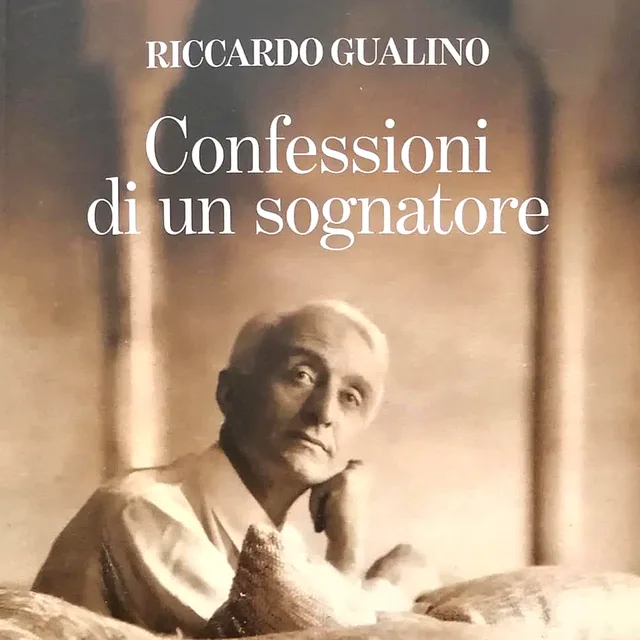
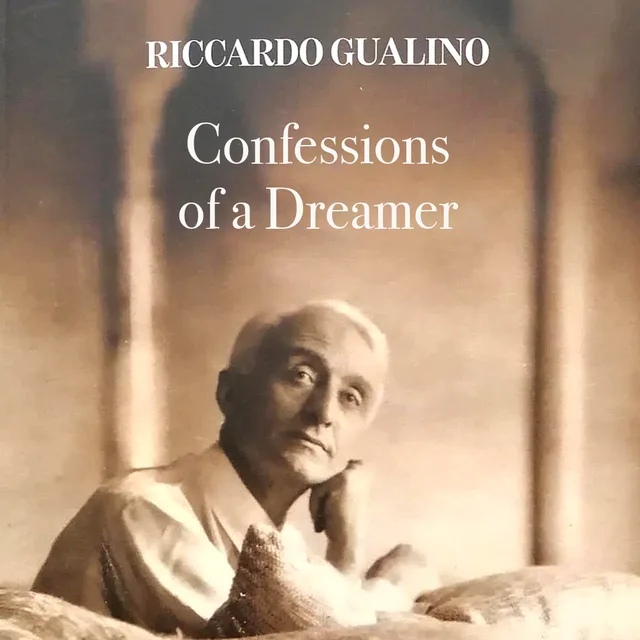
His name is Riccardo Gualino, and what's beautiful is that he didn't build for money, he said he wanted money in order to build. Factories, schools, entire cities. They called him the dreamer.
And then what happens?
And then in our story fascism arrives, Mussolini turns on him, sends him into internal exile, to Lipari, and strips him of everything: company, bank, fortune. The most powerful man in Italian industry suddenly has nothing left.
And the interesting thing there is: does he give up, or what does he do? Because at that point he was 65 years old.
Absolutely not. He comes back from exile, starts again from zero and builds another company of excellence. This time in film. Lux Film.
Which is one of the companies, like our Italian Hollywood. Incredible, crazy.
In the end he writes a book about his life, Confessioni di un sognatore (Confessions of a Dreamer), but at first he's afraid to publish it, so he puts a veto on it, even for his family: they could read it, but not publish it. This book stays shut in a drawer for more than 70 years and only comes out in 2021, thanks to his granddaughter.1
Seventy... Yes, seventy years. And the interesting thing is that he put a veto on his family. Seventy years.
And what's written in it? And why did he keep it hidden for a lifetime? Let's find out together. And as always, we'll gather the pieces that a man like this left along the way. Get comfortable, because this is a really, really great story.
And welcome to In Buona Compagnia.
OK, where do we start?
02 What Italy was like at the start of the twentieth century
I'd start from Italy in 1900, to get a sense of what the situation in Italy was like. There are so many things I discovered that I didn't know, and I think they're really fascinating. First of all, did you know that back then 6 out of 10 employed Italians, so about 61%, worked the land? And almost half the country could neither read nor write. National illiteracy was around 48%, and in the South it reached 70%. It's incredible, really a lot. And if we look at other countries, like England, illiterates were 3%, and in France 5%. So in this country, industry itself was a really tiny thing.2
03 How Italy industrialized thanks to a few "daredevils"
And to build it up, Gualino writes in this book, it took a few bold men, the so-called daredevils. And he writes: "Without the boldness, often reckless, of a few men, Italian industries would still be a negligible entity today," he's referring to Italy, "in the world economy. A populous country like ours, with insufficient fertile land, needs intense industrialization, and for that you need bold men who do not fear the fascinating but difficult paths of productive progress." And then here he writes something beautiful: "men who have the means to risk large sums, who do not lose heart in the face of negative results, who replace aging machines and plants without regret."
Exactly, because back then there was this idea of the bourgeois, of the industrialist, as the one who was rich, yes, but who didn't take risks. Who maybe had courage, yes, but didn't have this boldness that Gualino describes, meaning the ability to take risks, to invest money to change machinery, to renew.
04 Agnelli, his exact opposite
And at the time he was completely off the scale. We said he was from Biella, from Turin, and in Turin back then there were lots of industrialists, including Agnelli, who is, let's say, his great antagonist. Which is nice, though, because he's the complete opposite of Gualino: he wasn't as curious, as inventive, with the urge to expand abroad. He preferred to stay safe with something solid, to invest in something he knew, whereas Gualino was the complete opposite.
And it's a double-edged sword. Because he's a dreamer, he wants to build lots and lots of things, we'll see that. I mean, he's in thirty thousand different fields, silk, chocolate, ships, anything at all. So he's a dreamer and he likes to take risks, and I think, he writes here that this need to build, to always do more and take risks, will eventually also lead to his ruin.
Exactly. Agnelli, on the other hand, was calmer.
And let's explain, do you want to explain that part about Agnelli, where he says there was a period when Agnelli built FIAT and there was a period when he could use anything?
He could use anything, he could get anything. So FIAT was actually born from a group of big Piedmontese entrepreneurs together, but their representative was Agnelli. Giovanni Agnelli, not the Avvocato, his grandfather, Giovanni Agnelli. And at the time there was nothing, absolutely nothing. It was born by imitating, let's say, Ford, the Model T in Detroit. But Agnelli could have expanded abroad like never before, and instead he chose not to. Certainly, Gualino says, out of a bit of fear, a lack of imagination. As I said before, he preferred to invest in something solid that he knew, rather than trying to lower production costs, which is something Gualino always has in mind: reduce costs to produce more, sell more and make more money. Agnelli, instead, preferred to keep producing cars that were a bit more niche, rather than for the masses. Now, if we think of FIAT, FIAT did produce for the masses, but Ford was even more focused on the masses. And it's actually nice, because Gualino both hates and praises Agnelli. Because he criticizes him, as we've said so far, but at the same time he praises him, because he recognizes the fundamental role FIAT had in Italy's industrial growth: with the birth of FIAT came the birth of the Italian stock exchange, the first shares, the first speculation, but also the opportunity FIAT created in Italy.3 So far, of these pioneers, we've talked about Gualino and Agnelli.
05 "The best of these five pioneers? Perhaps it was me"
And then there are lots of others. There's, for example, Giacinto Motta, Guido Donegani, Giuseppe Toeplitz, and I didn't know this, but Giuseppe Toeplitz, I don't know if I'm pronouncing it right, ran the biggest Italian bank, which was the Banca Commerciale, the biggest. And he writes, the nice thing is that you're born now but you know nothing about what happened before. I mean, it's crazy. And he writes, Gualino writes: "Without him, with all his mistakes, Italy would not have the industrial base it has today." Now, we won't explain the whole story of Giuseppe Toeplitz, but he was one of these pioneers who basically financed a huge slice of Italian industry, with Edison's electricity, Terni's steel, chemicals with Montecatini. Basically, thanks to these pioneers, Italy began to industrialize.4
And Gualino writes, with great modesty: "The best of these five? It was me. Perhaps it was me. Me, precisely. With the dangerous flaw of dealing with too many things at once and following too many paths with equal enthusiasm." So, what we were talking about before. And this is maybe an interesting trait of Gualino's: he's not modest, but that's fine, he considers himself the best.
That's true. But there's a part in the book where, I don't remember exactly what he writes now, but he writes that we need men like this. Because thanks to these men who do big things, who maybe don't feel superior, but really feel they're good, they manage to build something truly incredible. Even if this is a flaw of his, the risk-taking too, that's a flaw, because we'll see...
But does he know it?
He knows it.
And I think he really does write that I'm the best. Not so much for what he did, but I think precisely for the ideas he had. Many of the things we'll talk about, he thinks of them, he makes plans, but then they don't go through. Why? Because they were too far ahead of their time.
06 How he imagined high-speed trains in 1923
Let's take an example. He wanted to build a high-speed network between the three poles of Italian industry, so the industrial triangle, meaning Turin, Genoa and Milan. He wanted to build a motorway network and a high-speed rail network. In the twenties, in the thirties.
So he wasn't just thinking of building a motorway to connect Milan and Genoa, but of really creating a complete ecosystem. He explains, I'd like to bring the sea to the Milanese, so really creating an industrial ecosystem.
Because the goods would arrive in Genoa and from there, in one, at most two days, they would reach the industry of Turin and Milan. And here there's an interesting part, because he says, OK, let's create this high-speed rail network. Now, don't imagine 300, 400 kilometers per hour like today, but we're talking around 180, which back then was really a lot. But he says, fine, let's use this network both for passengers and for freight. But what happens? Fine, the train leaves, it leaves Milan, gets to Turin, slows down, stops, lets the passengers off, leaves again, gets to Genoa and so on. He wanted this network not to share the existing passenger network, he wanted to build another one, which would run underneath the cities so as not to lose time and not to stop. So you arrive, let the passengers off, and he was already imagining a kind of subway, with elevators going down underground, and that way the train lost only a few minutes from city to city. And then at night the network would be used for freight. And it's beautiful, because he knew that without an efficient transport process, the potential of these three places, of this industrial triangle, would never really be used to the fullest. And so he writes that by creating such an effective organization, these three cities would actually become a single city, because they would be so well interconnected that they would seem like a single city. And why doesn't it happen? It doesn't happen because he didn't have the money, it took too much money, and it doesn't happen because the State itself also opposes it, it opposes it through the Italian railway network. Now, I don't know if it was already called Trenitalia, I'm not sure, but anyway this project would have taken away many passengers, would have taken a lot of market share from the state railway company, and so nothing comes of this project. But this is to make you understand how truly far-sighted he was. I mean, guys, we're in 1923 here and he's imagining the high-speed rail network.
07 Why he couldn't do just one thing
Well, it's incredible. The interesting thing is that he wasn't only working on that project. At the same time he was doing a ton of things, including building SNIA Viscosa.
He doesn't even give this project much importance, precisely because he wasn't 100% focused on this idea. And so we always come back to the fact that he maybe does a few too many things at once.
Too many things. Let's explain why he does all these things at once. There's a reason. It's true that today, if you look at the big picture, let's make a reference to Phil Knight, to Nike, OK? He did only one thing, only that, and he did it extremely well. Most of the people we're going to look at did one thing in a big way. Look at James Dyson, he did one thing in a big way. And so, though, what's right and what's wrong? Is it this, or Gualino's way? I don't think there's a right or a wrong, I think it's just about understanding who you are as a person.
Exactly.
Because Gualino was incapable, and not incapable in the sense of saying I'm not capable, no, really a gut-level inability to do just one single thing.
08 "He didn't want money: he wanted money to build"
Exactly, I completely agree. And that's because actually, as we said in the intro, he didn't simply want money, meaning to build for money, he wanted money in order to build, which is completely different. For him money was really only a means, but not to become rich, to live well, but to truly create added value for society. Cities, infrastructure, transport, well-being, hospitals, anything, to really improve the quality of life. In fact he writes in one chapter that he, from Turin, from Biella, wanted billions, but real billions, the Americans' kind, where you really spend millions the way we take a sip of water, but he wanted the billions, for example, to renew Turin, to make it more beautiful.
And here he writes: "My passion is to build, to raise something that lasts. Nothing is more interesting to me than making a factory rise from bare ground." So here too, the way he writes, it's poetic.
Yes, the desire to see a company grow and be born out of nothing.
09 "A factory that works like a symphony"
And he goes on writing: "to study its organization, equip it with the most modern systems, see a factory working at full pace that transforms harmoniously," even the word harmoniously, in a practically perfect way, "raw material into finished products through countless intermediate stages of processing, like a symphony or a work of art. Order and rhythm: these are the pillars on which a large company can be made to prosper. The great sums I possessed, or those I was able to obtain, always served me solely for this purpose: to give life to a dream, to set up some enterprise. After all, what better use could they have? Perhaps to be squandered on costly so-called amusements, from which one returns tired and dissatisfied, or on luxurious society life, where boredom reigns triumphant and supreme." It's very interesting. And here he writes: "The beauty of money," so money, the beauty of this tool, "lies in the power it gives to whoever holds it. To see thousands of men transform, create industries, centers of work, of well-being: these are joys of the imagination. But if to make these dreams come true you need money, and you have it, then it is a source of happiness. He who has created something can claim to have lived: even if unfortunate, he will always be worth more than an indifferent spectator."
10 When building becomes a mania
Very beautiful. And this really sums up Gualino's thinking.
And it's because... And then he writes, the passion, maybe because this is a mania.
I mean, it's a drug. When he writes it, from here it seems like a drug, it seems like he can't do without it.
And here he writes: "The passion, perhaps mania, for new ventures, risky ones perhaps, naturally risky, led me into a great variety of fields of activity. This made my work harder, for it lost in depth what it gained in breadth. But it is hard to fight against one's own temperament." So here you understand that this was how he was, you couldn't change it.
11 From 50 lire a month to the richest man in Europe
Also because this temperament leads him, at 17, to leave home, to leave Biella, without a trade. He writes, without a trade and without a penny. He starts working in the timber industry, we'll get to that, with a first salary of 50 lire. From 50 lire, 20 years later he has a personal fortune of about one billion lire, so almost a billion euros today, if we do the conversion from that time. And he was among the richest men in Europe. He employed 80,000 people, in a dozen different sectors: steel, leather, chemicals, banks, ships, real estate, basically everywhere, art, theater, film, an incredible thing. SNIA Viscosa, the artificial silk we'll talk about, in 1925 had a capital of one billion lire, so about €850 million today, which made it one of the biggest Italian companies at the time.5
But then he had an art collection: he had seven Modiglianis, a Duccio, a Botticelli and a Manet. And to understand how much these paintings were worth, at auction a Modigliani like his went for $170 million, a Botticelli for $92 million, a Manet for $65 million. So that collection alone, which is at the Collezione Gualino in Turin, I don't know if all of it is there, but anyway you can go and see it, that whole collection would be worth hundreds of millions of euros. So, let's go back: at 17 he leaves Biella and goes.
12 Why at 17 he quit his studies and left Biella
Wait a moment. OK. He leaves by chance, because before that he was actually fairly focused on studying, on university anyway. Just think, in 1900, thinking about university. So he studied a lot, and at some point his father tells him, it was a family dinner, and he says: Riccardo will become a man of letters, he'll never earn anything, but we'll work and we'll be able to support him. And he writes, in another book, not in Confessioni di un sognatore but in Frammenti di vita, and we'll do another episode on that book, he writes that after this sentence he says to his father, oh really? You want to see? And so he leaves his studies and at 17 he sets off. And where does he go? He goes to his cousin, in Genoa. He starts working, mainly practical jobs.6
And here he writes: "My first job lasted a year; my boss was my brother-in-law. He was at the forefront of the Genoese trade in timber imports from Florida." So big sailing ships.
The sailing ships came into the port.
But then he writes: "Despite my keen desire to get along with him, I was not able to."
And why? He wasn't able to because he starts working there and then he thinks, I can improve things by investing here, buying a new machine, improving the business, and his cousin didn't want that. I mean, his brother-in-law didn't want that.
And the Treccani dictionary here defines it, it defines his training as an essentially practical apprenticeship in the world of business.
Exactly.
And here he writes: "So, little by little, the desire to break away from him grew in me," so from his cousin. "The time I spent with him was nonetheless very useful to me: I understood the importance and the possibilities of a port, I thought of other lands, further away, beyond the seas, and I felt that the road to success is slow and hard."
But did you know that the first stock exchange was in Genoa?
It was in Genoa, yes, yes. I didn't know that.
The port was there, everything came in through there. The first Italian stock exchange was in Genoa, and then little by little, as you were saying, they move to Turin and then to Milan.
So at 17 he finds himself there, but Genoa is an international place, people arrive from all over the world.
13 The art of the deal
And then here he writes: "What did I dream of back then? While my chest swelled with an almost anguished longing, I dreamed of going far away, of seeing and knowing the unknown."
And here we're in the twenties.
Wow.
Meanwhile, people couldn't read or write. He dreamed of seeing the world.
The other interesting thing is that the Treccani dictionary, where we found many of our sources, describes him as someone with "uncommon gifts as a salesman." And in the book, here he writes: "I know how to dream, to see in my imagination what I intend to create, and I know how to describe it so well that the listener, whether a partner, a financier or a stranger who happens to be part of the conversation, is caught by my impeccable presentation as if in the mesh of a net. There is a whole art to presenting a deal, and I believe I am not exaggerating when I say that I am an artist of that kind." This one is also beautiful, he writes: "From any complicated project I strip away the useless details." This made me think of Steve Jobs, simplicity, making something simple. Anyway, he writes: "From any complicated project I strip away the useless details, I make it simple and understandable to any listener even in its most obscure parts, and with a far-sighted vision of the future I can serve it up piping hot to the spellbound listener."
I think this part you were talking about, the fact that he talked with investors and managed to convince anyone, connects a lot with Phil.
With Phil Knight.
Yes, because in Phil Knight's book, Shoe Dog, he writes: "I believed in running. I believed that if people got out and ran a few miles every day, the world would be a better place. People, sensing my belief, wanted some of that belief for themselves. Belief is irresistible." And it connects because there's this trait of belief, the fact that he's convinced of what he's doing and he manages to pass it on to others, and the others, sensing his belief, his confidence, want some of it for themselves.
14 What let him find capital everywhere
There are two things I asked myself several times while reading and studying Gualino. One is, how does he know all these things? From artificial silk to cement, to theater, to film, anything. And then the second question is: where does he find all the money to do all these things? Because he didn't come from a rich family, he starts with very little money, with nothing, and yet little by little he always finds people, capital. And the thing I wrote down here is that one hugely important thing about Gualino, besides presenting a deal in a simple way that everyone can understand, is his ability to build relationships with other people. Because in most of all these big companies, he's not the only partner: there are other partners who put in the capital. He's part of this organization, and that's how, little by little, he starts creating his first empires. But above all he also finds capital by going into debt.
Above all by going into debt. Always by going into debt. And it's nice to connect this back to Agnelli again, because he really wasn't afraid of going into debt. And for him it was the only way he had: go into debt, raise capital, invest in his companies, and not hope, he was convinced they would do well, and so make money from them.
The interesting thing is that if he hadn't been born in that period, my God, if he'd been born today, damn, he'd kick everyone's ass.
He even writes that, if he'd been born in America, in the same period.
Because he doesn't fail because he isn't good, he fails because there's the First World War, the Second World War, the Balkan Wars.
15 The first empire: 22,000 hectares of forest in the East
I mean, basically the world is... He fails because of the Bolshevik Revolution in Russia. There you go, this is the first example. So, after the business with his cousin, we're in 1914, the year the First World War broke out. I didn't understand why, but he decides to go and work on land reclamation in Eastern Europe, and he goes to Russia and Romania to reclaim land, so land that's marshy, full of trees, or near a big city that's developing, so reclaiming the land around it. And so little by little he goes there, goes into debt, creates railways, sawmills, cutting-edge industries there too, in places where there was practically nothing, absolutely nothing. So he doesn't go there only for his company, but also to modernize those places.
And he goes there because, after working for his cousin, he moves to Casale Monferrato to stay with another cousin, called Tancredi Gurgo Salice, who worked in the lime business. And there he marries Tancredi's daughter, Cesarina, and there, with the family's help, he begins to find his first capital. He founds his first company, called Società Anonima Riccardo Gualino, to buy vast forests cheaply in the East and to produce timber and export it to Italy. Remember that he already knew how to do these things, because he had worked in Genoa for a couple of years. So he founds a company with 5 million lire of capital. But he's not the only partner. Gualino's great ability is getting other people to believe in his vision, raising the capital and then doing what he has to do. So he founds this company, whose partners include his cousin Gurgo Salice and also a bank from Biella run by the Sella brothers, who were the grandsons of Quintino Sella. So thanks to this first capital he founds the company, and in 1910, a few years later, the company had about 7.1 million in capital. And what does he do with this money?
He goes.
He starts buying. And here he writes: "22,000 hectares of land and magnificent oak woods in Volhynia, and others in Romania, with their marvelous forests of fir and beech. More than 1,500 cubic meters of fir and beech were cut every day, to achieve production costs that would allow the sawn timber to be sold in any Mediterranean port. I had to build buildings, railways, a most daring cableway, suspension bridges, viaducts, tunnels. Only mechanization pushed to the extreme could allow me to beat the fierce foreign competition."
So here too he becomes the best of the best.
He was 30. At 30 he already had a small forestry empire.
16 When the war destroyed everything he had
What happens? The First World War breaks out. The Ottoman Empire starts attacking Europe, it closes the Dardanelles strait, which was the only sea route he had for exporting. The war begins, they slowly start destroying his plants, the First World War breaks out, there's the Bolshevik Revolution in Russia. So he loses the part in Romania and Transylvania to the war, and the part in Russia is requisitioned by the Bolshevik Revolution. And of all the money he had invested, especially in Russia, with the Soviet state taking over his industries, he doesn't get a single lira, nothing at all, he loses everything, absolutely everything.
And here he writes: "The outbreak of the First Balkan War, and later the European wars. Romanians, Russians, Germans fought fiercely for months along the company's private railways, they set the sawmills on fire, destroyed the bridges, carried off the rails." Everything he had built, all destroyed.
17 How he turned the war into gold: ships and coal
But I don't understand how he got there. So the First World War breaks out and he has an idea. He understands that the European states are at war, so they need raw materials, mainly coal and steel. And at the time, for Europe, most of these materials came mainly from America. And so what idea does he have? He has the idea of going to America, somehow buying or chartering motor sailing ships to carry these raw materials to the European states and getting paid to do it. And since they were at war and these raw materials were scarce, he would make enormous profits. And in fact that's what happens. So he goes to America and at first he charters these motor sailing ships. But he charters them trying to find people who'll give him these ships at fixed rates. So he charters these motor sailing ships and starts carrying steel and coal to Europe. Then what happens? There's the war, and in America the State starts taking everything. Why? Because it has to turn those motor sailing ships into war vessels, it needed them. And so what does he say? OK, you're taking them from me? Then I'll start building them myself. Making these motor sailing ships myself. And so he creates the Società di Navigazione Italo-Americana.
And do you know how he does it?
With whom? With Agnelli.
He creates two companies.
The acronym is SNIA, which will later take the name SNIA Viscosa. So he creates the first SNIA, with Agnelli. So he starts producing these ships, between New York and New Orleans, and still carrying coal and steel to Europe, really making money, truly enormous profits. First of all because there were no ships to carry things, because they had all been requisitioned by the American government, so he's one of the few who has ships he built himself. And then, again, coal and steel, essential materials for the war effort, which were paid for at exponential prices, precisely because they were scarce, but above all because everyone needed them.7
And then he writes: "I had a great deal to do in those years, including a supply contract signed with the Italian government for 800,000 tons of American coal, at $30 a ton."
But it's interesting, I don't know if you know this, he doesn't build the ships in America, he builds them in Italy.
OK.
And do you know who builds them?
No.
He has 22 cargo ships built by Piaggio.
Oh, wow!
And then what does he do? And so then it made no sense to have them built in Italy and then trade with America, because it was America that exported coal and steel to Europe. So he has the ships built by Piaggio, then he goes to America, and from there he starts carrying coal and steel to Europe, with 22 cargo ships, as you said, in partnership with Agnelli. So he takes the ships to America. Yes, yes, yes. But Piaggio, because Piaggio...
And why does he have them built by Piaggio? Well, surely... No, in Italy?
Well, surely because Piaggio at the time built airplanes and ships, and evidently it was a company of excellence, it surely had some agreement...
But are these the first ships he builds? Why does he build them both in Italy and in America? Yes. At the same time?
What I found in the sources, because, as we said, not everything is written in the book, is that he has 22 cargo ships built, partly, not all 22, by Piaggio. But what happens? So we said, 1916, 1917, 1918, he really makes a lot of money with this business. He writes it himself, that part of his first real money comes from this business, because the profits are truly enormous. January 1919. The First World War is now in its final stretch, it's almost over, and he understands that when the war ends his business ends. Why? Because nobody really needs these raw materials so much anymore, the world isn't at war anymore, so the freight rates can go back to pre-war levels. So he goes to America to try to sort out this situation, and he starts selling the first ships. But, and this I found, there's still a sailing ship of his in San Francisco.
No, really? Yes.
He writes it, I don't remember if he writes it here in Confessioni di un sognatore or in Frammenti di vita. OK. But from what I understood, there's still a sailing ship of his in San Francisco.
18 In New York, at the heart of the business world
So he goes to New York. And he writes: "Here I am, at the center of the world. In the midst of business, is it possible that I should leave without closing a deal worth mentioning?" And here we come to Gualino's first big chance to become a billionaire.
Also because we mentioned it before, but why did he want to become a billionaire? And here he writes: "Several times in my life I have cherished the desire to become a billionaire. Not a joke billionaire, who has scraped together a thousand million with great effort, but a real billionaire, the American kind, one of those who own so much money that they can spend fortunes fit for a nabob with the same indifference with which we poor mortals take a sip of water." And let's remember, though, that he doesn't want billions in money, he wants billions in order to build. In fact he writes, I'll tell you right away: "To build. To change the face of Turin a little, likable but cold and sullen, with those unbroken rows of houses, all the same and so provincial. What a good rinse I would have liked to give it, to break its monotony with some whimsical buildings. To build a marvelous, ultra-modern church. The architects would have said I was mad, that vaults are not used in modern buildings. I would have listened to them, then I would have said: I want a church as beautiful as St. Mark's, but ultra-modern. Sort it out yourselves, set to studying it with as many people as you like, cover the walls with mosaics and paintings, but the church must be marvelous. All plays of light and shadow." And then: "The real purpose, for which I needed to be a real billionaire and not a joke one, was the redemption of Italy's South. For 25 years I have had this fixed idea: to develop Italy from Naples downward, and a little also the most backward regions of the center. If those provinces, in poverty for centuries, could join their productive effort to that of the northern regions, the standard of living of the poorest classes would change radically. It would take a billion, with a checkbook in its pocket, that sets off on a journey and visits those regions, starting with the poorest."
19 The two times he missed the billion
So the first chance slips away, and this is really interesting, a genius. So he arrives in New York, it's 1919, New York isn't the New York of today, and he senses something. Right, the First World War is over, this place is already the center of the world, it'll become even more the center of the world, the war has only just ended. I mean, just imagine how prices had collapsed during Covid, let alone after a world war. And so he understands that he should buy lots and lots and lots of land, because one day those lots will be worth a fortune. For what? And he says, to build skyscrapers, which is exactly what happens in New York. So he starts to work out, to identify what in his view is the most beautiful area of New York, and he identifies what really is the most beautiful area of New York, so the whole area around the park. And he says, ah, good, and he writes that this would have been a really great deal, but he didn't have the money, he didn't have the billions. So what does he do? He asks Agnelli to come in again, so after the shipping company, SNIA, to go into partnership with him again, but this time Agnelli refuses. He says that in his view, with the war just over... anyway, he doesn't go into partnership with Gualino, and this opportunity slips away. Think, if he had bought all of it, he really would have made money, real billions, even just after 20 years, or after the Second World War, think how much those places are worth now. So this is the first missed chance to become a billionaire. We already mentioned the second one earlier, with the land reclamation in Russia, near today's capital. Those areas he was reclaiming would have become areas where houses, industries, offices, residential neighborhoods would have sprung up, but he loses everything precisely because of the Bolshevik Revolution.
Then he writes: "The second was offered to me by Russia. It was a long-range undertaking, which would have required years of work, but it had the makings of an extraordinary deal. Think of 2,600,000 square meters of building land in the Russian capital, in a city that was then growing by 200,000 inhabitants a year and was the largest maritime emporium of a boundless empire."
And it's nice because he starts building, as we've said many times so far, and it's all requisitioned by the Bolshevik Revolution. But over there Italians were seen as good people, as people who build infrastructure, houses. And so he writes that during the Second World War, when Germany invades Russia, and then during the great winter retreat, if many Italian prisoners were not exterminated, or truly tortured, crucified, it was also thanks, and this is true, it was also thanks to his works, because over there Italians were seen as good people who before the war had helped the place develop. And so when the soldiers retreat, Italians and Germans together, many people actually manage to get back home. And so this is the second chance to become a billionaire.
20 How he reinvented SNIA in artificial silk
But he doesn't stop there. Why? Because let's remember SNIA. He already has this company, he already has capital, it's a structured company, so he keeps SNIA and tries to find some other sector where he can break through, and he finds it in silk.
And here he writes: "Why did I begin to deal with artificial silk? It had been more than twenty years since this fiber had entered the world of textiles. And it was December 1918, the war had been over for a few weeks, and one day a gentleman I did not know," here too, chance encounters, "asked me for an urgent meeting. He represented the French viscose group, and it was he who explained to me the production costs, then extremely high, the selling prices, the profits the products yielded and the possibilities of an agreement with the patent holders. At once the idea leapt into my mind of developing and perfecting them so as to reduce costs until they could compete not with the luxury product, silk, but with the poorer and more widespread fibers, wool and cotton. A revolution would follow in the extremely important textile sector."
And it's nice, because at the time the world consumed a billion kilograms of wool and two billion of cotton. So he had to slip in between the two and steal a bit of market share from one and from the other. And the first thing he does, he goes to America, because they had the production patents there. And he says, fine, I'll take the patents and I want to set production at 8,000 kilograms a day.
This is Gualino's big deal, this one too.
And they tell him, come on, that's too much, that's absolutely too much.
He writes: "In those days I concluded an agreement with the patent holders that allowed me to manufacture 8,000 kg of viscose a day in Italy, with them also binding themselves not to exceed the same production." Everyone, as you were saying, thought it was impossible to produce 8,000 kg.
The problem with these 8,000, which in their view was already a lot, and he wanted to produce 100,000, wasn't so much the demand, it was the supply. Because production costs were sky-high and the machinery didn't even physically exist.
Exactly. And so here he writes: "The costs of viscose were extremely high, between 60 and 70 lire per kilogram." And he brings them down to 10. "But I knew very well that, as soon as I had greatly increased production, prices would collapse. It was therefore necessary to simplify the processes, make them automatic, produce a greater quantity of viscose per worker. My plan was 100,000 kg of fiber a day, to be manufactured in 10 units of 10,000 each. Several plants were needed, which would have given work to more than 20,000 workers."
21 The factory city of Venaria Reale
And besides the plants, he needed machines, but new machines that didn't exist. So he hires engineers and starts inventing these machines from scratch. He buys a plant in Turin, at Venaria Reale.
Exactly, where we looked at the photos. If you search "SNIA Viscosa Venaria", it was basically a city. It was a city, not like Olivetti, but it was a city. There were 20,000 people working there. And within those few months that plant had 1,500 workers. And in fact here he writes: "It was not only a matter of building the new machinery, but of continually inventing new machines that would allow increases in production, improvements in quality and reductions in costs."
22 "You think too big. Go to America"
So he creates this plant at Venaria Reale, and here there's a really funny anecdote. Because Agnelli loved to tell Gualino over and over that yes, he considered him extremely capable in finance, but that he didn't have what it takes to be an industrialist. And what does Gualino do? Fine. OK, then come and see my factories at Venaria Reale. Agnelli goes to see the factories and he's left open-mouthed, astonished by what's there, not only by the organization, but by the innovation, the cleanliness, the attention to detail, to production efficiency and above all to automation. And so Gualino says to him, after seeing the plants, are you still of the opinion that I don't have what it takes to be an industrialist? And he answers: no, from what I can see you are a great, a very great industrialist, but you have a serious flaw, you think too big. And he tells him: our country cannot live up to such grandiose plans. Go to America, and there you will become a billionaire. And Gualino writes, in reply: and I didn't go, and I'm happy I didn't abandon this country of ours.
The word you said, which makes me think of a line of Gualino's, is order. Do you remember when he wrote that order is the most important thing? And here's a sentence he writes: "In the world of business, of whatever kind, the most scrupulous order," he uses exactly this word, "the most scrupulous order is the best guide."
23 How he listed SNIA in London, where no Italian had succeeded
So he starts creating SNIA Viscosa, but as we said, Gualino keeps growing more and more, and to keep growing he needs capital, so he has to go into debt. In this case, for SNIA, he comes up with another option, the stock exchange. The problem with the stock exchange is that Italy was only just industrializing, and the stock exchange wasn't that established. He describes it a bit like a gamble, the stock exchange in Italy. And so to really grow the way he wanted, he needed a strong capitalist nation. And in Europe the only one there was, was England. So he goes to London. Many Italian companies had tried to get listed in London, but it was extremely difficult. Why? Because there too the stock exchange wasn't like today, it wasn't super established like the American one, and so before going public, especially if you were foreign, a foreign company, a bank had to vouch for you. So that bank actually had to buy your whole block of shares and then take care of reselling it to investors. So the only way he has is to hope, and to present his financial statements to a bank. And the bank he presents them to is called Hambros. So Hambros starts visiting the plants, analyzing the financial statements, his account books, everything.
And it's here that he writes that in the world of business the most scrupulous order is the best guide.
And in fact Hambros accepts and buys the shares, it buys a million shares of SNIA Viscosa at 350 lire each. But it's interesting, because these shares, as I said before, are bought by the bank, so Gualino gets the money right away. Then that bank takes care of reselling those shares to English investors. And all those shares get placed, so once Hambros buys them, they're all placed in less than an hour. So that means the English were really interested in SNIA Viscosa.
Also because here he writes: "I took advantage of a financial year in which SNIA Viscosa was going to make 140 million in profits, and an operation was proposed to the powerful London group Hambros." So SNIA Viscosa was no joke of a company.
And so he starts to get this first injection of capital. And it's nice, because he comes back to Italy and everyone asks him, how did you do it?
And here he writes: "I told Toeplitz," this too, the fact that the two of them know each other, it's crazy, and he writes: "I told Toeplitz that I had sold a million shares in London and that they would be introduced on the Stock Exchange. He jumped in his chair, exclaiming: impossible. You have been capable of many things, but not this. You know that we have never managed to get our shares listed in London, neither Edison nor Montecatini. When I showed him the contract, he confirmed his admiration."
And after doing it in London, he listed it in Berlin, Amsterdam, Paris and New York. So he really starts to have a lot of capital to finance things with.
And SNIA Viscosa becomes the first Italian company to be listed on a foreign market. I mean, it's incredible. The very first of them all, the first one, started by a 17-year-old boy who left Biella, whose name nobody knows. It's Riccardo Gualino, and who knows Riccardo Gualino?
24 "Let me close with one last dream"
Right, let's close this episode with one last dream. And Gualino writes: "So, let me close this book of confessions and dreams with one last dream. I know there was no benefit for the millions of beings who died in the war, buried by the bombings, killed in the gas chambers or devoured by the crematorium ovens, who perished of hunger or vanished at the bottom of the sea or in the mists of the unknown. I am nonetheless convinced that from this immensity of evils and from such atrocious family and social upheavals there will arise, and is already arising, a different and better humanity. May the sorrows, the bitterness, the unstoppable anxieties of countless mothers and wives have at least this comfort: that the evil suffered be a seed from which men will draw a better future." "Even then I glimpsed humanity marching united toward a new light. It seemed to me that among the tears and the weeping of millions of innocent victims a faint song of hope was rising, as if those devouring fires, those gutted houses, those sunken ships were giving birth to a new life. Now, after the war, everything has to be rebuilt. A marvelous task. It will take a long time to rebuild it. A very long time. Perhaps one thing alone would be enough: freedom. A total, absolute freedom to go, to come, to write, to speak, to buy, to sell, to cross oceans and borders. The secret of world prosperity lies precisely in the complete freedom of trade and of people, in the worldwide pooling of the goods each state possesses. The way to salvation is world cooperation."
And then Gualino writes: "And we, what will our torn country be able to do in the near future? A great deal. Ours is a blessed country, but every Italian must free himself from fear, the fear of looking the future straight and steadily in the eye, once and for all. Let us set to work, trusting in the inexhaustible power of repair that is in all peoples, and in the Italian people in particular. Let us put back in order roads, bridges, railways, ports, cities, industrial plants, aiming to reach not merely the level of American prosperity, but a higher level. To look far ahead, ever further ahead, must be our motto. To develop industries to the utmost and to lead the way: this is our task. Let us at last have the courage to have new ideas, to try roads different from the old ones, to go ahead of everyone and everything on the paths that open up before humanity. The courage to want to raise from the ruins not a frightened Italy, content with a little sunshine, but an Italy worthy of the place that is its due for its history, for its humanity and for the fervor of its people." Well, this is how we want to close this episode of In Buona Compagnia. I hope you enjoyed it. If you enjoyed it, share it with someone who might be interested, and go to our website, In Buona Compagnia, we have all the episodes there. Sign up for our newsletter, where every month we send you the most important reflections we've learned from each episode. And everything is there, all the sources, everything, which you can go and look at and read. Thank you so much, and see you in the next episode. Bye bye!