






01 Intro
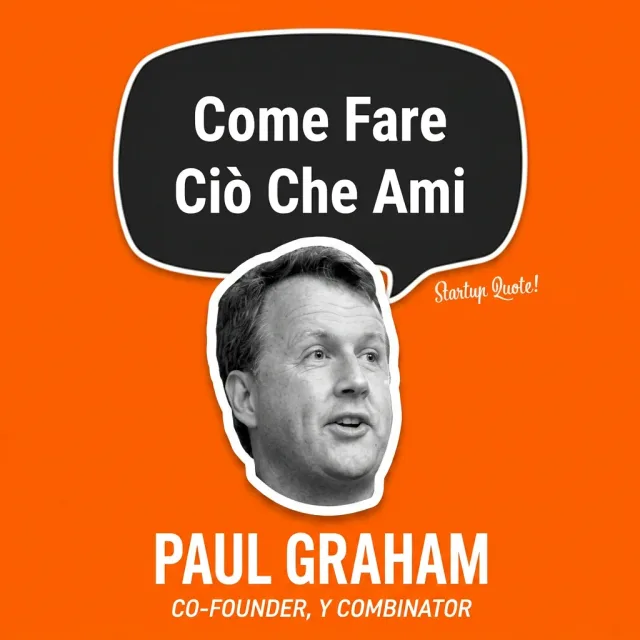
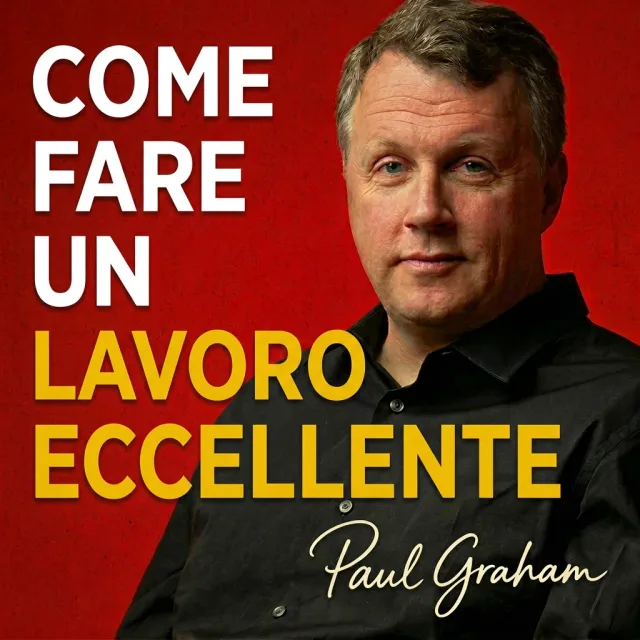
Today we're diving into more of Paul Graham's essays. In episode number 7, I think, we did an episode on the essay called How to Do Great Work. Again on the theme of how to find and do what we love. If you're new to this project, we're Marco and Francesco, and every month we do something fairly simple. We dive into a book, an essay, an idea from someone who in our view has done really beautiful work in their life, and we try to share ideas and reflections that we think are useful for our work and our lives, hoping they'll be useful to you too. So welcome! So, the first essay I'd go and read, to see if there are some good ideas in it, is How to Do What You Love. Here Paul starts by saying: to do something well, you have to like it, you have to love it. The idea isn't new, and it can be boiled down to four words. Do what you love.
But saying it isn't enough.
Doing it is very hard, also because if you ask everyone you meet every day: but do you love what you do? The answer isn't always, always yes.
Or maybe it's a yes, but it's a phony yes, a fake yes.
02 Work through a child's eyes: pain as the norm
So it's something very rare. Now Paul makes this point and says that when we were kids the world was split in two. There are the grownups, there are the kids. The grownups go to work and the kids go to school. There are times when the grownups tell you to do things, and that's called work. And when you want to do something you like, you want to play, that's called playing.
Fun.
Fun. And the grownups all agree that going to school is much better than working. And so a kid learns early on that work is work, by definition, it isn't play. So work in itself is something boring, and there's also a pinch of pain that seems like a normal thing. And Paul writes: "It might be wise to tell them that tediousness is not the defining quality of work, and indeed that the reason they have to work on dull stuff now is so they can work on more interesting stuff later." So Paul isn't saying we should let kids do whatever they want, but he's also saying it's good to tell them that boredom isn't the main quality of work.
03 Why everyone lies about their work
And he goes on making references to when he was a kid, and he writes: "The world then was divided into two groups, grownups and kids. Grownups, like some kind of cursed race, had to work. Kids didn't, but they did have to go to school, which was a dilute version of work meant to prepare us for the real thing." Then he talks about being a kid, then he grows up, gets to high school, and writes: "By high school, the prospect of an actual job was on the horizon."
And so when you're in high school, and also when you're at university, what happens? Maybe there are career fairs, so there are grownups who come and talk about their work. Or maybe you even do a stretch of shadowing, so you go and see what the grownups do. And Paul remembers that meeting and writes that it seemed like everyone enjoyed what they were doing. And yet Paul writes that maybe, in truth, only one person really loved his work, and that was the private jet pilot. But the bank manager he'd met after that, I don't think he really did, I mean, love what he did. And so he asks: but why does everyone act as if they enjoyed their work?
So exactly what we were saying before, that maybe it's a yes, I'm doing what I like, but really it's a phony yes. So why would anyone lie? And Paul answers: "It would not merely be bad for your career to say that you despised your job, but a social faux-pas." So you weren't only attacking yourself, you were also attacking your profession, so your social role, I mean your career.
And in fact nobody wants to have in the company, let's try to picture the bank manager, someone who says: honestly, it's all the same to me, I'm really only doing it because they pay me really well. I mean, it's not something you can say. The head of the bank, hearing yourself say these things, it's not a nice thing to say, and you can't say it to the kids who came there to understand how the world really works either. And then there's a third element, the most important one in my view. Lots of people copy the attitude of those who've done great things. We all know it: if we take people who are now considered great, like, let's give an example, Steve Jobs or, for example, Phil Knight, everyone knows that to do excellent work you have to love it, you have to love what you do.
In fact he writes: "If you have to like something to do it well, then the most successful people will all like what they do."
So people copy the words, but they don't really copy the substance. They copy the words, saying: yes, I love what I do. But the substance behind it isn't there. And Paul, to clear this up, writes it later on. I put it here, because right now we're talking about figuring out whether people are really telling the truth. Because it's something very harmful for a high school kid. It's harmful because you understand that school comes before work. School in itself is boring, and so work in itself must be boring too. Work has a tinge of pain, and work is a boring thing. But then you go out and you see everyone saying they love what they do. And so you ask yourself: but how is that possible? So is there something wrong with me? Do I not belong in this world?
In fact he writes: "I am not like these people; I am not suited to this world."
04 "Would you do it even if you weren't paid?": Paul Graham's test
And yet the truth is that some do really love it, but others are just pretending and just telling you lies. And to clear this up, Paul proposes a test to do. Which I think is so true and so beautiful. The test is this: "The test of whether people love what they do is whether they'd do it even if they weren't paid for it, even if they had to work at another job to make a living. How many corporate lawyers would do their current work if they had to do it for free, in their spare time, and take day jobs as waiters to support themselves?" The example that comes to mind for me is Phil Knight. Why does Phil Knight come to mind? Because how much would you have had to pay Phil Knight not to do what he wanted to do? That is, to build this dream of a shoe company? Not only could you not pay him enough, he literally paid to get started. With his father's help he set off and went to Japan to convince this company to import shoes to resell in America. So he literally paid to get started. And not only did he pay, for years he didn't earn a cent. Quite the opposite.
He was up to his neck in debt.
He was up to his neck in debt, but he had another job to support himself, and then he worked on this shoe dream. How many people would do with their own work what Phil did? How many bank managers, how many lawyers would do that job if they had to support themselves with another job?1
05 Why "work-life balance" is the wrong phrase
So this is the first test, something very important. Another sign that these people are telling a lie is if they believe in this notion of work-life balance. What is the notion of work-life balance, in itself?
A balance between work and life.
And here Paul writes: "People who've never experienced the thrill of working on a project they're excited about can't distinguish this kind of working long hours from the kind that happens in sweatshops. That's why it's a mistake to insist dogmatically on 'work/life balance.' Indeed, the mere expression 'work/life' embodies a mistake: it assumes work and life are distinct." And he goes on to write: "For those to whom the word 'work' automatically implies the dutiful plodding kind, they are." So this distinction between work and life does exist. "But for" the others, the people who love what they do, "the relationship between work and life would be better represented by a dash than a slash."
Right, this distinction you were talking about, that the phrase is actually wrong because it assumes work and life are two separate things, it reminded me of a line from Armani, whom we did in the second or third episode: "This work, which for me is life, is a continuous act of love." So in reality there's no distinction at all between life and work. In itself it's life itself. Exactly.
06 Free time isn't the reward for the pain of work
Now though, this doesn't mean you have to work 24 hours a day. That's not what Paul is saying. He isn't saying that living is working. People who see work as work and free time as free time don't really love their work, because free time is an escape, it's something you do to drive away the suffering of work. And so now, in your free time, you relax, you have all the unproductive pleasures. And then Sunday comes and you say: damn it, on Monday I have to go to work again. So obviously Saturday and Sunday are a moment of relaxation, a moment of "finally, I don't have to work." Monday comes and you have to go to work, and that's a moment of suffering. And so there's this distinction. What Paul is saying is that for people who love what they do, this distinction doesn't exist. Free time is just a moment when you can relax, because carrying on doing what you do could be counterproductive. Because your brain can't exactly work 18 hours a day, so after a certain point you just make mistakes. So it's better to rest, to relax, but that moment isn't a reward for the work you've done. It isn't a reward for the suffering of your work. It's a moment when you can relax because you can't wait to get back to work. That, in my view, is the difference Paul is drawing.
07 Lying parents: when unselfishness teaches that work hurts
And then Paul adds, he writes: "The most dangerous liars can be the kids' own parents." There you go. "If you take a boring job," don't you agree? Absolutely not. Okay, wait, I made a note on this too. Here he writes: "If you take a boring job to give your family a high standard of living, as so many people do, you risk infecting your kids with the idea that work is boring. Maybe it would be better for kids in this one case if parents were not so unselfish. A parent who set an example of loving their work might help their kids more than an expensive house." My comment here was: too easy.
Too easy to talk.
Okay, why?
Well, because it's too easy to say from the outside, when maybe a parent is making sacrifices to give his kids a standard of living different from the one he had, to send them to the best schools possible, to let them do whatever they want, any sport, any activity, to pursue any passion. Yes, it's true, maybe the parent is sacrificing himself doing a job he doesn't love, doing a painful and boring job. Because if the parent didn't sacrifice himself, okay? Then the son would end up in the same position. It's one thing to do a job you don't like, to be unselfish and explain to your son why you're doing it. That it's right for him to do a job he loves, but that I, the parent, am not doing that, so that in the future he can do what he loves.
That I agree with. But here I made two distinctions. The first distinction is that, in my view, this reasoning doesn't work when the family is poor.
Absolutely.
So you live in a tiny apartment, in a neighborhood that isn't safe, so if the parent has to do anything at all to give the family security, in that case I think it's a very beautiful thing, a dignified thing, because the parent is doing whatever it takes, but the kid understands it. The second distinction, where I think Paul is right, is that when there's already comfort, a bigger house, one more car can't make up for a dad who's bitter, okay? When you can see he isn't happy. It can't make up for that. On top of that, in my view, there's also the difference in how the parent talks about work. If the parent says: look, I'm doing this because I want you to be able to have a better life than mine. That's one thing. There's the other side of the coin, where the parent says: what a shitty life. If the kid always hears things like that, it's natural that he thinks, so work is pain, it's suffering. If the parent has to go and work as a farmer, because that's what he can do, you see that he's slogging away to give you a better quality of life. But when you already have the big house, though this is also tricky, because the parent's comfort came thanks to that job, and so the parents keep doing that job, but you can still see he's bitter because he doesn't love doing that thing.
08 At university: from "making a living" to "making a contribution"
Good, then Paul Graham writes, so we've basically done child, kindergarten, high school, and now university, and he writes: "It was not till I was in college that the idea of work finally broke free from the idea of making a living." And here, in my view, comes one of the most beautiful definitions. "Then the important question became not how to make money, but what to work on. The definition of work was now to make some original contribution to the world, and in the process not to starve. But after the habit of so many years," so the ones we were talking about before, "my idea of work still included a large component of pain. Work still seemed to require discipline, because only hard problems yielded grand results, and hard problems couldn't literally be fun." So, actually, the sentence I wanted to dwell on is exactly this: doing something, a job I love, that is also a contribution to the world, and in the process, I liked this part, "and in the process not to starve," meaning I do it not for the money, but because I want to make a contribution not just to myself, but above all to society and to others.
That's a beautiful sentence.
It's gorgeous.
And then here, though, he makes a distinction: sometimes these things coincide, meaning you get paid to do what you love and you manage to make a living from it, but often these two questions don't coincide. Sometimes you need to do something to pay the bills, and meanwhile you devote yourself to what you love, hoping, of course, that you know what you love.
09 Doing what you love doesn't mean what you'd like to do right now
So now let's move on to the next part. You talked about doing what I love, right? And he writes: "Do what you love doesn't mean, do what you would like to do most this second." And here there's a beautiful metaphor. "Even Einstein probably had moments when he wanted to have a cup of coffee, but told himself," okay, I have to stay here and write the equations of relativity. Doing what you love doesn't mean you'd do it 365 days a year, 24 hours a day. Obviously at some moments you want to get up, go for a walk, go running in the woods. "The rule about doing what you love assumes a certain length of time. It doesn't mean, do what will make you happiest this second," in this moment, "but what will make you happiest over some longer period." So thinking long term. So obviously right now I'd rather go have a coffee at the bar with my friends, but in the long run, working on this project is much more important than going for a coffee. Now, this example is very simple.
No, but it's true. Here he writes, after a while, here he writes: "Unproductive pleasures pall eventually. After a while you get tired of lying on the beach. If you want to stay happy, you have to do something."
And in my notes I put a bracket and wrote: this is the truest thing in the world. I mean, I'd never thought of pleasures as unproductive, but it's true, there are unproductive pleasures.
In fact he says "you have to like your work more than any unproductive pleasure." Because that work is your pleasure. "You have to like what you do enough that the concept of 'spare time' seems mistaken."
10 When pain becomes normal: you lose your compass
But let's go back for a moment to what you said, that at university, even though he thought that to do great work you have to solve hard problems, he thought: well, hard problems still require discipline. So there's always a tinge of pain in work.
Personally, I think I agree.
Yes, it's true. Absolutely. But here he makes a distinction, he says, he writes: "If you think something's supposed to hurt, you're less likely to notice if you're doing it wrong. That about sums up my experience of graduate school." Let me give you an example. Sunday comes and he tells me to go to work. If you think that thing is supposed to hurt...
Ah, you mean that it's right for it to hurt.
Exactly, that it's supposed to hurt. Because you've never thought about it. You're convinced that work is work, so it's pain, so it's normal that on Monday I don't want to go and do that thing. But after a while, after years go by...
It becomes normal.
It becomes normal, and so you're likely not to notice if you're doing it wrong. Meaning, you're likely to lose your compass. So you say: this is normal, twenty years go by and you wake up and say: oh, I'm still here. But you lose your compass. Maybe that compass is telling you: look, this isn't right, maybe there's something else out there. I really liked this one.
11 "Wow, but for whom?": the judgment that counts is your own circle's
We said that the lower bound is the unproductive pleasures, which shouldn't serve as an escape, as "I'm free from the suffering," but as a period to recharge, to go back to doing what we're really focused on doing. Well, if your work is not your favorite thing to do, Paul writes, "you'll have terrible problems with procrastination. You'll have to force yourself to work, and when you resort to that the results are distinctly inferior." And this is the truest thing in the world too. "To be happy," this is what Paul writes, "I think you have to be doing something you not only enjoy, but admire." So that when you've done it you say: wow, okay, cool, okay, it could be better, it could be done better, but still, cool, wow, what I'm doing is interesting. And then he goes on: "So one thing that falls just short of the standard," so, of the unproductive pleasures, "except for some books in math and the hard sciences," is that there's no test of how well you've read the book. "And that's why merely reading books doesn't quite feel like work. You have to do something with what you've read to feel productive."
Oh, absolutely.
Which is what we're doing. If you think about it, okay, I pick up a book, fine, it isn't considered an unproductive pleasure, but still, after you've read the book...
You don't do anything.
You've read the book.
Reading something is about changing your behavior.
"You have to do something with what you've read to feel productive."
But another thing, this one, which is important, is that you're saying: wow, this is so cool, but cool for whom? For you! For you and for the people in your circle whom you respect and admire, not for strangers.
No, no, no, no.
What Paul is saying is that he doesn't mean saying "wow, how cool" to strangers, but not to friends in general either. He means friends, people you've chosen, whom you know and whose judgment you respect, which could be three people, it could be your girlfriend, two or three friends, and that's it. Everything else doesn't matter. If they think: oh, wow, how cool, what this guy is doing, it doesn't matter. What matters more is that the people close to you can think: wow, how cool!
12 The four sirens that lead you astray: prestige, money, inertia
And in fact here we move on to the sirens, that is, the alarm bells. I put down four of them. This one we just mentioned is one of them, I mean he writes: "What you should not do, I think, is worry about the opinion of anyone beyond your friends," or anyway of the people dear to you. "You shouldn't worry about prestige. Prestige is the opinion of the rest of the world. When you can ask the opinions of people whose judgement you respect, what does it add to consider the opinions" of other people, so to consider the opinions of people you don't know, of strangers, when you already have the support of the ones who really matter?
He writes: "This is easy advice to give. It's hard to follow, especially when you're young. Prestige is like a powerful magnet that warps even your beliefs about what you enjoy. It causes you to work not on what you like, but what you'd like to like." So he gives an example about novelists, he says... "That's what leads people to try to write novels, for example. They like reading novels. They notice that people who write them win Nobel prizes. What could be more wonderful, they think, than to be a novelist? But liking the idea of being a novelist is not enough; you have to like the actual work of novel-writing if you're going to be good at it; you have to like making up elaborate lies." So you love being a novelist because there's prestige, because maybe you can win the Nobel.
Right, then here comes a sentence we talked about in the first episode, the Soldini one, that is: "Prestige is just fossilized inspiration." And then, this is really important: "If you do anything well enough, you'll make it prestigious." So what you were saying about Soldini: sailing, being a pirate, sailing across the oceans, isn't prestigious, or at least maybe now racing is. But back when Soldini started, it wasn't prestigious at all. But Soldini did it so well, with so much passion, that he was the one who made it prestigious, and became the first Italian, or anyway the first non-French person, in a non-French crew, to win the round-the-world race.
And now it's prestigious.
And now he builds boats with Ferrari. So, "just do what you like, and let prestige take care of itself."
And then he also writes: "Prestige is especially dangerous to the ambitious. If you want to make ambitious people waste their time on errands, the way to do it is to bait the hook with prestige. That's the recipe for getting people to give talks, write forewords, serve on committees, be department heads, and so on."
So making people believe that if they do that particular thing, they'll be prestigious.
"The other big force leading people astray is money. Money by itself is not that dangerous. When something pays well but is regarded with contempt," like prostitution, for example, it doesn't attract truly ambitious people, it only attracts people who need to earn money. And Paul says: "Tip: avoid any field whose practitioners say this." "The danger is when money is combined with prestige, as in, say, corporate law, or medicine. A comparatively safe and prosperous career with some automatic baseline prestige is dangerously tempting to someone young, who hasn't thought much about what they really like." Here I wrote down something important. Paul isn't saying that medicine is something you shouldn't do. He's saying that for a person who hasn't thought about what they really want, if you put something prestigious and money in front of them, it's almost impossible to resist, without even knowing what that job is. You see it from the outside and all you see is: well paid, it's prestigious. Prestigious, what does that mean? Other people's opinion, so already maybe you're doing a job because it's prestigious, but because you're worried about other people's opinion, about people who don't even matter. And on top of that you add money, boom. And then I wrote down another one, the last one is sheer inertia. What is inertia? It's when an object moves at the same speed and then something stops it. And in my view it works exactly the same way with people. You can picture it: you studied, you passed your little exams, you graduated, you did your traineeship, you opened a small practice, now you're a lawyer. You reach a certain age, you stop, you ask yourself some questions. The first questions are: am I doing this because I love it? I ask myself these questions all the time. Anyway, if you're listening to us and you have this kind of job, try asking yourself these questions. Am I doing this because I love it? Would I do it even if I weren't paid? Would I work at another job to keep doing it? Do I like my work more than any unproductive pleasure, more than anything else, to the point where the concept of free time, of leisure, doesn't exist for me? In my free time, is this exactly what I'd want to do?
13 The sunk cost fallacy: why you keep doing what you don't love
And then another question you ask yourself is this. If the answers are a bit muddled, then I'm doing this because I've already been on this road for 20 years, and stopping now would be really stupid. I'd think: I've thrown away 20 years to get here and now... I don't know, there's something... I don't know, I don't quite get it. And here there's a psychological mechanism called the sunk cost fallacy. It's a real illusion of the brain, where it treats the time it has already spent as something to protect, when in reality that time no longer exists, it's already gone. A concrete example: you're an engineer, you're 40, you've followed a whole path. It's not that you did anything wrong, you worked 20 years to become that thing, and then at some point you're a different person from when you started, so 20 years have gone by, you're a different person, and maybe that job you have... you simply realize that... you don't like it anymore, exactly. You have two options: let's say you want to become a writer, for example, we could put any kind of career here, in this case let's say this guy wants to be a writer.
Either you start over completely from scratch,
or you keep doing that. Most people would carry on for another twenty years, not of suffering, but of something that isn't right, because of this sunk cost fallacy. So the brain tries to protect you, and it tries to protect those years as if they were something that still exists.
But still, in my view we're back to what we said before, that is, being unselfish, so doing something that doesn't satisfy us for the good of someone else. I mean, okay, it's fine to do what I like, to do what I love, maybe after a very long path I realize it isn't my path, but I still know that position gives me stability and lets me be unselfish toward my kids, so it makes sense not to change. We always come back to what we said before about parents, about being unselfish.
Yes, but there are so many roads today. You can always do what Phil Knight did. Why can't you do what Phil Knight did? Keep doing that thing, and in the meantime try to discover other roads.
Yes, exactly. Like you say, when Phil Knight started he didn't have a family. But then, when he started a family, he still describes his life as unstable. But not because he had no income, because his company was unstable, since it depended on someone else, in this case Onitsuka, which had to send him the shoes. But still, once he had a family, he knew that if the company went under, his family would be in real trouble. In fact he often asks himself whether it might have been better to go back to being an accountant rather than founding his company. But, right, not everyone is like Phil; in my view it's also a question of courage and of taking risks.
But are you talking about this, about what I'm talking about, the sunk cost fallacy?
Yes, about the fact that after a long time you realize that maybe it isn't exactly...
But we're applying this to careers; it can be applied to anything. It can also be applied to your personal relationship.
Ah, okay, sure, why not.
You're with someone for twenty years, then you realize they're not the right person, but you keep staying because you've spent years on it. Your brain is trying to protect you, because that's our brain's role, to protect us. And so you think those years are something to protect. But in my view there are examples of people who discovered what they wanted to do later in life, whether in their 40s or even their 50s. Also because, in my view, it's much easier to change later. Well, it depends. Well, if you already have a position, a position, if you already have, if we're talking about, because we're talking about money.
Exactly, if you're well off you can do it.
So if you're well off.
If you're not well off, no.
No, if you're not well off, no.
14 Why great work takes less discipline than you think
So before, you were also talking about discipline. So yes, it's true, doing really great work takes discipline, because the pain is still there. But Paul writes: "Doing great work takes less discipline than people think." Why? "Because the way to do great work is to find something you like so much that you don't have to force yourself" or talk yourself into doing it. "Some people are lucky enough to know what they want to do when they're 12." Well, in that case it's true, they just sit on the train and follow the tracks, because they're lucky. Paul writes it: it's luck, you're lucky, because from when you're little you already know what you want to do, so you follow the tracks, you have the path, until you get there. "More often people who do great things have careers with the trajectory of a ping-pong ball." So they bounce, bounce, bounce: "They go to school to study A, drop out and get a job doing B, and then become famous for C." Obviously, as often happens, "after taking it up on the side." In fact, here there's a line that really mirrors Paul, that is: many people who do great things start out with disappointments, while they're looking for their niche.
15 The ping-pong trajectory: finding your path or being lazy?
Because here he's referring to this. Fine, many people have this ping-pong trajectory, so they try lots of things, but how do you tell whether you're trying to find your path or you're just switching out of laziness, because this thing is too hard? And that's the distinction he makes. It's fine to say: okay, I'm doing this, but it's too hard. But that's another thing; in this case it's laziness. So how do you figure out that you're really looking for your path, even if your trajectory is a ping-pong one? The first clue is that many people who do great things start out with disappointments, while they're looking for their niche. So, in itself, if you're doing something and there's a disappointment, it's a sign that you're seriously trying. Because in that case another person would say: disappointment, bye-bye, I'll try something else. So in this case, out of laziness, to avoid accepting the disappointment, you try something else. Fine, and how do I figure out whether I'm lazy or not? Then he writes...
"One is to try to do a good job at whatever you're doing, even if you don't like it. Then at least you'll know you're not using dissatisfaction as an excuse for being lazy. Perhaps more importantly, you'll get into the habit of doing things well." So, committing to doing things well even when you're doing something you don't like, so that when you get there and find the thing you like doing, you'll already be used to doing things well.
"If you have a day job you don't take seriously because you plan to be a novelist, are you producing? Are you writing pages of fiction, however bad? As long as you're producing, you'll know you're not merely using the hazy vision of the grand novel you plan to write one day as an opiate." And here what you were saying before comes to mind: it's true, yes, that if you have a family and what you're doing isn't really your path in life, but you're doing it because you have to pay the bills, you have to support this whole circus,
but at the same time you're doing something.
16 How to always produce, even when what comes out is bad
At the same time, you can always show your kids that you're producing. You want to become a novelist? I'm writing pages and pages of novels. I mean, this is possible, it's not like it's impossible. What does it even mean that it's impossible? It isn't impossible. But in my view this sends a big signal to the kids who watch you work. I want to be a carpenter, whatever. I want to be a painter. Look how much I'm producing. And here Paul writes: "'Always produce' will discover your life's work the way water, with the aid of gravity, finds the hole in your roof." And always producing also means you produce when something is bad. Because if you force yourself, I mean, always producing doesn't mean you produce something that's beautiful right away. Always producing means you make yourself produce something every day, even if it's bad. And if you make yourself do that, you automatically start gravitating toward the things that come to you more naturally. An example that comes to mind is Phil Knight, I don't know why we're mentioning Phil Knight in every...
Well, because that's the best one we've done so far.
When they're at the convention, no, not the convention, at the booth, at the Chicago trade show, when the shoes arrive, the first Nikes, they were awful. But in that case he keeps going, he keeps producing. Because he says: well, there are two questions a person asks when they look at their work or at what they want to do. One is: what do I want to do? And the other question is: what is it possible for me to do? What's realistic? And in some situations it's true to say: well, I can't do it. I can't do it because, let's say, to the question "what do I really want to do?" I want to become a basketball player. Well, it isn't realistic that I could do that. I'm not physically built to play basketball. I want to win the 100 meters and win the Olympics. It isn't realistic. Maybe it's realistic for some people, but for me it isn't realistic. I'm not that fast, and I'm not physically built that way. But for most things that don't involve a physical skill, usually a mental skill, it is possible.
17 Why the abyss between "what I want" and "what I can" kills ambition
The problem is that if I say, for example, I want to learn to play the piano like Ludovico Einaudi, is it possible that after 10 or 15 years of practice I could get close to Ludovico Einaudi? Who knows, if I practice for 10 or 15 years it's possible that I could get close to his abilities. Maybe not become like him, but become similar, or just a little bit closer than I am now. The problem is that on that day you say: is it possible? Yes, come on, it's possible, I'm sitting on my couch, I've just eaten, I've had a little coffee, and you say: oh, possible, fantastic. And the next day you start playing and you say: damn it, this is harder, it's much harder than I thought. And so now you look at that day, I'm playing, damn it, you look at fifteen years to become like him: an abyss. And looking into that abyss hurts like hell. Because who wants to be a failure?
For fifteen years.
For fifteen years. And so what happens? You lower, you censor yourself. You lower your expectations and you tell yourself... Me, playing a bit of piano, no, I don't really want to become like Ludovico Einaudi. This is one example; you can apply it to any kind of thing. I don't really want to be that good. Because looking into that abyss hurts like hell. And here Paul writes, for example: "If you asked random people on the street if they'd like to be able to draw like Leonardo, you'd find most would say something like 'Oh, I can't draw.' This is more a statement of intention than fact; it means, I'm not going to try. The fact is, if you took a random person off the street and somehow got them to work as hard as they possibly could at drawing for the next twenty years, they'd get surprisingly far. But it would require a great moral effort; it would mean staring," as you said, "failure in the eye every day for years. And so to protect themselves people say 'I can't.'"2
18 "Someone has to do the unpleasant jobs": Paul Graham's answer
Now, if everyone tried to apply these pieces of advice, okay? Maybe many more people would be able to do what they truly love. And Paul writes: the problem is that a line "you often hear is that not everyone can do work they love," because "someone has to do the unpleasant jobs." And I read this sentence and I said: holy crap. It's so true, so why, then? And he writes: in reality, nobody forces anybody, I mean, it's not like there's a law that prevents everyone from, I don't know, being a farmer, a silly example, or being a mountaineer, or joining the army. The only reason people do something they don't love is what we've been talking about so far. I mean, it's money and prestige that drive them, that encourage them to do what they don't love.
But okay, now let's take the example of someone who collects the garbage. What do you call that person's job?
Garbage collector.
Garbage collector? And how does it apply in this case?
It's that he can't do anything else and he does it for money, to get paid, to make a living. I don't think he'd do it if he weren't paid.
But in this case he's saying that not all people, but there still has to be someone.
Yes, but it's not that he does it because society forces him to. I mean, actually, on one hand yes, because he needs to live, he needs money. But I mean, it's not that... what Paul means is that there's no mechanism forcing people to do certain jobs, okay? There's no law decreeing that 30,000 people in Italy have to be garbage collectors. But they do it precisely because they have to make a living. And so this making a living gets veiled in the form of money and prestige. Or maybe just money, just prestige; in this case, just money.
And so what's the point he's making? I mean, what's the idea here?
It's that if a job isn't necessary and people manage to find a way not to do it, it simply disappears. The example he gives is servants. In the 1600s, the 1700s, there were domestic servants, there wasn't really a need for them, but it was a way to make a living. Over time this profession disappeared because it's no longer necessary, because those people found something else, maybe more pleasant, to make a living. So if that profession isn't essential to humanity, sooner or later it'll disappear. Now, in my view the garbage collector is essential, because he goes around taking away the dirt. So, tying back to this point that not everyone can do the work they love, what Paul writes is that you still have to make a living. And it's hard to get paid for doing work you love. And there are two routes to reach this destination. This is really beautiful; I'd never thought about it.
Also because, wait, a job that's more pleasant gets paid less, a job that's less, that isn't all that pleasant, gets paid more. For example, an investment banker.
Doing it is suicide, I mean, you have to devote your life to it.
And they get paid a ton. A teacher, which may be a lovely job to do, gets paid very little.
19 The two routes: organic vs two jobs (like Einstein)
So there are two routes to reach this destination. The first: the organic route. "As you become more eminent," you gradually "increase the parts of your job that you like at the expense of those you don't." So you start a certain kind of job knowing what you like, but at the beginning you're still forced to do something you don't like. Over time, as your career progresses, with your skills, your knowledge, you're able to cut out the things you don't like and bring along the things you do like. And then there's the two-job route. It's simple. You work, like Einstein, on something you don't like to make money, so you can do something you like. So you have the job that keeps you from starving, but really that job gives you the chance, really only a financial one, to discover in the meantime other things you like more.
Usually the organic one is the most common. Why? Because it's easier, and because you don't have to do two jobs.
But precisely because it's easier, in my view it requires less discipline, I mean, less tolerance for failure. The disadvantage of this route is that it's slower. If you think about it, it's true, because it's an extremely gradual route, whereas if you have two completely separate jobs, at some point, thanks to the one you don't like, you manage to find the one you like, and that's it, done. You cut out the one you don't like and you devote your time to doing what you like. Whereas on the organic route, also because organic routes are usually jobs that take up
hours of your day, so it's much harder to try to do something else. The organic route is also harder if you're an architect but you want to be a musician, a novelist. It's harder to become a novelist, because if you work eight hours a day it's harder for you to go from architect, it's really hard to go from being an architect to being a novelist. Because on the architect's timeline there's no novelist. Becoming a novelist isn't on that line. I mean, maybe for the architect, at the most... What can I do next? Well, maybe I can do product design, because it's on the same line, in the same universe, exactly. But you can't exactly say: now I'll be a novelist, now I'll try being a novelist. It's possible, it's possible because Phil did it. Before, he had a full-time job as an accountant, and at the same time he worked on his shoe company. But it's much harder. The second route, having two jobs, it's much easier to work at the patent office like Einstein and then do something very different, which is theoretical physics.3
And what Paul is also saying is that maybe you really want to be a novelist, but because life keeps getting more expensive, it's much easier to stay in that job than to try doing something else, because life keeps getting pricier and more expensive, and maybe you have a family and so you have to support your family, which is what we were saying before. If you start your career thinking "I want to write novels," and then you're a trader and you do it for 15, 10 years, when you finally quit and say: okay, now I really do want to write novels, maybe by then you're no longer the person who wants to write novels, because your brain has literally been reshaped. You're no longer that person who said at the start: I want to write novels. After ten years as a trader, maybe you're no longer the person who really wants to write novels. Another thing Paul says is that both on the organic route and on the two-job route, every kind of work shapes you. One or two years is one thing, but try doing it for fifteen years. Try starting your career as a bond trader, and then after 15 years you want to do something else, you want to be a... you want to do something else. Maybe you're no longer that person, because 15 years have gone by, your brain has changed anyway, it's been shaped by what you're doing, but also by the people you've met.
20 "Don't decide too soon": the last piece of advice
Well, the last reflection Paul makes is about the people we were talking about earlier, the lucky ones, the ones who know from when they're little what they want to do. And Paul writes: "Don't decide too soon. Kids who know early what they want to do seem impressive, as if they got the answer to some math question before the other kids. They have an answer, certainly, but odds are it's wrong." "A friend of mine who is a quite successful doctor complains constantly about her job. When people applying to medical school ask her for advice, she wants to shake them and yell 'Don't do it!' But she never does. How did she get into this fix? In high school she already wanted to be a doctor. And she is so ambitious and determined that she overcame every obstacle along the way, including, unfortunately, not liking it." This one is really great.
"Now she has a life chosen for her by a high-school kid."
"When you're young, you're given the impression that you'll get enough information to make each choice before you need to make it," so what we were talking about before. "When you're deciding what to do, you have to operate on ridiculously incomplete information. Even in college you get little idea what various types of work are like." "In the design of lives," right, here I wrote "what a killer piece of advice," and it's this: "In the design of lives, as in the design of most other things, you get better results if you use flexible media." So "your best bet may be to choose a type of work that could turn into either an organic or two-job career." So the two routes we were talking about before. "That was probably part of the reason I chose computers. You can be a professor, or make a lot of money, or morph it into any number of other kinds of work. It's also wise, early on, to seek jobs that let you do many different things, so you can learn faster what various kinds of work are like. Conversely, the extreme version of the two-job route is dangerous because it teaches you so little about what you like. If you work hard at being a bond trader for ten years," so what you were saying before, "thinking that you'll quit and write novels when you have enough money," what happens is that when you quit, you discover you don't actually like writing novels anymore. Because, like you said, your brain has changed. And then I'll go on: "Much as everyone thinks they want financial security, the happiest people are not those who have it, but those who like what they do. Whichever route you take, expect a struggle. Finding work you love is very difficult. Most people fail. Even if you succeed, it's rare to be free to work on what you want till your thirties or forties. But if you have the destination in sight you'll be more likely to arrive at it. If you know you can love work, you're in the home stretch, and if you know what work you love, you're practically there."