




01 "I keep sailing so I can wake up happy about what lies ahead"
"Today, after sailing around the world twice and making a considerable number of ocean crossings, I keep sailing so that I can wake up in the morning happy about what lies ahead, for the pleasure of discovering new things and having new experiences."
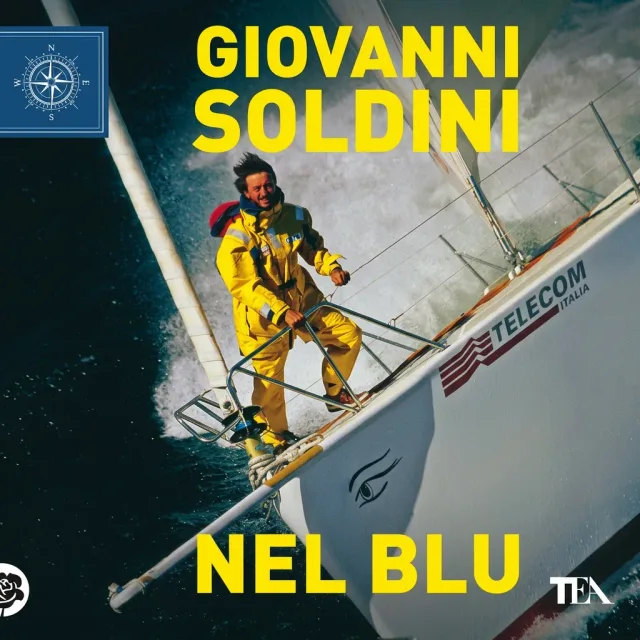
"I dreamed of one day becoming a true vagabond of the seas, the kind who has no constraints of time or space, who can stop for six months when he reaches a beautiful place and then set off again in search of other horizons. I didn't understand why you had to lead your life always geared towards tomorrow: high school and university to become an engineer or a lawyer, and then a nice career. None of that suited me, so I had decided to find other alternatives, and the alternative of my dreams was sailing. So the first thing I felt I wanted to do was find a way to learn and gain experience in the world of sailing." Right, today we're telling you the story of Giovanni Soldini and what we learned reading Nel Blu.
02 The forced abandonment and running away from Milan at 17
Giovanni's first encounter with sailing comes as a child, when his father takes him out on a boat for the first time, and they had this little boat on Lake Maggiore. At that time he was actually only 14. And while his brothers were learning to sail well, he felt like someone who had just had a taste of something that was slipping out of his hands. And at a certain point his father is forced to sell this little boat, and Soldini describes it as a forced abandonment. And maybe it's precisely this forced abandonment that made him want to learn to sail. And that's how, in January 1983, he runs away from home in Milan.
How old is he? 17. 17 years old.
03 Pesaro: the apprenticeship that changes everything
He runs away from home in Milan partly because school and a future already written for him were suffocating him, and he wanted to be free to try to follow what he had inside, so this passion for sailing. And that's how he and his friend Pino start traveling up and down Italy all the way to Sicily, and the problem is that they had no money, so to get by they start making and selling earrings. After the first few weeks he goes back to Milan with a good 800,000 lire in his pocket, which with inflation would be €1,450 today. The point is that he comes back from this little experience with one certainty: he had decided that he wanted to wake up in the morning happy about what was waiting for him during the day. And it's by chance that Soldini meets Francesco Malingri, the son of Franco Malingri, and Franco Malingri and his brother Doi had been among the first great Italian sailors and were building a cruising boat in Pesaro, so he didn't waste any time and asked Francesco to hire him, or at least to give him the chance to go and build this boat, and within a few days he was on a train to Pesaro to build the Moana 39. And this first experience was absolutely fundamental, because even as a kid he had the chance to build a sailing boat, and he quickly understood that on a boat you can't call the plumber, you can't call the fire department, you can't call the doctor, the electrician, not even the mechanic: you have to be ready to fix anything yourself.
The beautiful thing is this apprentice attitude that Franco taught him, a mental attitude I'd call positive towards the unexpected. Right from then he learns that there's always a solution, and I think that's an attitude that will help him above all later on, when he starts making his first ocean crossings and the really serious problems actually arrive.
04 Without a word of English, the first crossing on Pearly Gate
And we come to the winter of '83, when Giovanni was 17 and was supposed to start the first year of liceo classico again, because remember that in the meantime he had run away from Milan and dropped out of school. And after he managed to make up what he had lost at school, we come to the period between '83 and '88. And in October '84 comes his first encounter with the ocean, because he started doing seasonal deliveries in the Mediterranean, and so he went to the Balearics to look for a berth on a boat to the Caribbean. And that's how he manages to find a berth on this boat, Pearly Gate, and the deal was actually that he would simply take the boat to the Caribbean with no pay, no refund for the ticket home or anything else, but for him it felt like touching the sky. Obviously, for an ambitious sailor, crossing the ocean is the first big goal to reach, and he describes it as a necessary goal for becoming a real sailor.
And so he had joined Pearly Gate without knowing a word of English, and you can easily imagine how hard it was for me even just to try to take a fix with the sextant. And it's the first time I truly feel wonderful sensations. Here he writes: "For the first time I felt that unique sensation that ocean crossings give you. That strange thing that lets you taste time in another form, that makes you live the present to the full without worrying about anything else. It's a bit like taking off, leaving time and space to enter another way of living, of feeling and perceiving life, the present, the past and the future." I think this is something few people ever experience.
The crossing ended in Antigua, where they arrive after 26 days. The problem is that within two days they were put ashore and found themselves out on the street. During this crossing on Pearly Gate he makes a friend, Dimitri, and thanks to this friendship with the harbor mechanic they managed to start finding odd jobs to get by and find somewhere to stay.
05 Paul Graham and fossilized prestige
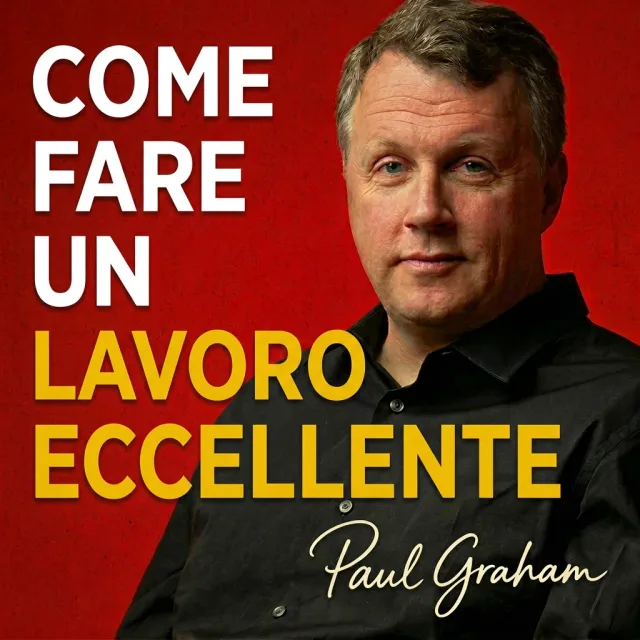
Well, he was 17 or 18. Could he have imagined he would become one of Italy's most important sailors? And here there's a concept I think is important to explore, the concept of prestige, which Paul Graham explores a lot in several of his essays. Paul Graham was the co-founder of Y Combinator, the leading incubator that has incubated many companies like Airbnb, Reddit and others that are huge today. I've got some notes here that I wrote because I think it's important and it connects a lot to Giovanni Soldini, the fact that he never sought prestige. I mean, if he had wanted to achieve or do something prestigious, he certainly wouldn't have become a sailor. But by following his own idea of what he wanted to do, and following not prestige but something he truly felt inside, he went on to become one of the greatest Italian sailors. And here he writes, in one of his essays he talks about what you shouldn't do, and he writes: "What you should not do, I think, is worry about the opinion of anyone beyond your friends. You shouldn't worry about prestige. Prestige is the opinion of the rest of the world. When you can ask the opinions of people whose judgement you respect, what does it add to consider the opinions of people you don't even know? This is easy advice to give. It's hard to follow, especially when you're young. Prestige is like a powerful magnet that warps even your beliefs about what you enjoy. It causes you to work not on what you like, but what you'd like to like." Now, Soldini is considered one of the greatest Italian sailors, right? Good. And now, if you think of Giovanni Soldini, he's prestigious. He works with Ferrari, he works with Maserati. But before, when he was selling jewelry, or when he was wandering around Jamaica, it was anything but prestigious. If you do something for a long time, you make it prestigious, exactly like Soldini. He did it for a long time, he followed what he wanted to do, and he made his work prestigious.
06 Newport: where the racing dream begins
So we come to another key year, 1990, the year of the first Vendée Globe, which I think is the hardest solo race in the world, because it's non-stop, with no legs and no assistance. And so on 15 September the BOC Challenge was starting, a hugely important race that starts from Newport, and he convinces his boat owner to go to Newport to look at these boats and buy one. And it's lovely how he describes his emotions when he lands at Kennedy airport, JFK, and on the highway to Newport it seems practically impossible to him that he's there, because little by little he's getting closer to fulfilling his dream of becoming a professional racer. And he's worried too, like any young guy who's just starting to chase his dream, so there are the fears that all this mess might come to nothing, that the owner might back out because the boat cost too much. But in the end, on the evening of 8 September, he arrives in Newport.
Wait, before you go on, I wrote something here: if you look, he always followed his interests, what he felt inside. And here it says: follow your interests, do it for a long time, and you'll meet people who will change your life. Because this is the luck equation: the more you do something that interests you, the more people know about it, the more people you meet, and as a result this little...
07 Looping: better an excellent 50-footer than a mediocre 60
This little engine that runs for you. The more you do something, the more people know about it and the luckier you get. And it's lovely that he arrives in Newport and all the boats are there, moored, ready to go, and he sees all his idols, and all his dreams appeared before him that night in Newport. The next morning the discovery of a new world begins, because they start wandering along the dock looking at the boats. And while he's walking along the dock he sees this boat, Looping, and says: "OK, this is the right boat." It was a 50-footer, not a 60, because the costs of racing a 60 were too high; it was a smaller boat, and being smaller, less demanding financially. And so, with no money and not even a sponsor, it was the best choice. It's also really nice that he says an important principle had to be made clear: being humble, understanding that he had no money and so couldn't afford a 60-footer, but above all that an excellent 50-footer was far better than a mediocre 60. So at this point he buys Looping, and it's a dream coming true. And in June '90 he takes her to La Rochelle because he has to fix her up and get her ready. Looping had just come from a round-the-world race and two Atlantic crossings, and the problem is that he had no money to fix her up, so he managed to get permission to hook up, for free, to another workshop across the road from the boatyard and use their electricity for free.
08 High agency: the difference between those who endure life and those who shape it
OK, wait a second, a normal person at this point would say "Bye guys, this just isn't possible," and instead he does the complete opposite. It's a thread I think you see throughout the whole book, and this thread is the concept of high agency, which is basically the idea that individuals differ in how much they actively shape their lives versus passively accepting circumstances. Meaning, if you picture Soldini, OK? Picture a person who happens to life: meaning Soldini happens to life, or life happens to him, and that's different. I mean, life doesn't happen to Soldini. He shapes life. And I think this is a thread you see throughout the book. He's a person who believes that every problem... Most problems are solvable unless they violate the laws of physics. Meaning: if they don't break the laws of physics, you can find a solution to anything. He's a person who questions authority and conventional wisdom. He's a person who recognizes that life is unpredictable and there are no guarantees, and that this motivates them to act boldly and pursue their ambitions. These are the people who have high agency. And there's a wonderful essay I think everyone should read, by George Mack, called High Agency, where he explains exactly this concept of high agency, and that there are three traits a person with high agency has. One: they're resourceful, people who combine creativity and persistence to find new solutions. Two: they have a bias to action. A bias to action: they prefer to act. Soldini doesn't give me the feeling of being someone who thinks, thinks, thinks, thinks, thinks, thinks. No, he's someone who acts, so he has this bias to action. And then, I think, this one, which is fantastic, fits Soldini perfectly. Disagreeability. They disagree with norms. It's a willingness to challenge norms and persist even when told no. And here, I think, there's that example in the documentary about Soldini, where he takes his license test and fails I don't know how many times, three, four times, three times, because he steered the helm with his feet. And the instructor tells him: "Look, you can't steer the helm with your feet." And he goes: "Ah, OK." He's a real pirate, he's a pirate. And he describes it: "We worked like animals. We showered in the public toilets."
"But without a penny, and happier than I had ever been in my life."
"La Rochelle really became the center of the world for me. That was what fascinated me about that world, and still does: the ability to have new ideas, to believe in them and to make them happen."
09 La Baule-Dakar: the first solo race
At this point we come to the first important race, another turning point: the La Baule-Dakar, the first solo race he does with Looping. And it's wonderful, because here he shows that he's actually human too, that he's scared shitless, that he's crapping himself. And it's a bit like those emotions when you're little and maybe doing your first competitive race. So you think: "Who made me do this, I don't want to be here, it's so nice here on land, I don't want to go." Those are the same emotions he describes.
Then there's this character, and here he writes something interesting: Jean-Luc, "the sunniest person I've ever met." "Even with a budget ten times smaller and an aluminum boat," and this is important. "His secret? He loves helming 15 hours a day in inhuman conditions. The more his beard freezes, the happier he is." I wrote something here: if you like doing something, or rather, not even if you like it, if you're obsessed with doing something, you do it longer than anybody else. You do it more, you do it for more hours.
10 MISCO: the sponsor who believed in him
At this point the start of his first serious solo race finally arrives. And it's lovely how at the start he's full of emotions, fear, he doesn't feel up to it, he says: "What am I doing here, among these people who are really here to win?" But it's lovely that as soon as the starting cannon fires, it all disappears and he focuses only on sailing well and making Looping go fast. In fact he says: "For me the cannon shot was a liberation." And at the end of the La Baule-Dakar he crosses the finish line after 12 days at sea, 1,700 miles. And he says: "Practically my whole wardrobe is up on Looping's spreaders, so I can repair the sails damaged by the spreaders." And yet he comes third. "Sailing into the bay of Dakar on this November night, I am the happiest man in the world. This healthy fear passes and leaves room for the need to solve problems." But as soon as he gets to Dakar he has no time to celebrate. From Dakar he immediately catches a flight back to Italy, because he has to find a sponsor. And so he manages to edit a tape of footage of what he does, and here too it's fascinating that he only had money for one tape, he had no money to make more, so he'd go to these offices, present his footage with his tape, and then he had to beg them to give the tape back because it was the only one he had. In all this mess, after three months, not a single interested sponsor in sight. But he gets it into his head that the fundamental principle is that it's better to have a sponsor who gives little money but believes in the potential of the project than one who spends a ton of money but doesn't care at all about what Soldini is doing. And after a while he gets in touch with the CEO of this company, MISCO, which made office supplies. And this man, together with his wife, had met Soldini in Cuba when he was taking people around the lagoon, and he tells him: "If you want, I'll sponsor you." And the man manages to find him thanks to the "sponsor wanted" sign he had put on the boat. So this company called MISCO...
They agree on a budget of 80 million lire, which wasn't much for him, but it was vital and essential for survival.
11 OSTAR 1992: the broken rudder a few miles from victory
So at this point we come to 1 June '92, when he took part in the OSTAR, which for him was the most important race, the one he had dreamed of doing since he was a kid, and in '92 he was only 26. The race starts, and after a few days he was actually leading the 50-foot class, with a significant number of 60-footers behind him. But suddenly Looping hits something in the water, breaks the rudder, the tiller breaks, and from that moment on the race is compromised.
And in fact here he writes: "Of course, that accident cost me dearly, but my impulsive nature and my inexperience were also decisive. I got so angry that I think, out of excessive self-pity, I handed my opponent at least half of the hours I was behind at the finish."
12 Quebec-Saint Malo: Looping capsized and lost
In fact it's often those last miles, when you're about to arrive, when you think it's all over, but actually it's precisely those last miles that get you. In the end this agony ends on 25 June, when he arrives in Newport, but in the end he came in only ten hours after Eric, taking second place in the 50-foot class. And straight after that he leaves for the Quebec-Saint Malo. This race isn't solo though, it's a crewed race, and with him are Manu and Sergio. This time too there's no shortage of... as always.
It's always one unexpected thing after another.
There's no shortage of problems, but this time it's one hell of an unexpected event. So what happens is that they have to tack, they try to tack, they push the helm all the way to windward, but the boat doesn't move an inch. So something's wrong. So he leans out, and the problem is that the more he leans out, the more he can't see the keel. Meanwhile, though, in all this, Looping is at 90 degrees with the mast in the water.
And the great thing is that here he writes: "I kept asking myself: let's see how I get out of this one now."
Oh yes, because just imagine the chaos, a boat at 90 degrees that then goes to 180 degrees, so completely upside down, the three of them in the middle of the sea in freezing water, and so in the end they get inside the boat and wait for rescue. Here too, and I find this super interesting, you see the relationship he has with the boat, because he writes: "Looping was my home, and somehow she had to stay there." Also because he could see all the things floating, wallets, money, and he writes: "All those things were part of my boat and my home, and I didn't feel like trying to save only part of it: all or nothing." Sergio and Soldini absolutely wanted to be spotted by a plane, so they decide to climb onto the hull, while Manu, terrified, stays inside. But Soldini writes: "I believe that in these cases morale, and not letting yourself panic, are decisive for getting out of difficult situations well."
So this becomes a bit of an extreme sport? It's not just sailing anymore?
No.
Why does someone do it? I mean, someone can have a passion for sailing, but they can buy a sailing boat and go for a nice trip, whereas this is a truly extreme level.
At those levels you reach a connection with the sea and with nature that I think we can't even imagine. Spending 80 days alone in the middle of the sea, sailing at 15-16 knots, with the boat slamming into the waves, and you're at one with both the boat and nature.
I don't know if there's something he's trying to avoid or escape.
Yes, at the end of the book he writes it: he wants to escape melancholy. It was his way of escaping melancholy and the boredom of life. Anyway, at the end of all this mess, they start hearing the sound of an engine, a twin-engine propeller plane. And so in the end they find them, and a cargo ship comes over, finds them and brings them to safety.
Here he writes about what it means to lose a boat, and remember it's always this great attachment you have to... in the end it's an object, but it's your home. "I believe that losing a boat this way is one of the saddest things that can happen to a sailor, but I won't hide that deep in our hearts we were all overjoyed to have come out of that situation unharmed. Sad for the boat, but glad to be alive." And once again he finds his dream completely crumbled in his hands.
Also because, if you think about it, he had put all the little money he had raised with MISCO into fixing up the boat.
Try to imagine how he must feel at that moment.
13 Stupefacente: the boat built with former drug addicts
But this time too he doesn't lose heart, he doesn't give up, he goes back to Italy and does something even more surprising. Because the Looping accident happens on 4 September '92, he goes back to Italy, and he doesn't want to stop sailing, he doesn't want to stop racing, so he has to find another boat. But this time, why not build one? So he gets in touch with this guy who is part of, or runs, this community of former drug addicts, who puts him in touch with the community's president. In the end he gets in touch with the president of this association and they decide: "OK, why not build a boat together?" Also because on one hand he's building a boat for himself, for his passion, for what is by now his profession, but on the other he's also helping other people who might discover a new passion, and maybe one day go and work in the world of sailing. And it's nice that this time too, just like when he went to buy Looping, nobody took him seriously. Everyone was saying: "This guy will never build a boat together with drug addicts." And that's why they decide to call her Stupefacente (in Italian, both "amazing" and "narcotic"). And in eight months Stupefacente was finished.
And here it's also lovely when he writes that when you're excited about doing something, the energy not only attracts the right people, but somehow you manage to convince anyone, because you have not just passion but this energy so big and positive that people believe in you. How he found the money: "The partners would lend some money, and once the round-the-world race was over I would sell the boat and pay them back. Obviously nobody really believed they would ever see the money again. At that point the money had really run out. I already had about forty partners, all of them friends, relatives and acquaintances who had taken part in the loan, and I really didn't know where to turn anymore."
14 When Kodak becomes the round-the-world sponsor
The breakthrough in finding the sponsor comes at Christmas '93, when again the CEO of Viaggidea, Boscoscuro, helps him find a somewhat bigger sponsor with more money, and so he put him in touch with the managing director of Kodak Italia. Soldini presented the project to him, and the head of communications liked it a lot.
And here the deal he makes is great.
Yes, because he calls it a deal they couldn't refuse.
Exactly. But just think about it: this kid sells jewelry, wanders around Jamaica, makes all these ocean crossings, and then he's also able to negotiate something that will help him do his first round-the-world race.
Also because here he's still young, he's not even 30 yet.
And here he writes what the deal is: "Kodak would give us 50 million, and for three months the boat would be called Kodak. I would organize the launch and take part in a trial race, the Roma per Due. At the end of the third month we would assess what kind of return there had been, and Kodak would decide whether to sponsor the round-the-world race with another 250 million. If the answer was no, Kodak would still be entitled to a logo on the spinnaker for the round-the-world race." And so now we come to his first round-the-world race. Here, one thing I wrote is... I mean, what a life he lived! Between 17 and 30, a full life made of adventures, sacrifices, determination, failures. When I think about my own life, or the lives of many people, by comparison they don't come close to even one percent of the life he lived. Also because imagine a teenager today running away from home and going to work in Cuba taking tourists around the lagoon. So at this point...
15 The first round-the-world race: Around Alone 1998-1999
After the Roma per Due he takes the boat to Charleston, where the round-the-world race would start. And on that 17 September 1993, when the race started, Soldini's biggest problem was that Australian with the little moustache sailing on his stern.
Something I'd never thought about is that in these races the sailor's skill alone isn't enough: it's also a psychological battle. And in fact here he writes: "These races are run a lot on psychology, and if you manage to put your opponent in difficulty psychologically, you've generally done at least half the work."
16 A 400-mile lead, and then a whale
At this point the race is actually going brilliantly, because he gets near the equator and can't believe how Kodak is flying over the water, and he builds up a 400-mile lead over David Adams. But here you also see the pride and the hunger and the desire Soldini has to win, because while he's sailing with a 400-mile lead, he also thinks about all the 60-footers and all the champions he's left behind him, who were literally losing to a little boat that, in proportion, was in a different league both in cost and in size.
But here he makes a big mistake. The mistake he makes is letting himself go, and in fact he writes: "It was probably the most serious mistake I made: letting myself go to all those thoughts, considering the leg already won." And it's right at that moment...
That something incredible happens.
"Before my eyes, astern of Kodak, an immense animal was thrashing in the water: first the tail and then the head. For a moment our eyes met, we looked at each other, both astonished and frozen. Each of us probably wanted to ask the other: 'What on earth were you doing right here?' Only, between a solo sailor and a whale the conversation can't be very elaborate."
Exactly, because Kodak crashes into a whale. At the end of this leg of the round-the-world race, David arrives more than 100 miles ahead of Soldini.
Here in fact you really see the psychological side: "The angrier I got about the leg, the more mistakes and careless moves I made, all to my opponent's advantage. After a few legs I learned very well not to get rattled." And it's easy to say: "OK, don't get rattled, stay calm," but...
In the middle of the sea. In the middle of the sea. When once again you're close to winning and something happens to you at the last moment.
"When you're alone the mind is fundamental, and if our brain can count on some excuse to accept a defeat, the defeat automatically becomes certain. Of the 22 hours I was behind in Cape Town, at least half could have been avoided."
17 The first time in the Southern Ocean
So at this point he arrives in Cape Town, his shore crew manages to repair the boat, and now the hardest part of the solo round-the-world race begins, because from Cape Town in South Africa he takes on the whole Southern Ocean. And in fact he writes: "Man is always most afraid of what he doesn't know, and the first time you face a southern ocean you're scared as hell."
It's interesting because you can't really understand that fear, because how many times have you set out to sail the Southern Ocean? And so the question always remains: why does someone do it?
But in this case he had never faced those seas, so he was certainly curious to see them too, and in fact he's completely fascinated by them. At this point the race goes on, and his duel with David never ended: he was always right on his heels. And at one point, picture these two guys on 50-footers with spinnakers up in the middle of the ocean, crossing paths. A real nightmare, and only the first of a long series, and it takes him a whole day to lose sight of him. But meanwhile Soldini writes: "My friend Adams was a really tough guy, and he proved it even more in those hellish days. He planted himself at the helm and drove like a madman, with a little sail on the bow and no mainsail." At one point, though, maybe he pushes it a bit too far too, and the boom breaks and ends up in the water, something Soldini only finds out at the finish.
In fact on 24 December at 11 o'clock Kodak crosses the finish line in Sydney, two hours ahead of True Blue. Two hours, that's not much. "The last four days had been the hardest I had ever lived aboard a sailing boat."
18 Kodak pulls out one step from the finish
At this point, after the stop in Australia, the round-the-world race sets off again for Punta del Este, so Latin America. Soldini arrives in Punta del Este with a lead over David, though, and at this point only the last leg back to Charleston is left. But the problem is that while everyone arriving there, after taking on Cape Horn, gets to rest, he can't: he catches a plane and goes back to Italy. Why? Because Kodak decided not to sponsor him anymore, because the company's top management had changed, the head of communications was no longer the same person, and so they decided to stop sponsoring Soldini. So he finds himself at the end of a round-the-world race with no sponsor. But luckily, and thank goodness he went back to Italy after sailing (I mean, OK, it's absurd), he gets in touch with Telecom Italia, and the following year Stupefacente would be called Telecom Italia. At this point comes the fourth and final leg.
Naturally, how does it go?
Disaster.
Total disaster.
Because the forestay breaks, which is a part that holds up the mast, and in fact he writes that a stay breaks and by some miracle he didn't dismast, which is when the boat's mast comes down.
19 "You can't sail around the world to win a race"
And here he realizes his round-the-world race was lost, and he writes this thing that I think is beautiful, because it makes you understand why someone does a race: "It wasn't easy, but in the end it made me understand a lot of things. What mattered was having completed that round-the-world race, and in the end winning would have changed little. Paradoxically, what counts when you take on these ventures is your relationship with your boat, the sea and the wind." Here I think there are three lines that I think are the three most important lines in the book. "You can't do it," so you think, why does someone sail around the world? Is it to win? Is it to prove something to themselves? He writes: "You can't sail around the world to win a race. You have to do it for the pleasure of doing it, and only then can you have the serenity you need to win it too." Do something for the pleasure of doing it; the goal of winning comes second.
20 Fila and the jump to 60 feet
Now we come to September '96, when he has a splendid season with Telecom Italia, except that it's time to move up, to take a seat at the winners' table, at the table of the big boys. So he decides to leave the 50-footers and move into the 60-foot class. Meanwhile there's another problem too, because he realizes that Telecom Italia isn't, let's say, all that keen on buying the boat's whole name, so he has to start finding another sponsor. He finds Fila: Fila's CEO is a sailing enthusiast, he calls him and they set up a meeting, he presents the project and it goes really well. And so in the period between October '96 and January '97, Fila was the main sponsor, Telecom Italia took part as second sponsor, and Banca Nazionale del Lavoro completed the budget as third sponsor. "And they were truly difficult and frantic months." And Soldini writes: "We worked like crazy every day to try to test the boat. Fila was cutting-edge, with lots of systems none of us had ever seen, which had to be perfected and fine-tuned." And in mid-March Fila was finished, and they went to New York to test the boat, but above all to break the Atlantic record from New York to Lizard Point. But above all he writes: "Fila was moored next to the City, and every morning we saw thousands of little gray men walking quickly towards their offices." And on 20 March '98 Giovanni and his crew set off to break the record for the New York-Lizard Point route. At first it's all wonderful, Fila is planing like there's no tomorrow, they're well ahead of whoever set the previous record, and they're very positive. But as always, and this is something Soldini often stresses, man is small, he controls nothing, the real force in command is nature. And so this big low-pressure system arrives that hadn't been forecast. And on 2 April the depression reached its peak strength, with huge waves and wind that blew up to 85 knots. The problem is that this time not everything goes well, and sadly a member of the crew can't get back inside the boat, because he was in the cockpit when the boat capsized. And one of the two Andreas who were in the cockpit never came back.
21 The night of 3 April: Andrea's death
And here he writes, what he writes here is beautiful: "The night of 3 April was the worst of my life. It would have taken next to nothing for it all to end as a great adventure to tell our grandchildren. I don't know what happened to Andrea that night, but something must have gone wrong and he didn't manage to reach that hatch. And in the end those four meters separating Andrea from safety won, and we were unable to do anything. The boat and the crew were in tatters. It wasn't easy to put that night behind us. We decided we would stay united and keep Fila sailing, also to remember our lost friend, so as not to throw away the fruit of a year and a half of his work, and to show that he had built a great boat." Damn, this is moving.
At this point they take the boat back to La Rochelle to fix her up, and obviously, as you say, he wants to quit. But in the end he decides to set off for the Atlantic Alone.
Starting out, though, in an emotional state that was a disaster. And it was his first time alone on that boat.
22 The Atlantic Alone, and the round-the-world race to win it
Right after a friend of his had just died at sea. His direct rival was Mike Golding, and it's great how he draws the contrast between himself and Mike, because he writes: "Mike had a perfect team and organization, everyone in uniform, everything taken care of down to the smallest detail, and a gleaming boat with protective covers on the deck so as not to dirty it by walking on it. Psychologically we all felt so down and so defeated inside that we were a bit terrified at the idea of going up against that perfect Anglo-Saxon organization." In the end, though, this time too he doesn't lose heart, and he makes the best start of his career, already leaving Mike a hundred meters or so behind. But then he writes that right after the last mark of the course he puts the autopilot on and couldn't care less about the race: the only thing he wants to do, above all to recover from that tragic night, is to find his connection with nature and with the boat again. And then, beautifully, he writes: "Me, nature, the boat, the sea and Andrea, whom I always felt was there." He writes: "It was a liberating race," because he arrives in Charleston after 21 days at sea, lowering the race record, with a lead of more than four days over his closest pursuer, winning the Atlantic Alone. He shows how high-performing and strong Fila is as a boat, but above all how strong he is. At this point we come to one of the most important dates, if not the most important: 26 September 1998, when the round-the-world race starts. That is, the round-the-world race that Soldini prepared for with Fila and his crew in order to win it. It's a round-the-world race in legs that starts from Charleston in America, so from Charleston to Cape Town, then from Cape Town to Auckland in New Zealand, from Auckland to Punta del Este, and then the last leg goes from Punta del Este back to Charleston. At the start of this round-the-world race too, maybe Soldini really feels the pressure, between the fact that he'd prepared to win it, everything that has happened, all the effort put into building Fila, and above all the fact that it's a 7,000-mile leg. And here all the fears and anxieties of the first time you put to sea alone come back. I mean the same thoughts: "Who made me do this, I don't want any of it, it's so nice here on land in Charleston." In the end, as you were saying earlier, this time too he decides to take a different route, passing north of the Bermuda high, and at first it was an advantage. The lead he built up was more than 100 miles, but then here too he shows us how it's actually nature that's in command, not man.
Because an unexpected depression arrives, and "the result is that in three days my deficit went from 150 to 770 miles." So before, I was ahead because I'd taken a different route.
Exactly.
But then with this depression he ends up behind.
In the end he arrives in Cape Town fifth, two days and twenty hours behind.
He writes: "After all of us had worked like mad for almost two and a half years, with my meteorological theories I had compromised the result for Fila and for this race, which was so important to us." So I try to imagine his state of mind at that moment too.
23 The hearing that saves the race
After the first leg, on 16 December '98, Soldini is sailing the second leg, from Cape Town to Auckland in New Zealand. And during this leg, obviously, the unexpected keeps coming, it has to, otherwise it wouldn't be a Soldini race. But this time it's his hearing that saves him. And it's lovely, he describes it a lot, the relationship between him and the boat, and the most important thing is hearing, because the boat has its own noises and every noise corresponds to something, and then he hears this noise that didn't add up, that wasn't right. Basically the boom was coming out of its fitting, it was coming away from the mast. And luckily he hears this noise, goes out, and sees that the boom is slowly coming out, so he quickly runs to get the hammer, puts the boom back into the mast, and he's saved. And it's also lovely how he actually describes his relationship with the boat, because: "The boat inevitably becomes a kind of little world where everything has a reason. I am just one component of this world. She takes me from South Africa all the way to New Zealand, and in exchange I take care of her needs. When the wind picks up, she warns me that conditions have got tougher, and I understand that she needs me." And very soon, and this is wonderful, you learn that the worst thing you can do is pretend nothing is happening. Sometimes we humans are strange, and our body often tells us things that by now are clear signals for us, but we pretend anyway, for a thousand reasons. And that's exactly the point.
In that situation he would have had to go out into the cold, with frozen hands, with the water getting into his veins, to fix the boom, when instead he was below deck, relaxed, nice and warm. "One thing is certain: sailing solo brings out a part of us that we usually keep hidden, because bringing it out usually takes effort, and nobody ever feels like making an effort."
24 The first Italian win and Isabelle's rescue
And in the end, on 31 December '98, the sound of the siren marks the end of the second leg and Fila's first win in the round-the-world race. But above all it's the first win ever by an Italian boat in the history of this race. Obviously winning this leg was super important, because it was a real comeback for Soldini and his crew, after the failure of the first leg too. And now the third leg starts, from Auckland to Punta del Este, where it becomes clear that he, Isabelle and Golding are the three fighting for the win. But above all he makes it clear that Fila is one of the boats to beat, not just some little boat that... And during the third leg, from Auckland to Punta del Este, the unthinkable happens. He leaves Auckland, crosses the whole ocean, reaches Cape Horn, rounds Cape Horn, and they're on the home stretch to Punta del Este, but then Isabelle capsizes, her boat completely upside down at 180 degrees. So the race committee immediately calls Soldini to alert him, and the first thing he does, even though he was in the lead, even though he was there to win the leg, the first thing he does is turn around and go back. And the problem is that he's still in the middle of the ocean, and even though Isabelle has a device to locate herself, it was an area of 5 miles by 5 miles, so he starts combing the area, going back and forth across this small square. And by sheer dumb luck, and he writes this too: "Every now and then you need a bit of luck." And he finds her, because he realizes that even if he had passed 300 meters away he wouldn't have seen her. And so while he's sailing and tidying up the cockpit with the mainsheets, he sees a black spot, so he turns by chance and sees the keel and the hull of the boat, so he gets close and rescues her. And it's moving how he describes that he had never been more tense, because Isabelle's life was very probably in his hands alone, because he was the only one who could have saved her. In the end he wins the Punta del Este leg anyway, because the rival who was in the lead, who didn't turn back to save Isabelle, had a problem. And so now, from Punta del Este, we come to the last, decisive leg, from Punta del Este back to Charleston. And now comes maybe one of the most beautiful parts, the end of this story: the fourth leg, from Punta del Este to Charleston. So they set off again from Punta del Este with his rival Marc, who manages to fix his mast in record time; they set off, but Soldini starts out fiercer than ever and keeps piling up his lead over Marc like there's no tomorrow. He reaches the equator, where he writes: "I was lucky enough to pass in the right place at the right time, and the gap between me and Marc kept growing relentlessly." And then it's beautiful that he writes: "In those days, despite the urge to race and above all the urge to go fast, I let myself be gripped by a certain melancholy." And he writes about why: finishing such a long venture, such an important one, after so many years of work, probably scared him.
Maybe because the fact of finishing it scared him.
Maybe not knowing what was waiting for him afterwards.
And in fact in his journal, because this book is full of notes from his logbook, he writes: "15 April. It's the fourth time I've crossed the equator, and every time it's a great emotion." I mean, try closing your eyes and imagining this description as he crosses the equator: "The stars of the southern hemisphere slip below the horizon to make way for the ones we're used to. Tonight the Big Dipper told me I'm on my way home. It may not seem like it, but a round-the-world race is a big thing that leaves its mark on you. It's 30,000 miles in a straight line, but at least 50,000 miles sailed. Now, at the end, only 3,000 are left, and I feel the moment of goodbyes is getting closer. It's strange, because I'm happy to have accomplished something I wanted to do. Besides, as I may have said already, for me winning this race is like fulfilling a lifelong dream, but at the same time I'm a bit sorry. I'm comforted by the fact that Fila and I will do other things together, but it can never be the same."
25 8 May 1999: Soldini wins
And on 8 May '99 we come to the end of this story, when Soldini and Fila arrive in Charleston after 116 days and 17 hours at sea, and for the first time a solo round-the-world race was won by a boat that wasn't French, wasn't run by a French team and wasn't built in France. And Soldini manages to fulfill his dream: he wins the round-the-world race.
And finally, the last page of this book is beautiful, I think. First of all he thanks everyone, and writes: "Everything I've managed to do up to today I did thanks to a great many people who helped me a lot. Without them I would never have managed to make my dreams come true." And then he ends, he ends like this: "I hope this book can be a small testimony that helps those in doubt to overcome their fears and resistance, and to throw themselves into a life spent chasing their dreams." Right, this is what we learned from Giovanni Soldini in the book Nel Blu. I hope you enjoyed it, and we'll see you in the next episode.